
Canary strawberry tree (madroño)
Arbutus canariensis Veill. · Family: Ericaceae
Typical of dry laurel forest, preferring steep sunny sites on ridges and slopes, 600–1,200 m.
Where it grows on Tenerife
Grows in: North coast · North, 300–1000 m
Zones are derived approximately from the Cabildo belts.
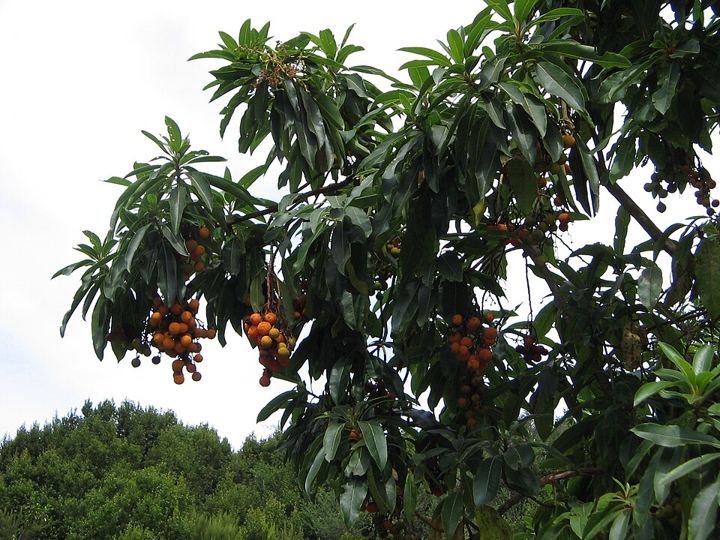
Photos
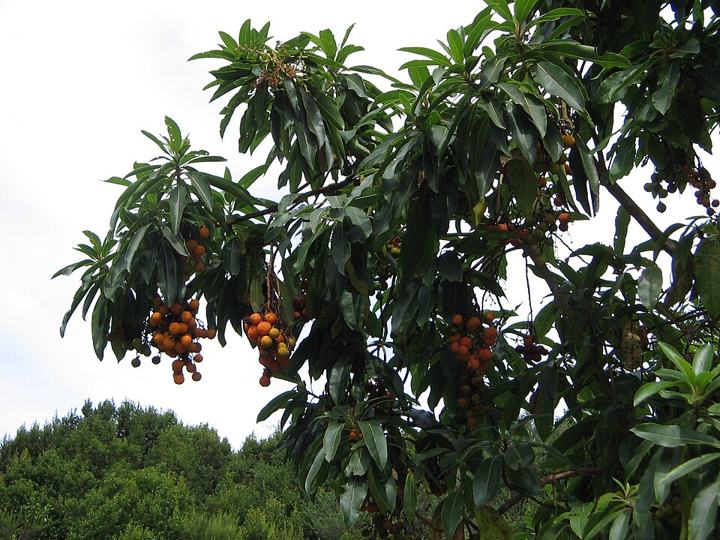
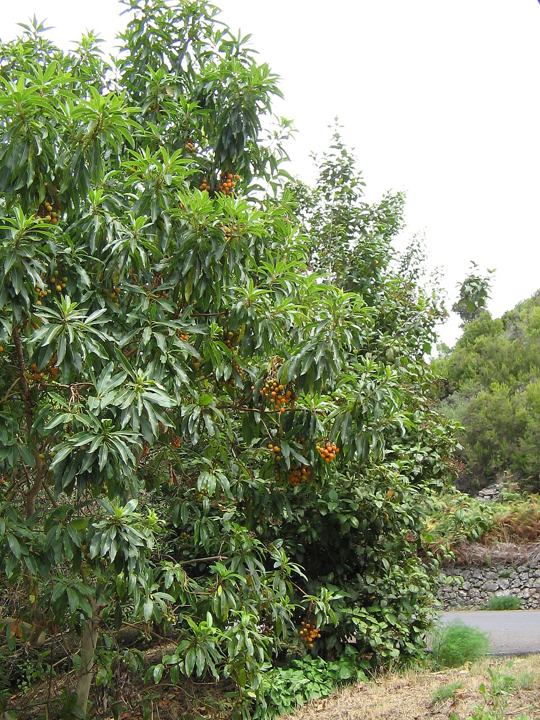
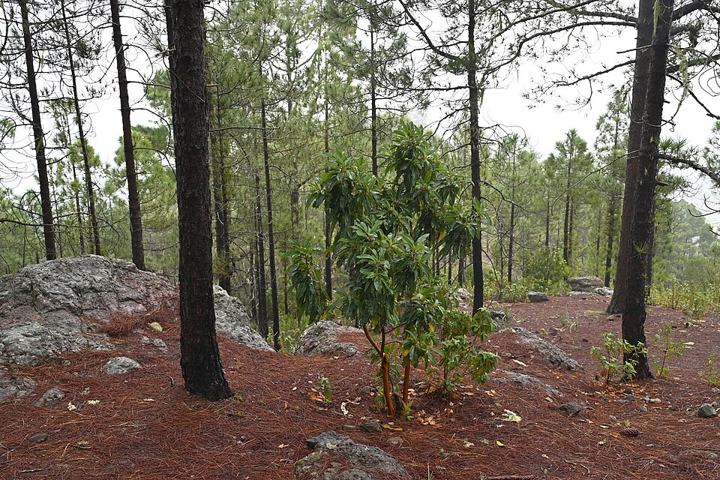
From Wikipedia
Arbutus canariensis, known in Spanish as madroño canario; in English as Canary Islands strawberry tree, is a species of shrub or tree in the heath family. It is endemic to the Canary Islands of Spain, specifically Tenerife, La Gomera, Gran Canaria, El Hierro, and La Palma. It is threatened by habitat loss.
Text from Wikipedia, CC BY-SA 4.0: Arbutus canariensis
Description
A small evergreen tree that can reach 8 m in height, although sometimes it remains a shrub, with reddish-brown bark that peels off in plates. Leaves oblong-lanceolate, sub-leathery, 8–15 cm long, with a toothed margin, dark green above and pale glaucous beneath. Flowers with an urn-shaped corolla, pale green with pinkish tones, arranged in branched terminal inflorescences. Fruits globose, 2–4 cm in diameter, fleshy, somewhat rough on the surface, orange when ripe. Flowers and fruits from late winter to summer.
Propagation and growing
This is one of the Canary trees of greatest ornamental value; its trunk, flowers and fruits are very beautiful. It can be used on its own, in groups, or, typically, together with mocán trees. Its conservation value is also high given its scarcity. It needs staking for several years until the plant is firmly established and the trunk becomes sturdy, especially if planted in places exposed to gusts of wind, which damage it greatly and blow it over. It needs watering during the dry season in the first two years after planting. Being an evergreen tree, it is recommended for gardens and recreational areas in general, providing shade and a feeling of coolness. It requires more or less fertile soils with some moisture, so its watering should be controlled in places where rainfall and relative humidity are low. Planting in moderately sun-exposed areas is recommended. It accepts moderate pruning. In suitable habitats it is ideal for roadsides.
Garden use
This is one of the Canary trees of greatest ornamental value; its trunk, flowers and fruits are very beautiful. It can be used on its own, in groups, or, typically, together with mocán trees. Its conservation value is also high given its…
Notes
Hybridises with Arbutus unedo. Its fruits are edible and were eaten fresh by the Guanches.
Protection status
Annex II of the Order of 20 February 1991 on the protection of wild flora of the Canary Islands.
Potential vegetation
Visneo-Arbutetum canariensis.
Source: Cabildo de Tenerife, “Guía de especies vegetales”, CC BY. Translated from Spanish by us.
Bioclimatic belts
Warm coastal belt
- Inframediterranean, dry, with trade-wind fog
Warm mid-slope belt
- Thermomediterranean, semi-arid (upper level), with trade-wind fog
- Thermomediterranean, dry, with trade-wind fog
Districts
Anaga · Metropolitan area (Santa Cruz and La Laguna) · Acentejo · La Orotava Valley · Daute · Güímar Valley