
Bencomia
Bencomia caudata (Ait.) Webb & Berth. · Family: Rosaceae
Lives on damp cliffs and slopes, usually in the laurel forest belt, at 600–1,500 m.
Where it grows on Tenerife
Grows in: North coast · North, 300–1000 m · South, 300–1000 m · Above 1000 m
Zones are derived approximately from the Cabildo belts.
Photos
Description
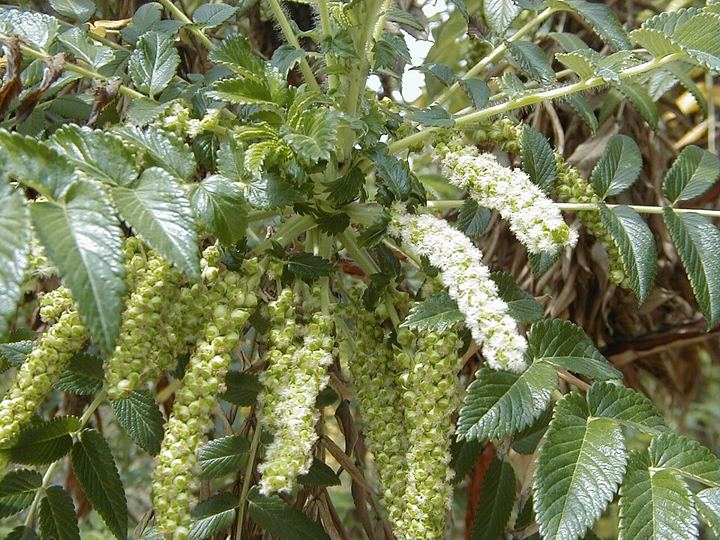
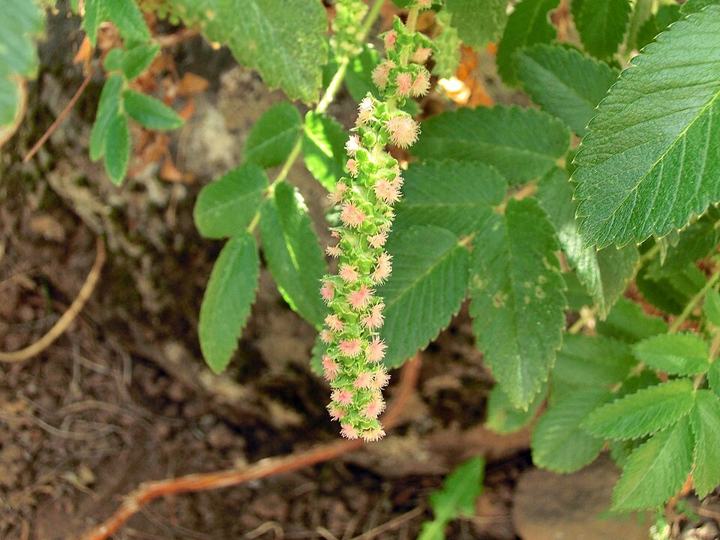
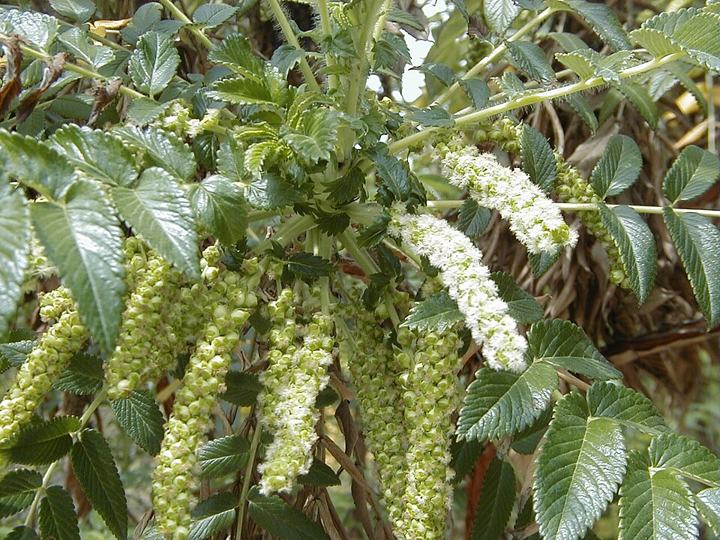
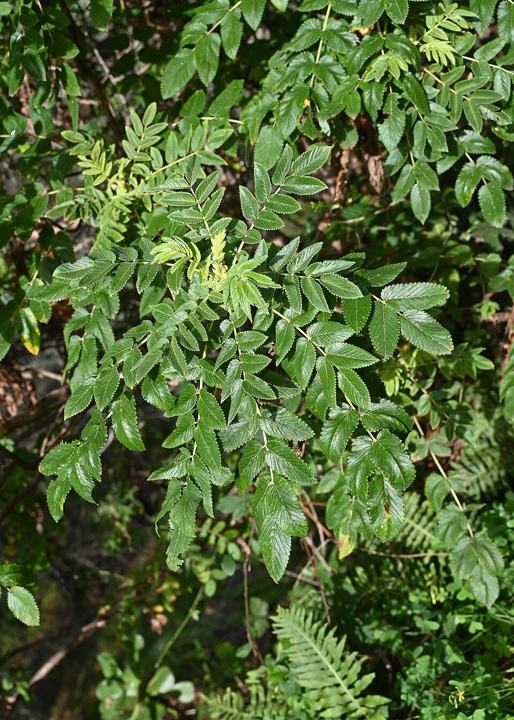
A shrub up to 2 m tall, with a short trunk and broad crown, and brownish bark that peels off in thin plates. Leaves compound, imparipinnate, up to 30 cm long, dark green, with 7-11 ovate leaflets 2.5-5 cm long with a serrate-toothed margin. Flowers small, unisexual, in dense hanging catkins, the male ones yellow and the female ones pinkish. Fruits subglobose, greenish. Flowers in winter and spring.
Propagation and growing
The abundant fruits of the female plants of this shrub contain seeds that germinate easily, provided that before sowing they have been thoroughly washed to remove all remains of the fruit. The seedlings are vigorous, fast-growing and easy to grow on. After a year in a container the plants can reach half a metre in height. It is not usually available in nurseries, and it is advisable to order it to be grown a year in advance.
Garden use
This decorative shrub, which flowers in winter and spring, has great ornamental value for landscaping of all kinds. Its habit, flowering and fruiting are very beautiful. It is a very hardy plant with a wide altitudinal range (600-1500 m above sea level), and it needs hardly any maintenance; for all these reasons it deserves to be used more widely in gardening.
Notes
The genus is dedicated to the memory of Bencomo, mencey (king) of Taoro. Also found in Madeira.
Protection status
Annex II of the Order of 20 February 1991 on the protection of wild flora of the Canary Islands.
Potential vegetation
Lauro-Perseetum indicae; Visneo-Arbutetum canariensis; Sideritido-Pinetum canariensis.
Source: Cabildo de Tenerife, “Guía de especies vegetales”, CC BY. Translated from Spanish by us.
Bioclimatic belts
Warm coastal belt
- Inframediterranean, dry, with trade-wind fog
Warm mid-slope belt
- Thermomediterranean, semi-arid (upper level), with trade-wind fog
- Thermomediterranean, dry, with trade-wind fog
- Thermomediterranean, subhumid, with trade-wind fog
- Thermomediterranean, dry (upper level), without trade-wind fog
- Thermomediterranean, humid, with trade-wind fog
Temperate belt of laurel and pine forest
- Mesomediterranean, lower, dry, with trade-wind fog
- Mesomediterranean, lower, dry, without trade-wind fog
- Mesomediterranean, lower, subhumid, with trade-wind fog
- Mesomediterranean, lower, subhumid, without trade-wind fog
- Mesomediterranean, lower, humid, with trade-wind fog
Districts
Anaga · Metropolitan area (Santa Cruz and La Laguna) · La Orotava Valley · Daute · South-west · Abona · South-east · Güímar Valley