
Bougainvillea
Bougainvillea spectabilis Willd. · Family: Nyctaginaceae
Grows and flowers best in sunny places with a high average temperature. Well suited to a Mediterranean climate. Likes humid, fresh air when it is hot.
Where it grows on Tenerife
Grows in: South coast · North coast · South, 300–1000 m · North, 300–1000 m
Zones are derived approximately from the Cabildo belts.
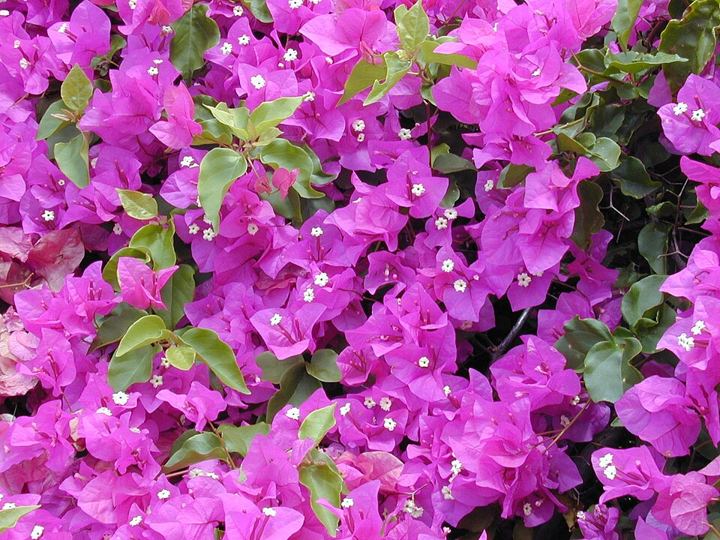
Photos
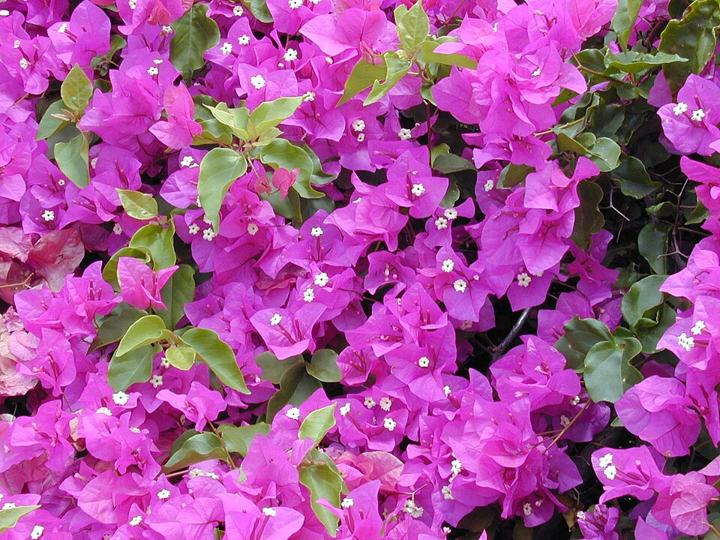
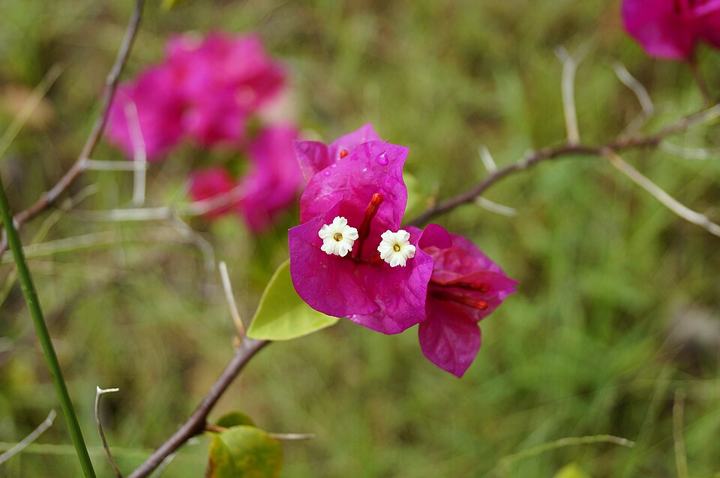
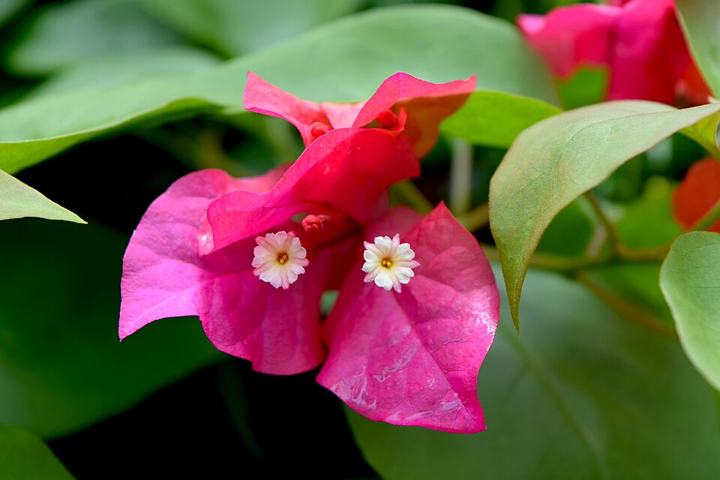
From Wikipedia
Bougainvillea spectabilis, also known as great bougainvillea, is a species of flowering plant. It is native to Brazil, Bolivia, Peru, and Argentina's Chubut Province. It is widely grown as an ornamental plant.
Text from Wikipedia, CC BY-SA 4.0: Bougainvillea spectabilis
Description
A woody climbing plant native to Brazil, densely tomentose, with stems up to 30 cm in diameter and long arching branches armed with hook-tipped spines that help it climb. Leaves broad, oval, 5–10 cm long. Flowers small, arranged in threes, each on a leaf-like bract of vivid colour (pink, red, violet, white, orange). There are numerous cultivars of this species, which can be in flower almost all year round, especially in warm, sunny places.
Propagation and growing
They grow fast. It needs a supporting surface or stakes to bear the weight of the branches and guide them. They need well-drained soils and tolerate dryness well, although they are sensitive to frost. It is not very demanding as to substrate and adapts easily to neutral or slightly alkaline soil. However, it grows better with fertilisers rich in potassium and magnesium. They are propagated by hardwood cuttings in the first months of the year or by semi-ripe cuttings in summer under glass, since outside their native latitudes they do not usually set fruit; also by layering. Available in commercial nurseries.
Garden use
It needs moderate watering, less in winter, letting the soil dry out between waterings; at the start of flowering it benefits from generous showering. To increase flowering, the tips should be pinched out several times a year, coinciding with the flush of new growth. The previous season's side growths should be pruned in autumn, late winter or early spring, shortening and restraining excessive growth. It is relatively resistant to pests and diseases, although susceptible to "caspillas", red spider mite, scale insects and mealybugs, whitefly and caterpillars. It is used to cover walls and fences and to clothe pergolas.
Notes
There are numerous cultivars of this species, such as "typica", with purple bracts; "Thomasii", with pink bracts; or "lateritia", with brick-coloured bracts. It is an introduced species with no invasive potential, posing no risk to the flora and…
Source: Cabildo de Tenerife, “Guía de especies vegetales”, CC BY. Translated from Spanish by us.
Bioclimatic belts
Warm coastal belt
- Inframediterranean, hyperarid
- Inframediterranean, arid
- Inframediterranean, semi-arid (lower level)
- Inframediterranean, semi-arid (upper level)
- Inframediterranean, dry, without trade-wind fog
- Inframediterranean, dry, with trade-wind fog
Warm mid-slope belt
- Thermomediterranean, semi-arid (lower level)
- Thermomediterranean, semi-arid (upper level), without trade-wind fog
- Thermomediterranean, semi-arid (upper level), with trade-wind fog
- Thermomediterranean, dry, with trade-wind fog
- Thermomediterranean, dry (lower level), without trade-wind fog
- Thermomediterranean, subhumid, with trade-wind fog