
Sea rosemary (Campylanthus)
Campylanthus salsoloides (L.f.) Roth · Family: Scrophulariaceae
A Canary endemic of spurge scrub and cliff vegetation in the low and middle zones, from near sea level to 600 m. Very common on recent lava fields.
Photos
Description
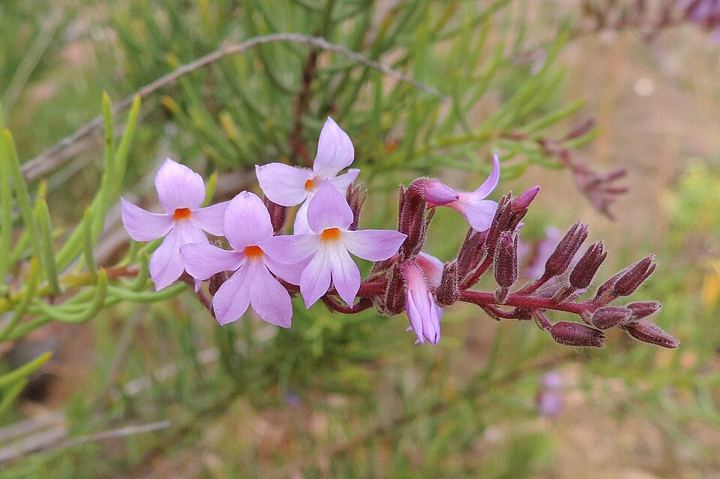
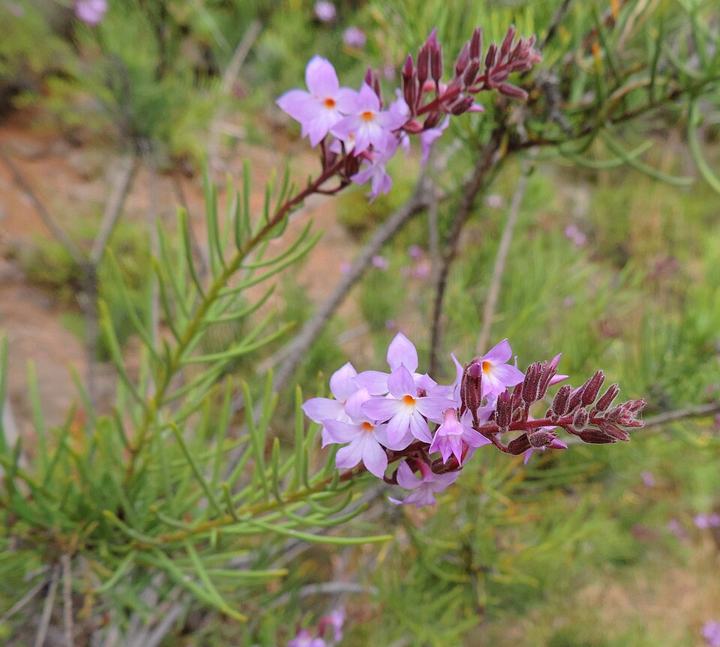
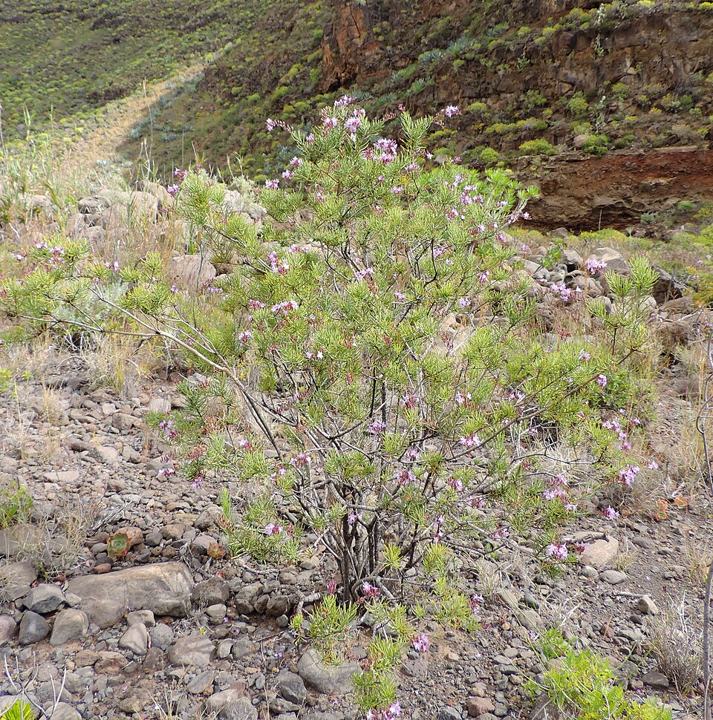
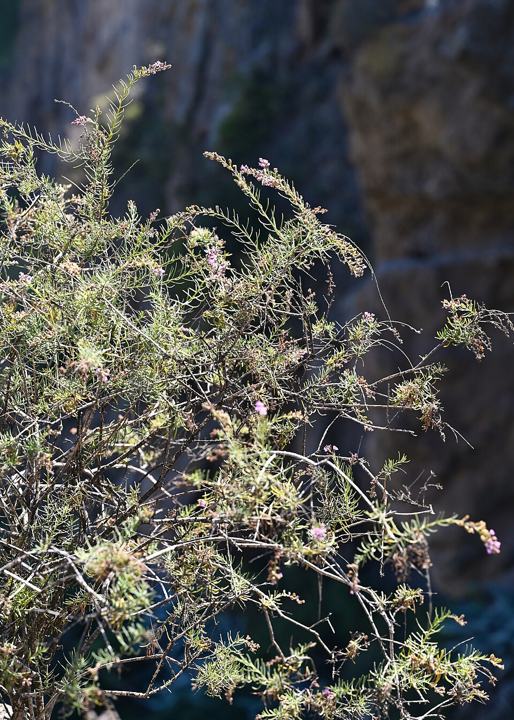
A woody, evergreen shrub up to 2 m tall, branching from the base, with ascending or arching, flexible branches. The thickest stems are woody and greyish-brown, yellowish or dark purple when young. The leaves are green or glossy green, simple, alternate, linear, succulent, almost cylindrical, 2 to 6 cm long and scattered along the stem. The inflorescence is a terminal raceme, showy and erect or drooping, often curved. The flowers are pinkish-violet, pink or white, with the base of the lobes usually white and the inside of the tube yellow. The corolla is tubular, elongated and five-lobed, with rounded or lanceolate lobes, usually pointed, flat and spreading; the tube is narrow, downy and long-curved. It has 2 stamens. The calyx is greenish-purple, downy and five-parted. The fruit is a sticky capsule with 2 chestnut-brown valves and several very small seeds. The variety leucantha differs from the typical variety mainly in its white flowers.
Propagation and growing
It grows on slopes and in ravine (barranco) beds, on cliffs and ledges, on lava fields (malpaís), etc., preferring the driest situations. It grows well in warm, sunny areas sheltered from rain and wind, and does best on rocky substrates and lava flows. It is propagated by seed in spring or by cuttings. The latter method is more effective. Simply cut a flowering sprig about 15 cm long and bury two thirds of it in soil and sand in a shady spot. The plants need protection during their first winter. To do this, cut the cuttings back by half at the end of summer. New shoots will appear and the plant will be strengthened to withstand the winter better.
Garden use
This species is used strictly as an ornamental in semi-arid areas, occasionally in gardens and flower beds. It has a low water requirement and needs a medium-high number of hours of light. It grows best at warm temperatures, around 23 ºC, in stony, well-drained soils. Its root growth is small, so there is no need to fear underground damage from its roots. It flowers between July and September.
Notes
It is related to species found in Cape Verde, East Africa and the Arabian Peninsula, which represents a remarkable geographical disjunction.
Protection status
Annex II of the Order of 20 February 1991 on the protection of wild flora of the Canary Islands.
Potential vegetation
Matorrales xerófilos. Característica de Kleinio_euphorbietea.
Source: Cabildo de Tenerife, “Guía de especies vegetales”, CC BY. Translated from Spanish by us.
Districts
Anaga · Teno