
Canary bellflower
Canarina canariensis (L.) Vatke · Family: Campanulaceae
A shade species of damp places at 300–1,000 m, mainly in thinned parts of the laurel forest.
Where it grows on Tenerife
Grows in: North coast · North, 300–1000 m · Above 1000 m
Zones are derived approximately from the Cabildo belts.
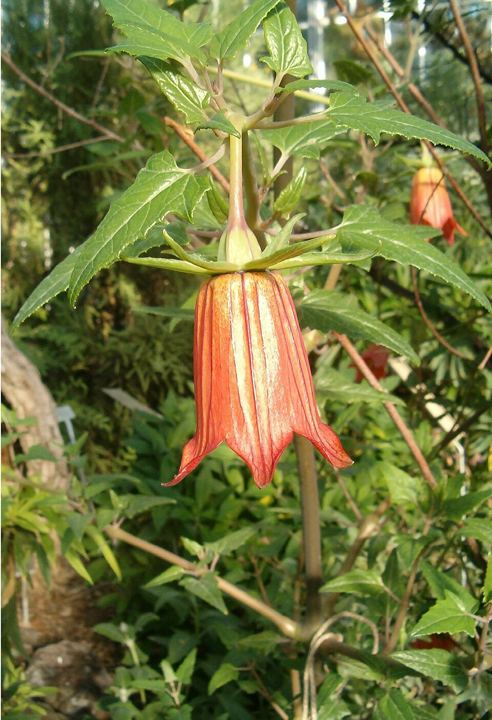
Photos
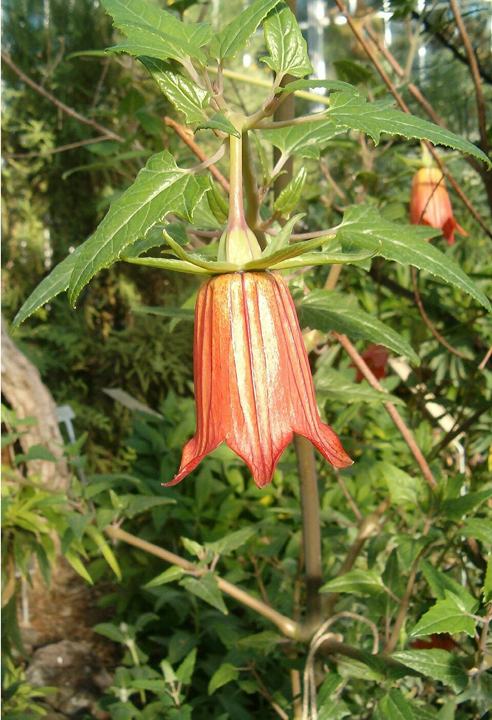
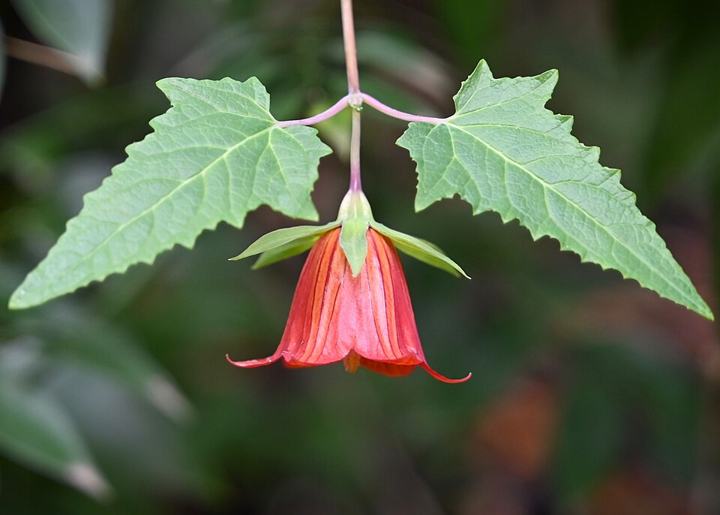
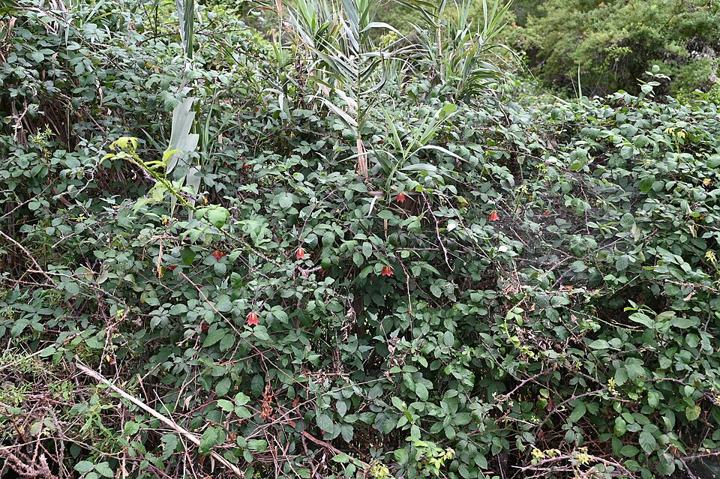
From Wikipedia
Canarina canariensis is a species of flowering plant in the bellflower family Campanulaceae, commonly known as the Canary Island bellflower, and known locally as bicácaro.
Text from Wikipedia, CC BY-SA 4.0: Canarina canariensis
Description
A herbaceous climber with stems up to 3 m long that regrow each year from a thick tuberous root. Leaves 10–12 cm long, opposite, triangular, hastate-sagittate, with a toothed-lobed margin. Flowers solitary, very showy, with a bell-shaped corolla 3–6 cm long, orange with darker veins. Fruits fleshy, also orange. Flowers in winter and spring.
Propagation and growing
The edible fruits of the "bicacarera" contain many small orange seeds which, sown in the cool season (September) in a loose, well-worked substrate, germinate from the first week but very irregularly, depending on the seed batch. Germination can be improved by soaking the seeds in a 0.2% potassium nitrate solution for 24 hours before sowing; they are then collected with a fine sieve, dried and mixed with soil, which is then sown in seed trays (E. Barquín, pers. comm.). The "bicácaros" (fruits) are harvested in early summer when the plant is almost dry, and in the following September–October the tuberous roots that have stayed underground will sprout again. If the plants have been grown in containers, it is best not to water them in summer so that the "batatitas" (little tubers) do not rot; plants can be raised again from these small tubers of the previous season. It is fast-growing, and its long hollow stems are extremely fragile and break easily. It prefers loose, dark soils rich in organic matter, and humid conditions in sun or semi-shade. For the plant to flower, it must be grown in a large container. It is not usually available in native-plant nurseries, and growing must be ordered at least a year in advance.
Garden use
It is a herbaceous perennial with a trailing habit and climbing tendencies, whose above-ground part dries off completely in summer, surviving as a root underground and resprouting the following season with the first rains. Its curious arrow-shaped leaves, its unusual sprawling habit and above all its lovely winter–spring flowers give it enormous value as an ornamental for planting on banks, slopes and ground in monteverde laurel forest areas, along roads, promenades and in parks in cool, humid areas with partial sun, and even as a cultivated plant in flower beds, large pots or planters. It needs little maintenance provided it is in loose soils with some moisture, between 300 and 1000 m above sea level.
Notes
Canarian endemic present on all the islands except Lanzarote (L) and Fuerteventura (F).
Protection status
Annex II of the Order of 20 February 1991 on the protection of wild flora of the Canary Islands.
Potential vegetation
Visneo-Arbutetum canariensis; Lauro-Perseetum indicae; Diplazio-Ocoteetum foetentis; Ilici-Ericetum platycodonis.
Source: Cabildo de Tenerife, “Guía de especies vegetales”, CC BY. Translated from Spanish by us.
Bioclimatic belts
Warm coastal belt
- Inframediterranean, dry, with trade-wind fog
Warm mid-slope belt
- Thermomediterranean, semi-arid (upper level), with trade-wind fog
- Thermomediterranean, dry, with trade-wind fog
- Thermomediterranean, subhumid, with trade-wind fog
- Thermomediterranean, humid, with trade-wind fog
Temperate belt of laurel and pine forest
- Mesomediterranean, lower, dry, with trade-wind fog
- Mesomediterranean, lower, subhumid, with trade-wind fog
- Mesomediterranean, lower, humid, with trade-wind fog
Districts
Anaga · Metropolitan area (Santa Cruz and La Laguna) · Acentejo · La Orotava Valley · Daute · South-east · Güímar Valley