
Popcorn senna
Cassia didymobotrya Fresen. · Family: Caesalpiniaceae
A tropical and subtropical species. Undemanding about soil, prefers good drainage in dry, sunny spots.
Where it grows on Tenerife
Grows in: South coast · North coast · South, 300–1000 m · North, 300–1000 m
Zones are derived approximately from the Cabildo belts.
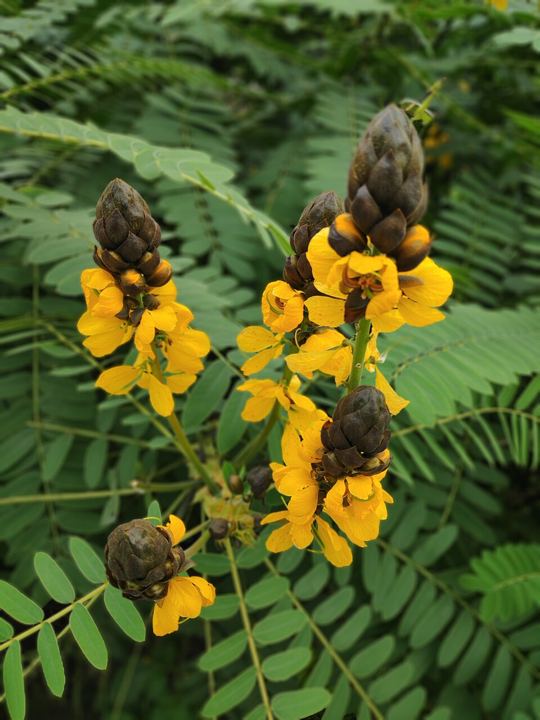
Photos
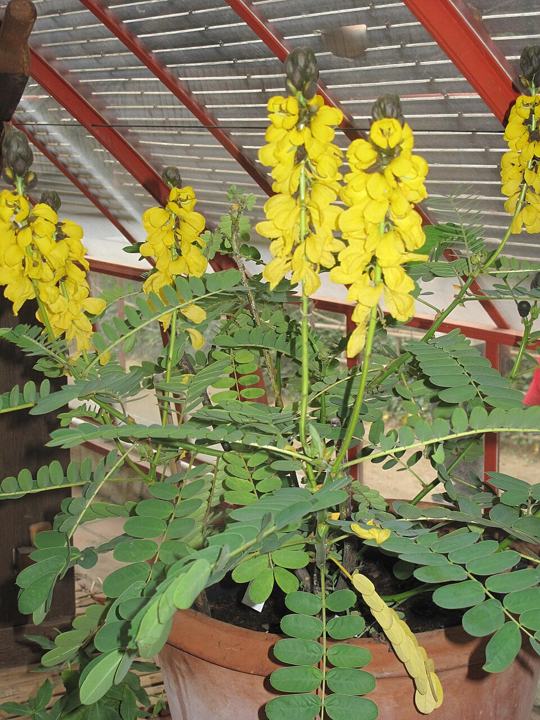
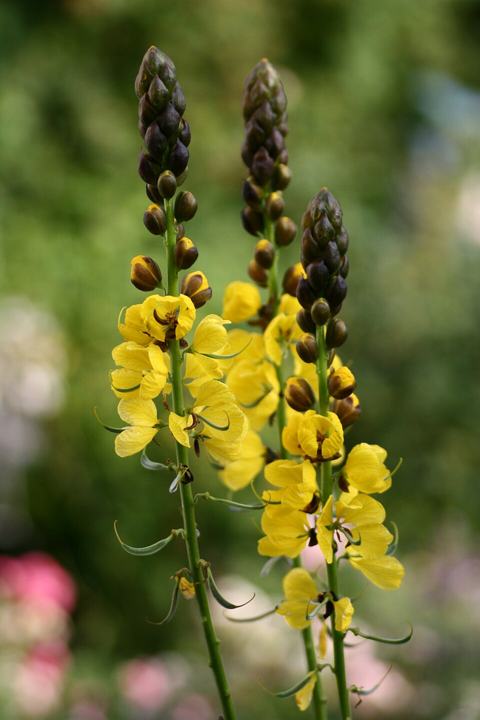
From Wikipedia
Senna didymobotrya is a species of flowering plant in the legume family known by the common names African senna, popcorn senna, candelabra tree, and peanut butter cassia. It is native to Africa, where it can be found across the continent in several types of habitats.
It has been introduced to many other parts of the world for use as an ornamental plant, a cover crop, and a leguminous green manure. In some places it is now naturalized in the wild, for example, in parts of Indonesia, Australia, Mexico, and the United States in California, Florida, and Hawaii.
Text from Wikipedia, CC BY-SA 4.0: Senna didymobotrya
Description
A shrub native to tropical Africa, 2-4 m tall, with pinnate leaves up to 50 cm long; leaflets in 8-18 pairs, ovate-oblong, with a rounded tip, up to 5 cm long. Flowers abundant, in erect spike-like racemes, with a yellow corolla, covered by dark brown sepals before opening. Flowers almost all year round.
Propagation and growing
Easily grown from seed, it needs warm, sunny places. It can grow to 3 metres, although its lifespan is short. It is fast-growing. Propagated by seed.
Garden use
It is striking for its characteristic smell, hence its name; its intense yellow flowers and the habit of the plant itself make it interesting from an ornamental point of view. It tolerates pruning to keep its shape and is resistant to adverse conditions such as periods of drought. It grows well on roadsides, embankments and in gardens in general. Used in parks and gardens for its spectacular flowering, it can be pruned to keep the desired shape.
Notes
Its common name refers to the smell of gofio (toasted grain flour) given off by its flowers.
Source: Cabildo de Tenerife, “Guía de especies vegetales”, CC BY. Translated from Spanish by us.
Bioclimatic belts
Warm coastal belt
- Inframediterranean, hyperarid
- Inframediterranean, arid
- Inframediterranean, semi-arid (lower level)
- Inframediterranean, semi-arid (upper level)
- Inframediterranean, dry, without trade-wind fog
- Inframediterranean, dry, with trade-wind fog
Warm mid-slope belt
- Thermomediterranean, semi-arid (lower level)
- Thermomediterranean, semi-arid (upper level), without trade-wind fog
- Thermomediterranean, semi-arid (upper level), with trade-wind fog
- Thermomediterranean, dry, with trade-wind fog
- Thermomediterranean, subhumid, with trade-wind fog
- Thermomediterranean, dry (upper level), without trade-wind fog