
Cardoncillo (Ceropegia fusca)
Ceropegia fusca Bolle · Family: Asclepiadaceae
Typical of dry, hot rocky places in the south of the island.
Where it grows on Tenerife
Grows in: South coast · North coast
Zones are derived approximately from the Cabildo belts.
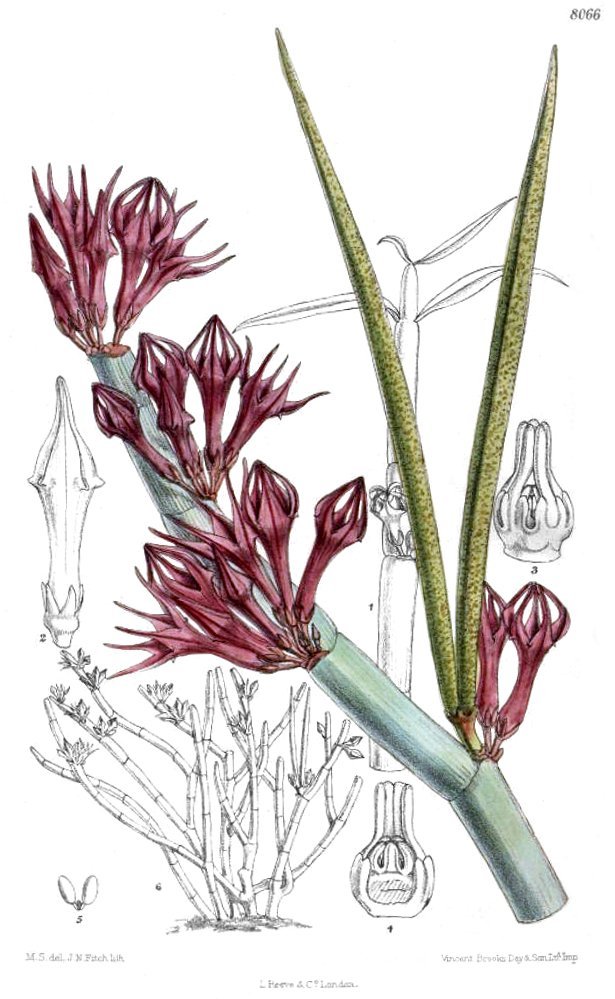
Photos
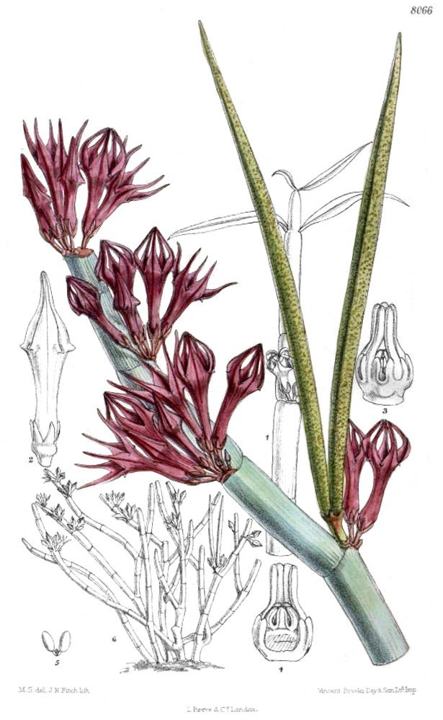
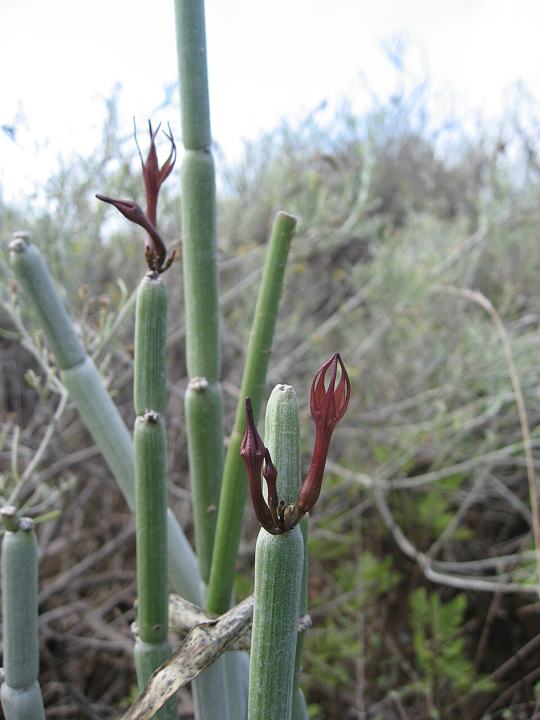
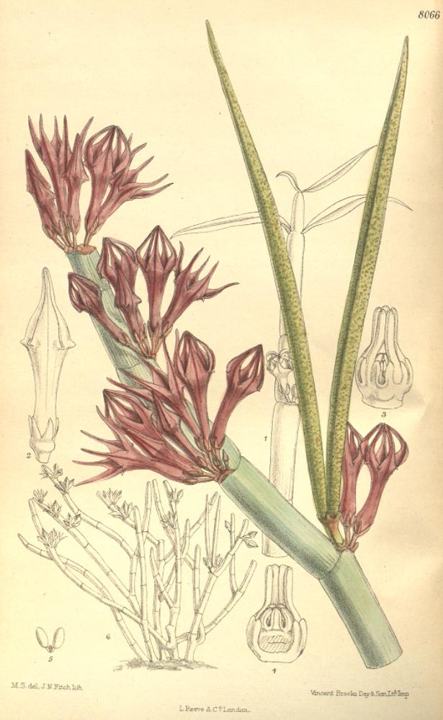
From Wikipedia
Ceropegia fusca is a flowering plant in the genus Ceropegia (Apocynaceae). It is endemic to the Canary Islands, where it grows on Tenerife (especially the Macizo de Anaga area), Gran Canaria, and La Palma in the Tabaibal-Cardonal zone at up to about 600 m altitude.
Text from Wikipedia, CC BY-SA 4.0: Ceropegia fusca
Description
Succulent plant branching from a semi-woody base, with erect or spreading stems 30–60 cm tall, cylindrical and jointed, greyish white. Leaves linear, small. Flowers tubular, borne on the upper part of the older stems, reddish brown. Fruits in pairs, up to 12 cm long. Flowers in spring–summer.
Propagation and growing
The fruits of the cardoncillo are long capsules (up to 12 cm) that appear at the joints of the stems, opposite and in pairs, shaped like horns. They contain numerous small, flattened seeds bearing a tuft of fine hairs (pappus) that aids their dispersal by wind. The seeds are hard to collect because of their size and because this plant fruits irregularly and only briefly. The fragility of its curious jointed stems and their ability to root quickly may be a strategy for the vegetative multiplication of this species, and this is exploited to propagate it vegetatively: pieces of stem are taken and left unplanted for one or two weeks (so that the wound dries and heals), after which they root easily. It can also be propagated vegetatively by layering stems that lie on the ground ("margullo"). Grown in containers it is slow-growing, but needs almost no maintenance or watering and, because of its particular shape, takes up very little space, as it can be grown in very small, shallow containers. It is undemanding as to soil and requires full sun. It is not usually available in native-plant nurseries, and its cultivation must be ordered at least a year and a half in advance.
Garden use
This small succulent shrub, up to 75 cm tall and branching from the base, flowers irregularly (not every plant, nor every year) in spring–summer (sometimes in winter) with small, inconspicuous flowers of very distinctive structure. Its strange and curious appearance is very beautiful and attractive in the areas of the southern slope of the island where it grows naturally (and abundantly) from almost sea level up to 600 m above sea level, on crags, tosca (soft volcanic tuff) and malpaís (rough lava fields), and generally in dry, rocky places. It is an excellent plant for delicate gardens and rockeries in dry, warm areas. It is highly drought-resistant but mechanically very fragile. It needs hardly any maintenance or watering. It should not be planted very close to paths or walkways where it might be trodden on by accident.
Notes
Its sap contains toxic alkaloids ("mataperros"). Endemic to Tenerife and Gran Canaria; it is scarce on the latter island.
Protection status
Annex II of the Order of 20 February 1991 on the protection of wild flora of the Canary Islands.
Potential vegetation
Ceropegio fuscae-Euphorbietum balsamiferae.
Source: Cabildo de Tenerife, “Guía de especies vegetales”, CC BY. Translated from Spanish by us.
Bioclimatic belts
Warm coastal belt
- Inframediterranean, hyperarid
- Inframediterranean, arid
Districts
South-west · Abona · South-east · Güímar Valley