
Clivia (bush lily)
Clivia miniata Regel · Family: Amaryllidaceae
Temperate climate, partial or full shade with good light. Undemanding about soil; needs permeable garden earth. Likes plenty of moisture, especially in summer, yet tolerates drought.
Where it grows on Tenerife
Grows in: South coast · North coast · South, 300–1000 m · North, 300–1000 m · Above 1000 m
Zones are derived approximately from the Cabildo belts.
Photos
From Wikipedia
Clivia miniata, the Natal lily or bush lily, is a species of flowering plant in the genus Clivia of the family Amaryllidaceae, native to woodland habitats in South Africa (Eastern Cape, Mpumalanga and KwaZulu-Natal provinces) and Eswatini. It is also widely cultivated as an ornamental.
Text from Wikipedia, CC BY-SA 4.0: Clivia miniata
Description
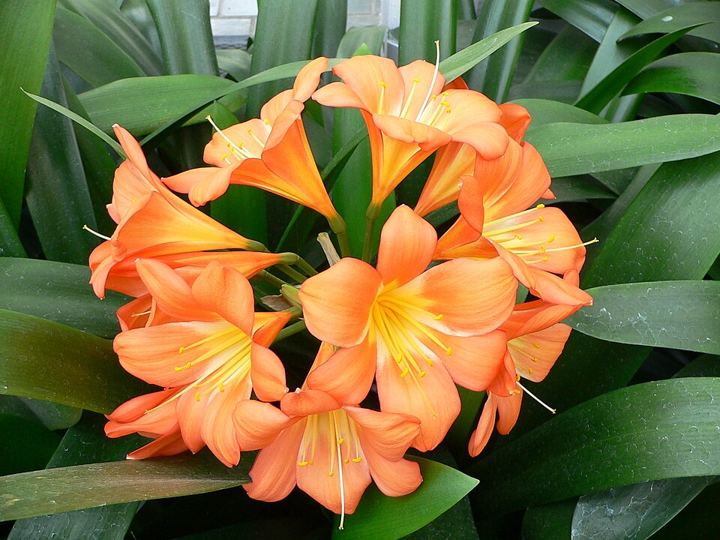
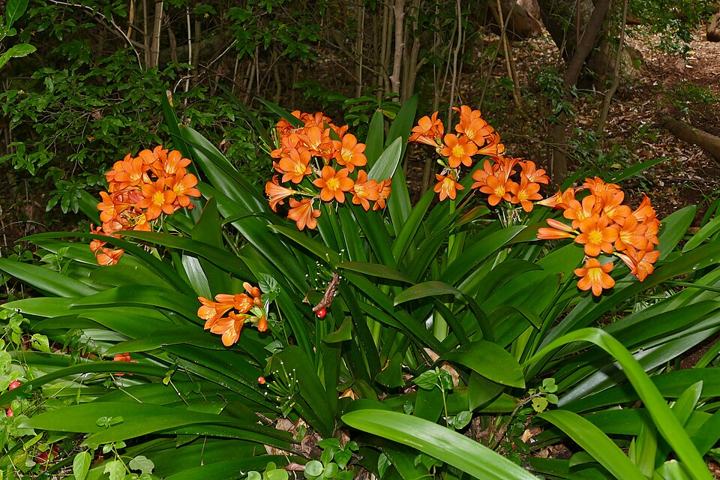
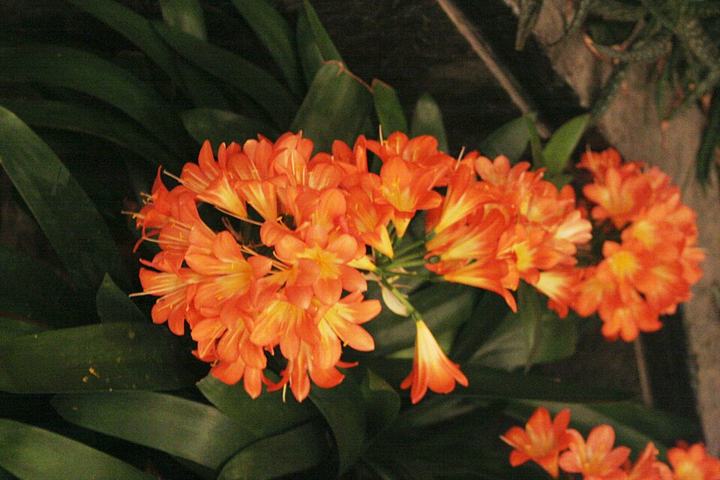
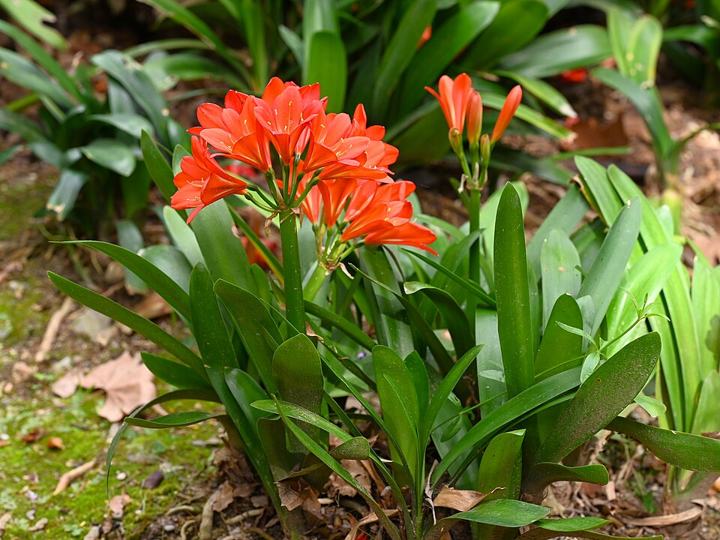
A stemless rhizomatous perennial native to South Africa, with fleshy roots. Leaves strap-shaped, arching and pointed, glossy green, up to 65 cm long and 4 cm wide. Flowers gathered in umbels at the top of a scape about 45 cm long. They have a funnel-shaped corolla with reddish lobes and a yellowish base. Fruit a berry, ovoid and bright red. Flowers in spring and early summer. There are various cultivars differing in flower and leaf colour.
Propagation and growing
It is propagated by seed or by dividing its roots. It needs a partly sunny position and moderate watering; its cultivation has spread because it grows so well and is in demand for gardening. A moderately growing, easy plant. Propagation by seed and by division of the clump.
Garden use
As it is ideal for shady areas, it is recommended for planting in groups at the foot of trees, which gain prominence and beauty from it; its flowers are very showy, red-orange, and suitable for bouquets that last several days. Watering should be moderate and the soil reasonably fertile. In gardens it is used for group plantings; it is also sold as a houseplant or as a pot plant for outdoors.
Notes
"Clivia" species are toxic and irritate the skin and mucous membranes, which should be borne in mind when using them, especially if they will be within reach of children.
Source: Cabildo de Tenerife, “Guía de especies vegetales”, CC BY. Translated from Spanish by us.
Bioclimatic belts
Warm coastal belt
- Inframediterranean, hyperarid
- Inframediterranean, arid
- Inframediterranean, semi-arid (lower level)
- Inframediterranean, semi-arid (upper level)
- Inframediterranean, dry, without trade-wind fog
- Inframediterranean, dry, with trade-wind fog
Warm mid-slope belt
- Thermomediterranean, semi-arid (lower level)
- Thermomediterranean, semi-arid (upper level), without trade-wind fog
- Thermomediterranean, semi-arid (upper level), with trade-wind fog
- Thermomediterranean, dry, with trade-wind fog
- Thermomediterranean, dry (lower level), without trade-wind fog
- Thermomediterranean, subhumid, with trade-wind fog
- Thermomediterranean, dry (upper level), without trade-wind fog
- Thermomediterranean, humid, with trade-wind fog
Temperate belt of laurel and pine forest
- Mesomediterranean, lower, semi-arid (upper level), without trade-wind fog
- Mesomediterranean, lower, dry, with trade-wind fog
- Mesomediterranean, lower, dry, without trade-wind fog
- Mesomediterranean, lower, subhumid, with trade-wind fog
- Mesomediterranean, lower, subhumid, without trade-wind fog
- Mesomediterranean, lower, humid, with trade-wind fog