
Canary bindweed
Convolvulus canariensis L. · Family: Convolvulaceae
Lives at 500–1,000 m in the laurel forest, twining through trunks and crowns of trees and shrubs.
Where it grows on Tenerife
Grows in: North coast · North, 300–1000 m · Above 1000 m
Zones are derived approximately from the Cabildo belts.
Photos
Description
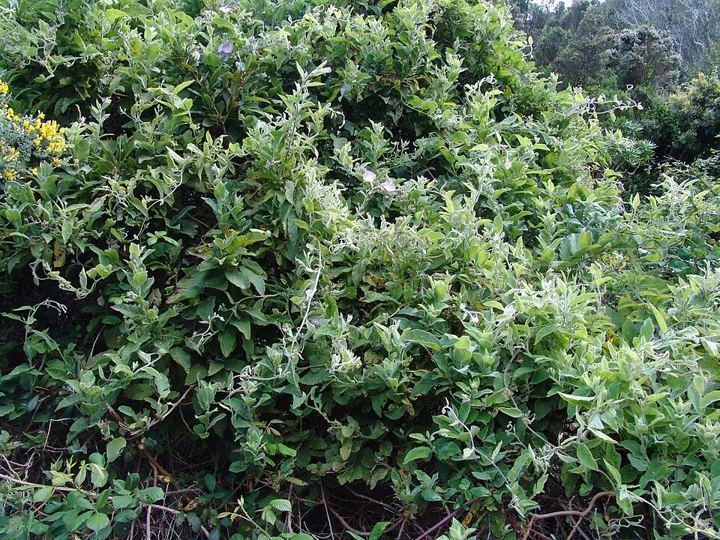
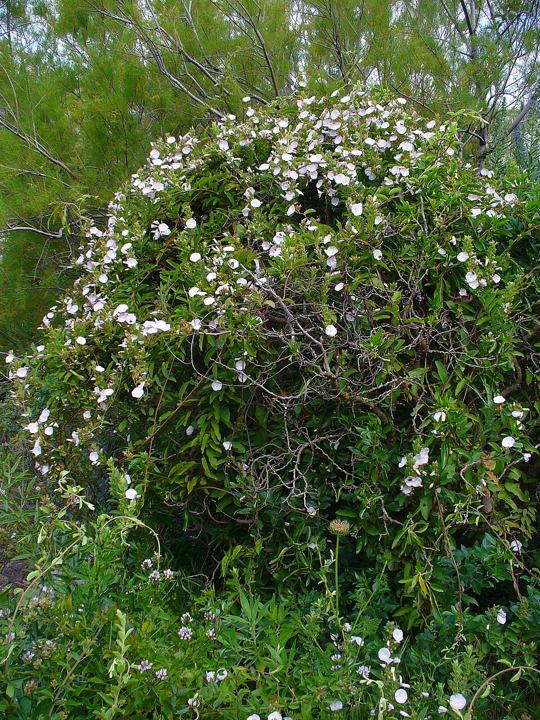
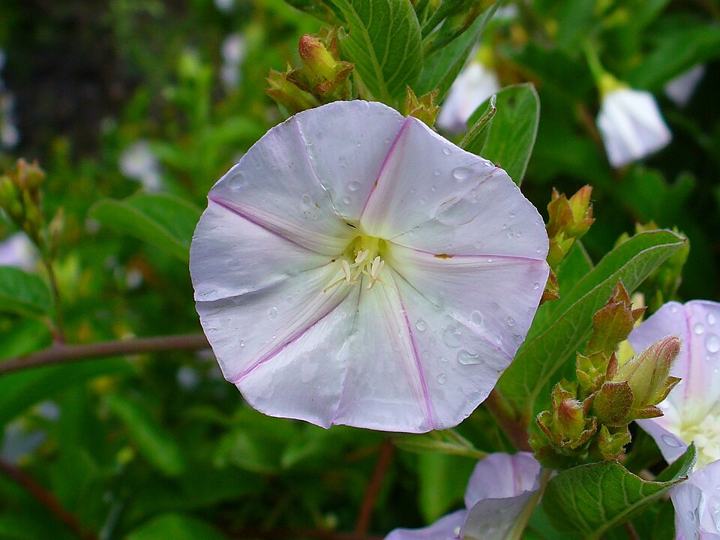
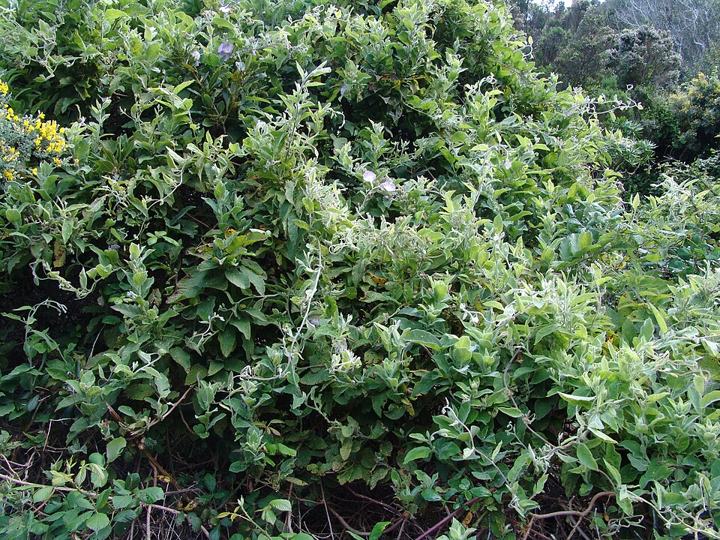
A climbing shrub whose stems can reach 8–10 m in length and are woody in their lower part. Leaves heart-shaped, 4–9 cm long, densely hairy, with prominent veins on the underside. Flowers grouped on long peduncles, with a funnel-shaped, pale blue corolla. Flowers from spring to early summer.
Propagation and growing
The capsular fruits of this liana contain one to four black seeds that germinate easily. Vegetative propagation by semi-ripe cuttings is also possible. The resulting plants are vigorous and extremely fast-growing, so much so that in containers they need staking and frequent pruning so they do not twine around nearby plants. It is not demanding as to soil, although it prefers deep soils, and it is moderately drought-resistant, though it prefers moist soils and sunny positions. It is not usually available in native-plant nurseries, although growing can be ordered 4 or 5 months in advance.
Garden use
This aggressive liana with attractive flowers grows so fast that, once planted in a garden, it needs very frequent pruning if it is not to end up overrunning everything. It completely covers the trees or shrubs that support it, hindering their growth; if you want it to climb a fence or railing, this must be far enough from trees, otherwise it will end up covering them entirely; moreover, after a couple of years the final effect is a tangled, untidy mass of vegetation along the top of the fence. Its use may be worth considering for covering pergolas or banks, combating brambles or covering unwanted trees or dead trunks, but we believe this pretty but aggressive climber has few ornamental uses.
Notes
Canarian endemic, present on all the islands except Fuerteventura (F) and Lanzarote (L).
Protection status
Annex II of the Order of 20 February 1991 on the protection of wild flora of the Canary Islands.
Potential vegetation
Visneo-Arbutetum canariensis; Lauro-Perseetum indicae.
Source: Cabildo de Tenerife, “Guía de especies vegetales”, CC BY. Translated from Spanish by us.
Bioclimatic belts
Warm coastal belt
- Inframediterranean, dry, with trade-wind fog
Warm mid-slope belt
- Thermomediterranean, semi-arid (upper level), with trade-wind fog
- Thermomediterranean, dry, with trade-wind fog
- Thermomediterranean, subhumid, with trade-wind fog
- Thermomediterranean, humid, with trade-wind fog
Temperate belt of laurel and pine forest
- Mesomediterranean, lower, dry, with trade-wind fog
- Mesomediterranean, lower, subhumid, with trade-wind fog
- Mesomediterranean, lower, humid, with trade-wind fog
Districts
Anaga · Metropolitan area (Santa Cruz and La Laguna) · Acentejo · La Orotava Valley · Daute · South-east · Güímar Valley