
Leñanoel (Convolvulus scoparius)
Convolvulus scoparius L. f. · Family: Convolvulaceae
Grows mainly in the spurge scrub zone, especially on the southern slopes of the islands, in the driest and warmest low belts.
Photos
Description
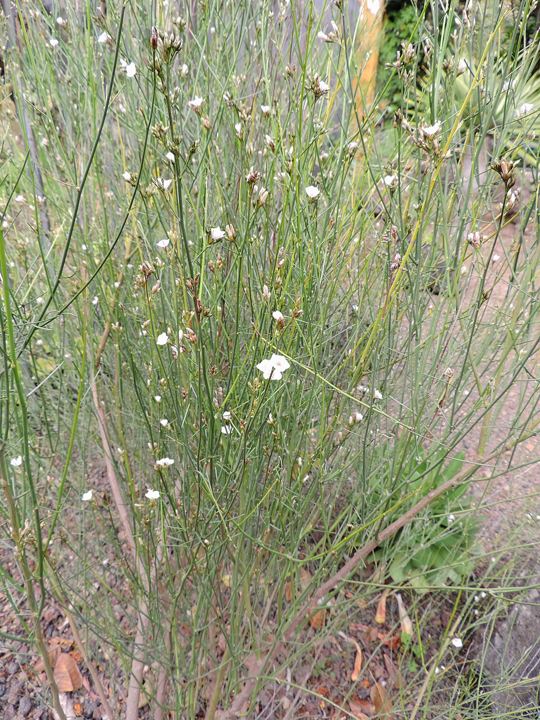
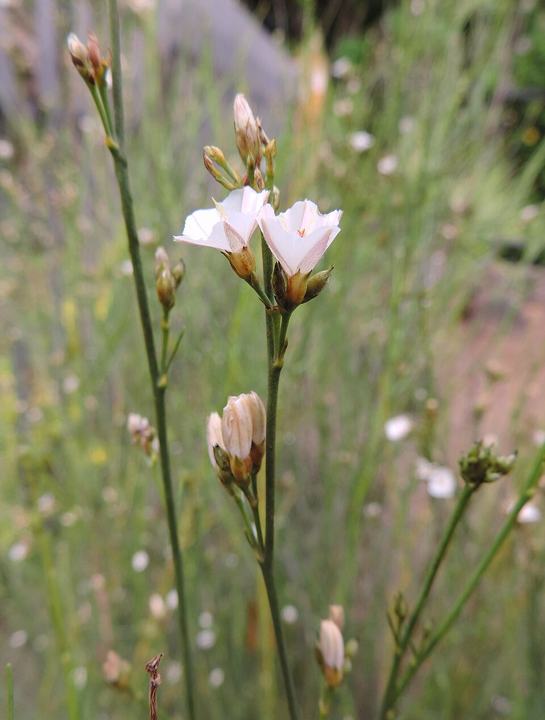
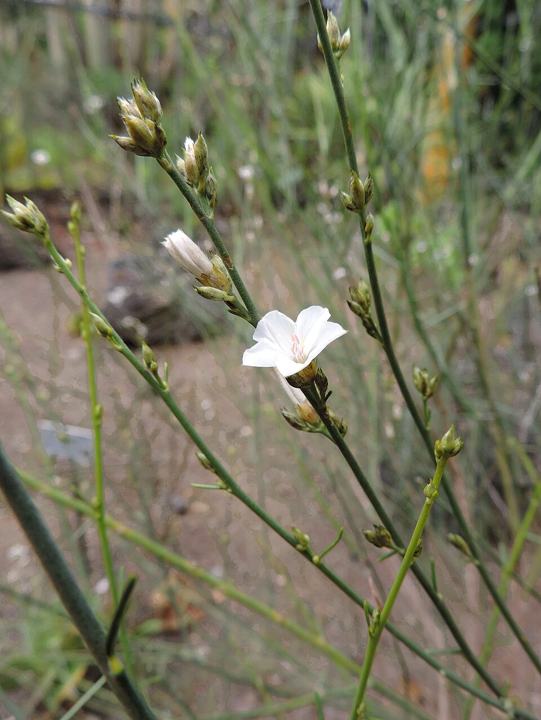
A nanophanerophyte with a broom-like (retamoid) habit and erect branches, up to 2 m tall. Leaves linear, thread-like, 0.7–4.4 × 0.05–0.07 cm. Inflorescences leafy, with 3–7 (17) flowers; bracts resemble sterile leaves, decreasing in size towards the apex. Flowers with lanceolate bracteoles 2–3 mm long and mucronate sepals 5 mm long; corolla white or faintly pink, hirsute, 1.5 to 3 times longer than the calyx.
Propagation and growing
It grows naturally in coastal areas with a hot desert climate, with rainfall below 100–300 millimetres and a mean temperature of 18–22 ºC. Strong sunshine, which causes high mean temperatures and small temperature swings, and the drying action of constant winds intensify the aridity typical of these places. It is adapted to very dry environments.
Garden use
Ideal for borders and for combining with larger shrubs or herbaceous plants, making use of its glaucous colour to create colour contrasts, and bearing in mind that it flowers from midwinter. Also suitable for rock gardens. Low maintenance, with little need for watering and high sun exposure. It needs maintenance pruning to keep its shape and prevent the clump from becoming untidy. Prune after flowering if you want sturdier growth. Feeding with a fertiliser rich in organic matter will be necessary.
Notes
This shrub must once have been common in the stony, dry valleys of the lowlands of Tenerife, La Palma, La Gomera and Gran Canaria; but because of the harvesting of the fragrant wood of its rootstocks, it is…
Protection status
Annex II of the Order of 20 February 1991 on the protection of wild flora of the Canary Islands.
Potential vegetation
Matorrales xerófilos…
Source: Cabildo de Tenerife, “Guía de especies vegetales”, CC BY. Translated from Spanish by us.
Districts
Teno · South-west