
Guaydil (tree bindweed)
Convolvus floridus L.f. · Family: Convolvulaceae
Very common on dry sunny slopes of the low and middle zones, 200–600 m, in spurge scrub and thermophilous shrubland.
Where it grows on Tenerife
Grows in: South coast · North coast · South, 300–1000 m
Zones are derived approximately from the Cabildo belts.
Description
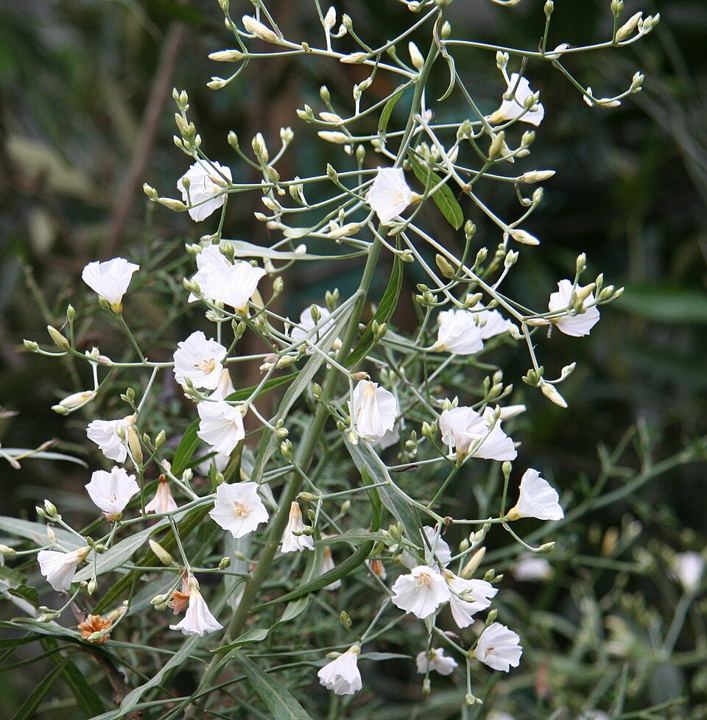
A shrub 2-4 m tall, with erect or slightly arching branches and greyish bark. Leaves oblong-linear to oblong, 2-14 cm long, shortly and densely downy, glaucous. Flowers numerous, white or pale pink, funnel-shaped, in showy terminal inflorescences. Flowers in spring.
Propagation and growing
The abundant capsular fruits of this shrub usually contain two seeds, which germinate irregularly and with some difficulty; it may be advisable to germinate them in a warm environment. Plants grown in containers have thread-like stems and leaves, typical of young individuals, and grow slowly, which makes them look fragile; however, once planted in the ground their growth speeds up considerably, so that it can be classed as a fast-growing species. It is undemanding as to growing media and soils and very drought-resistant. Widely used in local gardening, it is usually available in nurseries.
Garden use
This shrub, which can grow to more than 4 m tall, has abundant, showy white flowers over a long period (from early winter to summer). It prefers sunny positions and thrives on semi-arid slopes and cliffs between 50 and 500 m above sea level. It grows fast and takes pruning well. It needs hardly any maintenance or watering. It soon covers a considerable area, so unless it is to be used for hedging, plants should be spaced three metres apart. It is widely used as an ornamental in landscaping of all kinds, including roadsides, in low and mid-altitude zones.
Notes
It is a rather polymorphic species as regards the size (especially the width) of the leaves. Besides the species mentioned, others in the genus are also of interest. A curious one, with a broom-like (retama-like) appearance, is “C. Scoparius”.
Protection status
Not listed.
Potential vegetation
Periploco-Euphorbietum canariensis; Junipero-Oleetum cerasiformis.
Source: Cabildo de Tenerife, “Guía de especies vegetales”, CC BY. Translated from Spanish by us.
Bioclimatic belts
Warm coastal belt
- Inframediterranean, semi-arid (lower level)
- Inframediterranean, semi-arid (upper level)
- Inframediterranean, dry, without trade-wind fog
Warm mid-slope belt
- Thermomediterranean, semi-arid (lower level)
- Thermomediterranean, semi-arid (upper level), without trade-wind fog
- Thermomediterranean, dry (lower level), without trade-wind fog
Districts
Anaga · Metropolitan area (Santa Cruz and La Laguna) · Acentejo · La Orotava Valley · Daute · Teno · South-west · Abona · South-east · Güímar Valley