
Cabbage tree (cordyline)
Cordyline australis (G. Forst.) Endl. · Family: Agavaceae
Suits a subtropical climate without excessive heat. Moderately cold hardy, takes full sun or partial shade. Prefers rich, well-drained soil. Tolerates the seaside and urban pollution.
Where it grows on Tenerife
Grows in: South coast · North coast · South, 300–1000 m · North, 300–1000 m
Zones are derived approximately from the Cabildo belts.
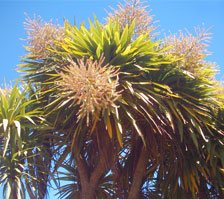
Photos
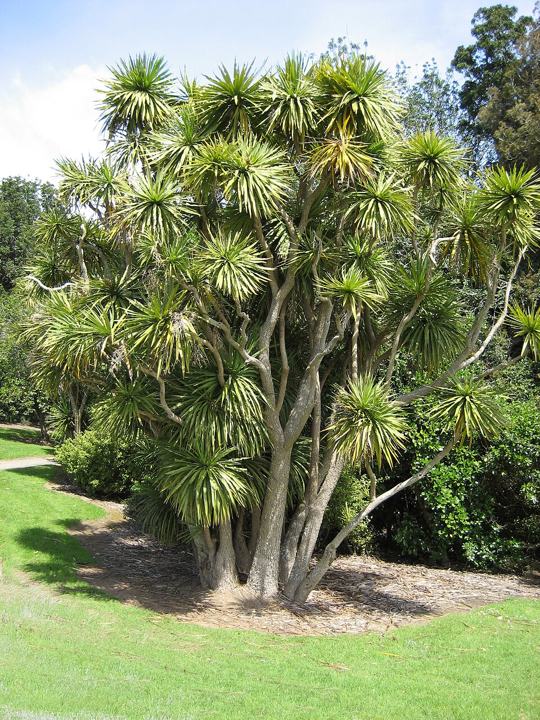
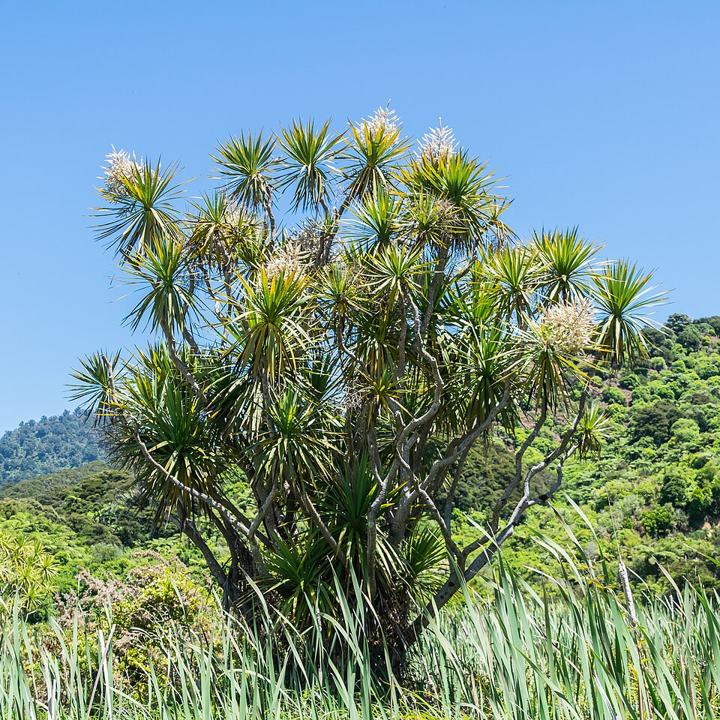
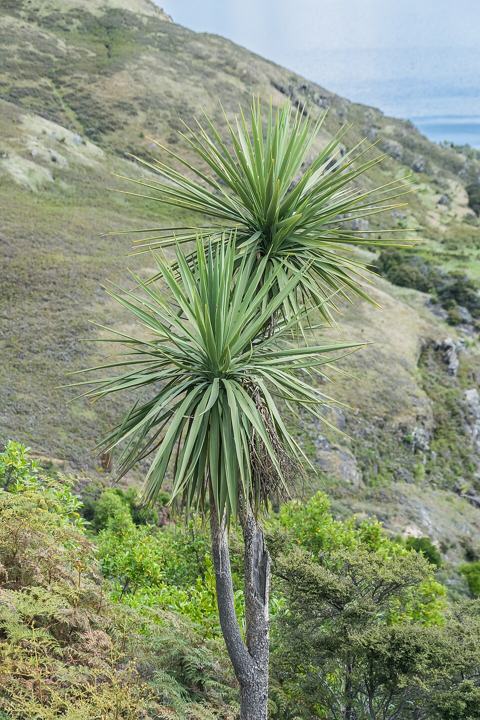
From Wikipedia
Cordyline australis, commonly known as the cabbage tree, or by its Māori name of tī or tī kōuka, is a widely branched monocot tree endemic to New Zealand.
It grows up to 20 metres (66 feet) tall with a stout trunk and sword-like leaves, which are clustered at the tips of the branches and can be up to 1 metre (3 feet 3 inches) long. With its tall, straight trunk and dense, rounded heads, the tree is a characteristic feature of the New Zealand landscape. It is common over a wide latitudinal range from the far north of the North Island to the south of the South Island. It grows in a broad range of habitats.
Māori used it as a source of food, particularly in the South Island, where it was cultivated in areas where other crops would not grow. It provided durable fibre for textiles. Hardy and fast growing, it is widely planted in New Zealand gardens, parks and streets, and numerous cultivars are available. It can also be found in large numbers in island restoration projects, such as Tiritiri Matangi Island, where it was among the first seedling trees to be planted.
It is also grown as an ornamental tree in higher latitude Northern Hemisphere countries with maritime climates, including parts of the upper West Coast of the United States, Canada and the British Isles, where its common names include Cornish palm, cabbage palm, Torbay palm and Torquay palm.
Text from Wikipedia, CC BY-SA 4.0: Cordyline australis
Description
Tree-like plant from New Zealand, about 10–15 m tall, with the trunk thickened at the base. Young specimens have an undivided trunk, which branches at the top in mature plants. Bark rough and fissured, brown. Leaves lanceolate, up to 1 m long, borne at the tips of the branches and forming a tuft. Leathery in appearance, they are light green, with the veins not prominent. Flowers almost sessile, small and fragrant, gathered in much-branched terminal panicles. They are soon displaced by a new flush of leaves growing from the axil of the adjacent leaf. The fruit is a globose white berry that later darkens. There are cultivars with bronze, purple and variegated leaves. Flowers in spring–summer.
Propagation and growing
It is propagated by seed or by pieces of stem planted directly in the substrate. It needs semi-shaded, humid conditions, but does not tolerate waterlogged ground, as this can cause the plant to rot. It does not tolerate very low temperatures. A very vigorous plant, easy to grow. Slow-growing. Propagation by seed and cuttings.
Garden use
It is recommended for landscaping squares, gardens and parks; it is also seen along promenades and avenues. A very strong fibre called New Zealand flax is extracted from its bark. As for maintenance, it needs moderate watering, and planting in warm areas is recommended. It is used for interior decoration and as an ornamental plant in parks and gardens.
Notes
A species with low invasive potential. It has not been recorded as naturalised.
Source: Cabildo de Tenerife, “Guía de especies vegetales”, CC BY. Translated from Spanish by us.
Bioclimatic belts
Warm coastal belt
- Inframediterranean, hyperarid
- Inframediterranean, arid
- Inframediterranean, semi-arid (lower level)
- Inframediterranean, semi-arid (upper level)
- Inframediterranean, dry, without trade-wind fog
- Inframediterranean, dry, with trade-wind fog
Warm mid-slope belt
- Thermomediterranean, semi-arid (lower level)
- Thermomediterranean, semi-arid (upper level), without trade-wind fog
- Thermomediterranean, semi-arid (upper level), with trade-wind fog
- Thermomediterranean, dry, with trade-wind fog
- Thermomediterranean, dry (lower level), without trade-wind fog