
Italian cypress
Cupressus sempervirens L. · Family: Cupressaceae
Needs a mild, temperate climate without hard frost. Withstands drought very well.
Where it grows on Tenerife
Grows in: South coast · North coast · South, 300–1000 m · North, 300–1000 m · Above 1000 m
Zones are derived approximately from the Cabildo belts.
From Wikipedia
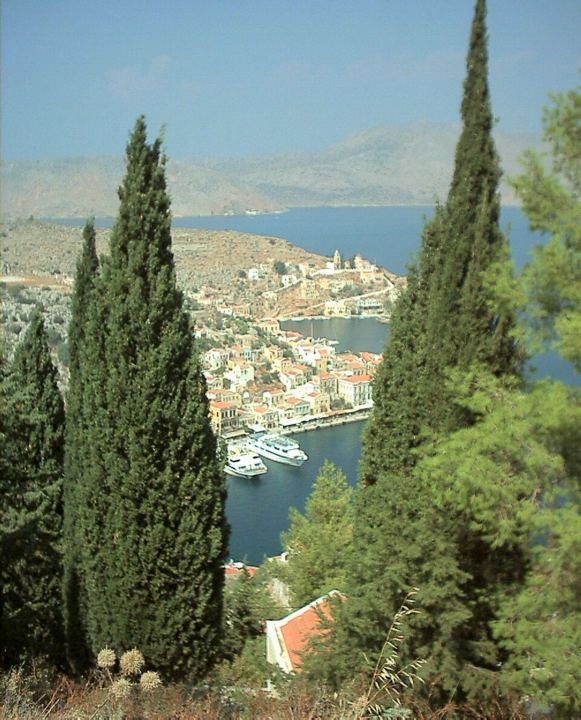
Cupressus sempervirens, the Mediterranean cypress, Italian cypress, Tuscan cypress, or Persian cypress, is a species of conifer in the family Cupressaceae, a cypress native to the eastern Mediterranean region and Iran. It is widespread throughout the Mediterranean basin and has become endemic in similar dry summer climates due to its ability to survive in both acidic and alkaline soils and withstand drought.
Cupressus sempervirens is important in Mediterranean and Middle Eastern culture; it has long been valued for its role in symbolism, various rituals, and folk medicine. In Iran it is both a sacred tree and a metaphor for "the graceful figure of the beloved". It is popular around the world as an ornamental tree and has been studied for possible medicinal properties.
In Israel, vestiges of wild specimens can be found but the majority of Mediterranean cypress trees are the result of intentional reforestation on the behalf of the JNF, and are common at cemeteries, parks, and within wooded areas.
Text from Wikipedia, CC BY-SA 4.0: Cupressus sempervirens
Description
A tree native to the eastern Mediterranean, which can exceed 30 m in height, with a straight trunk and a predominantly columnar habit; the bark is greyish-brown, fibrous and longitudinally furrowed. It produces abundant primary branches, which may be erect, giving a very elongated, narrow crown with very dense foliage (f. “sempervirens”), or almost horizontal, giving a pyramidal crown (f. “horizontalis”). The leaves are reduced to small dark green scales, overlapping and covering the twigs. Male cones ovoid, 4–8 mm, produced in large numbers, each at the tip of a twig. Female cones on the same plant, 2–3.5 cm in diameter, subglobose, green at first, turning glossy greyish-brown and becoming woody, made up of 8–14 polygonal scales. It flowers mainly in late winter and spring; the cones ripen in the autumn of the following year.
Propagation and growing
It is propagated by seed, although cultivars are grafted. It tolerates arid or semi-compacted soils very well, but does not accept excessively compacted soils with poor water-holding capacity. It needs a sunny position and withstands heat and drought very well; it does not tolerate very low temperatures.
Garden use
It is used for hedges, often as windbreaks and even to capture rainfall; also in reforestation or as an ornamental tree that takes pruning well. A very hardy species which, thanks to its longevity, is suitable for cemeteries; it is planted singly or in groups.
Notes
Because of its longevity (it can live for more than 500 years), it has been planted in cemeteries as a funerary symbol, but used in parks and gardens it lends them a touch of distinction and elegance, as in the “cármenes” (walled house-gardens) of Granada.
Source: Cabildo de Tenerife, “Guía de especies vegetales”, CC BY. Translated from Spanish by us.
Bioclimatic belts
Warm coastal belt
- Inframediterranean, semi-arid (lower level)
- Inframediterranean, semi-arid (upper level)
- Inframediterranean, dry, without trade-wind fog
- Inframediterranean, dry, with trade-wind fog
Warm mid-slope belt
- Thermomediterranean, semi-arid (lower level)
- Thermomediterranean, semi-arid (upper level), without trade-wind fog
- Thermomediterranean, semi-arid (upper level), with trade-wind fog
- Thermomediterranean, dry, with trade-wind fog
- Thermomediterranean, dry (lower level), without trade-wind fog
- Thermomediterranean, subhumid, with trade-wind fog
- Thermomediterranean, dry (upper level), without trade-wind fog
- Thermomediterranean, humid, with trade-wind fog
Temperate belt of laurel and pine forest
- Mesomediterranean, lower, semi-arid (upper level), without trade-wind fog
- Mesomediterranean, lower, dry, with trade-wind fog
- Mesomediterranean, lower, dry, without trade-wind fog
- Mesomediterranean, lower, subhumid, with trade-wind fog
- Mesomediterranean, lower, subhumid, without trade-wind fog
- Mesomediterranean, lower, humid, with trade-wind fog
- Mesomediterranean, upper, dry, without trade-wind fog
- Mesomediterranean, upper, subhumid, without trade-wind fog
- Mesomediterranean, upper, humid, without trade-wind fog