
Sago palm
Cycas revoluta Thunb. · Family: Cycadaceae
Subtropical climate with some cool-humid influence. Can live in full sun but does best in partial shade and humid air at an average of 18–21 °C.
Where it grows on Tenerife
Grows in: South coast · North coast · South, 300–1000 m · North, 300–1000 m
Zones are derived approximately from the Cabildo belts.
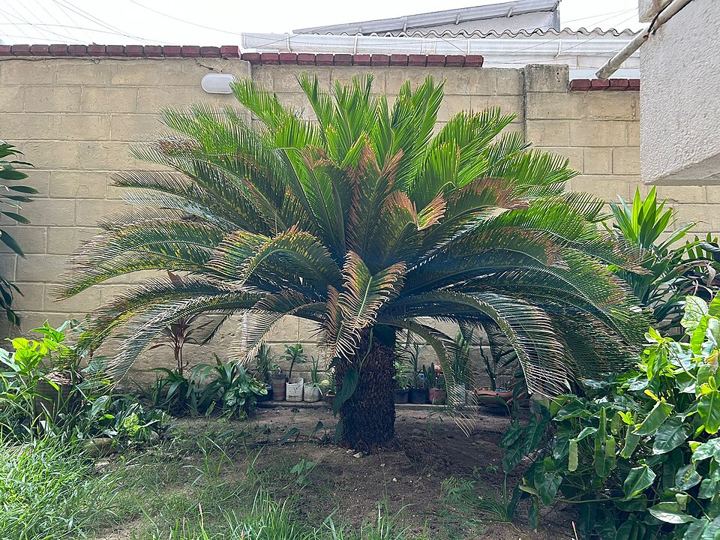
Photos
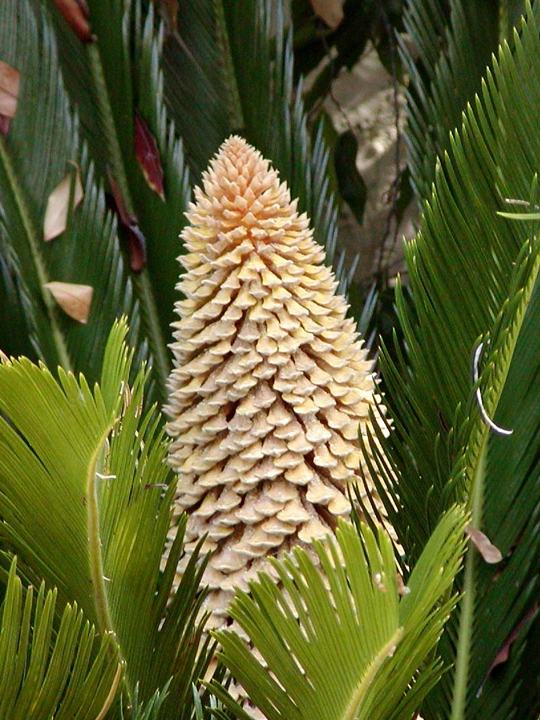
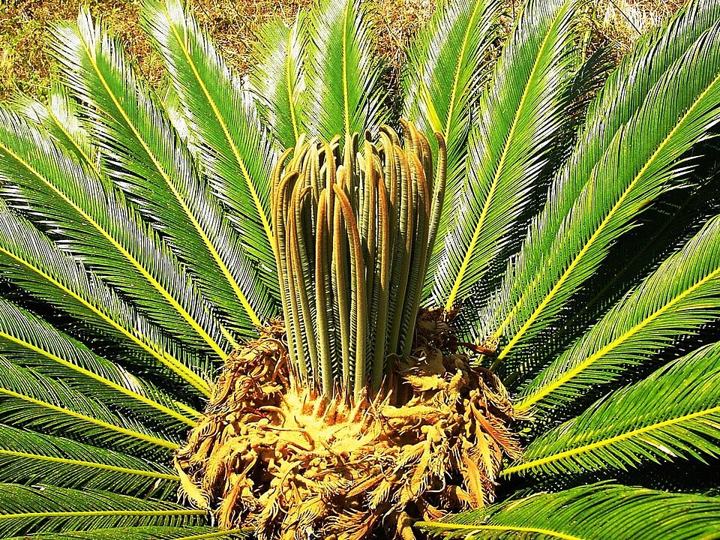
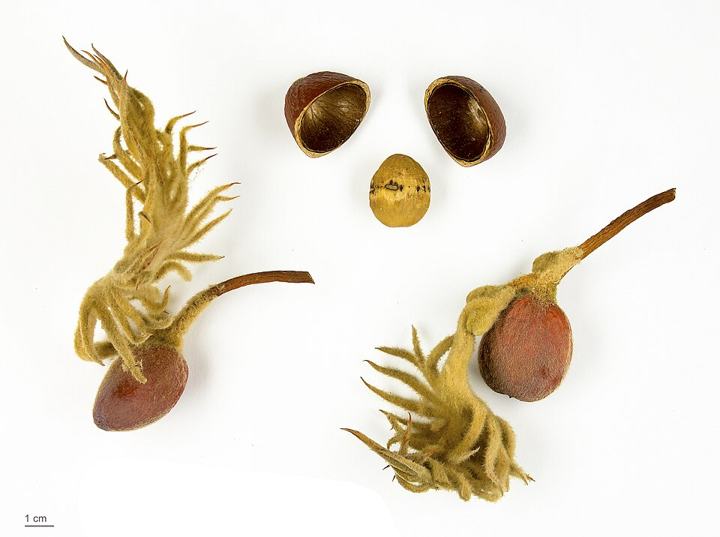
From Wikipedia
Cycas revoluta (Sotetsu [Japanese ソテツ], sago cycad, sago palm, king sago, Japanese sago palm) is a species of gymnosperm in the family Cycadaceae, native to southern Japan including the Ryukyu Islands. It is one of several species used for the production of sago, as well as an ornamental plant. The sago cycad can be distinguished by a thick coat of fibers on its trunk. The sago cycad is sometimes mistakenly thought to be a palm, although the only similarity between the two is that they look similar and both produce seeds.
Text from Wikipedia, CC BY-SA 4.0: Cycas revoluta
Description
A dioecious plant from Japan, 2–3 m tall, with a straight, cylindrical trunk covered by persistent leaf bases and topped by a crown of pinnate leaves, giving it a palm-like appearance. Leaves up to 1.5 m long and 20–25 cm wide, dark green, with numerous linear-lanceolate leaflets about 10–20 cm long, leathery and pointed. Male cones terminal, ovoid, thick, up to 40–50 cm long, chestnut brown. Female "inflorescences" consist of spreading whitish-brown leaves arising from the tip of the trunk, with the ovules along their margins; these give rise to large, oval, orange-red seeds. It is dioecious.
Propagation and growing
A slow-growing plant, propagated by seed or by dividing the offshoots that sprout at the base of the plant. It is very widespread in the Canary Islands; it needs a sunny position and relatively moist soil, so moderate watering is recommended.
Garden use
Widely used as a houseplant and in gardening. Ideal for patios. A plant typical of parks and gardens, but it can be grown in pots. It needs regular watering and well-drained woodland soil. Its high ornamental value makes it a much sought-after species in gardening. Its elegant habit gives it great aesthetic value, so it can be planted as a specimen or in groups, even alongside various palm species. It is ideal for all kinds of gardens, even road junctions and roundabouts. It is a tough species that needs moderate watering and can reach up to 3 m in height. The main maintenance task is pruning off the fronds or leaves once they have lost their vigour.
Notes
Also used for bonsai.
Source: Cabildo de Tenerife, “Guía de especies vegetales”, CC BY. Translated from Spanish by us.
Bioclimatic belts
Warm coastal belt
- Inframediterranean, hyperarid
- Inframediterranean, arid
- Inframediterranean, semi-arid (lower level)
- Inframediterranean, semi-arid (upper level)
- Inframediterranean, dry, without trade-wind fog
- Inframediterranean, dry, with trade-wind fog
Warm mid-slope belt
- Thermomediterranean, semi-arid (lower level)
- Thermomediterranean, semi-arid (upper level), without trade-wind fog
- Thermomediterranean, semi-arid (upper level), with trade-wind fog
- Thermomediterranean, dry, with trade-wind fog
- Thermomediterranean, dry (lower level), without trade-wind fog
- Thermomediterranean, subhumid, with trade-wind fog
- Thermomediterranean, dry (upper level), without trade-wind fog