
Dragon tree
Dracaena draco (L.) L. · Family: Agavaceae
Cliffs and coastal crags, and steep mid-elevation slopes. Typical of thermophilous woodland.
Where it grows on Tenerife
Grows in: South coast · North coast · South, 300–1000 m · North, 300–1000 m
Zones are derived approximately from the Cabildo belts.
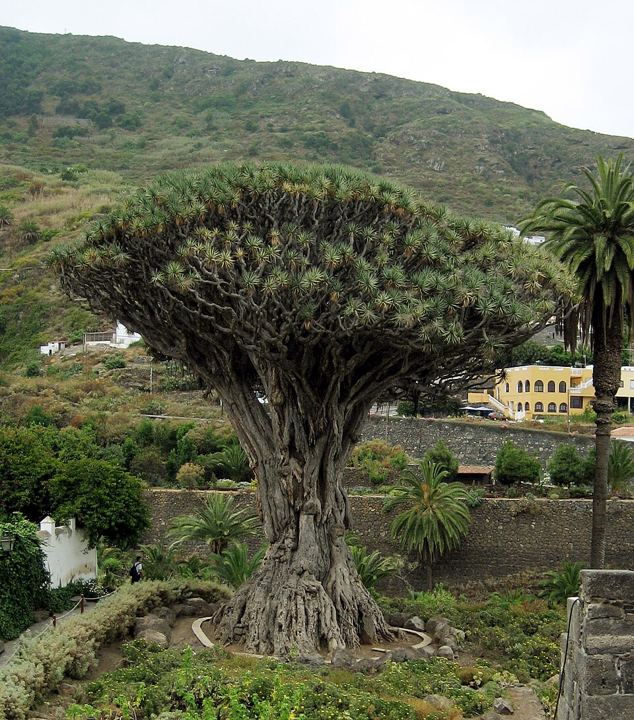
Photos
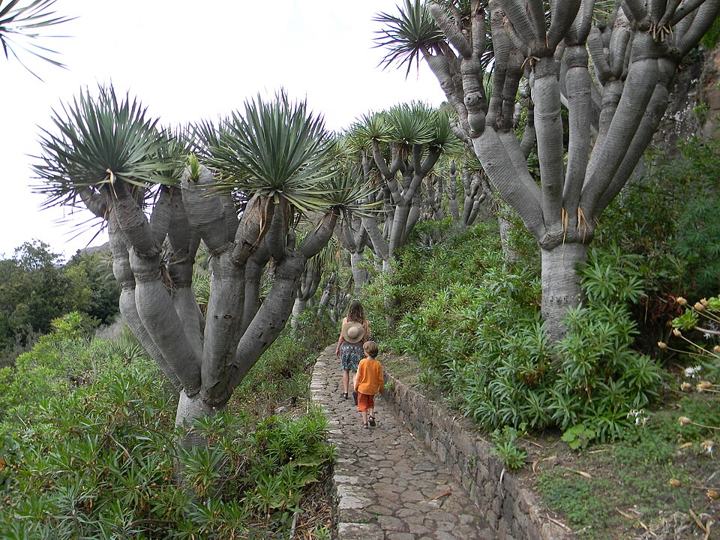
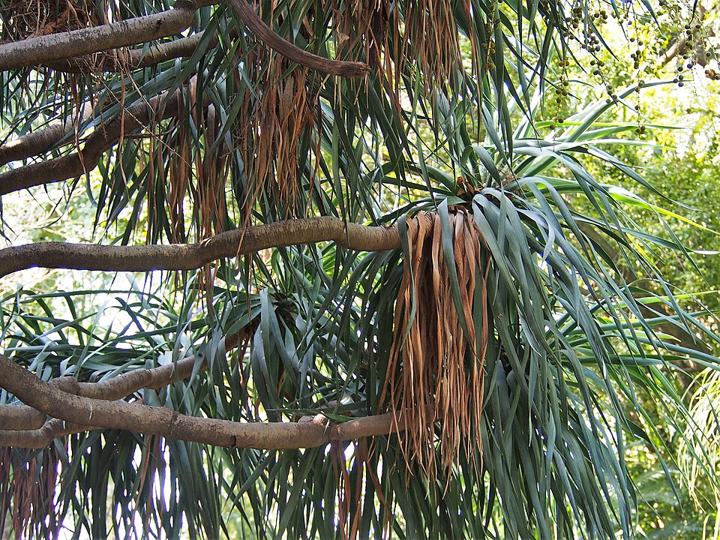
From Wikipedia
Dracaena draco, the Canary Islands dragon tree or drago, is a subtropical tree in the genus Dracaena, native to the Macaronesia archipelago (the Canary Islands, Cape Verde, and Madeira; possibly introduced in the Azores) and northwestern mainland Africa.
It was first described by Carl Linnaeus in 1762 as Asparagus draco. In 1767 he assigned it to the new genus, Dracaena.
Text from Wikipedia, CC BY-SA 4.0: Dracaena draco
Description
A tree that can reach up to 20 m in height, with a silvery-grey trunk branching dichotomously at a certain height to form a dense crown. Leaves sword-shaped, glaucous, leathery, reddish at the base, arising in dense rosettes at the branch tips. Inflorescences paniculate and terminal. Tepals greenish-white. Fruits globose, orange-red. Flowers in spring–summer.
Propagation and growing
Its edible fruits contain a seed that germinates quickly, producing vigorous, hardy seedlings that grow without any difficulty, are highly resistant to lack of moisture and need very little care; for this reason it is usually available in most nurseries. The plants grow slowly, but because of their powerful root system it does not matter much if they have been kept in a container for several years. It is also a species that is very undemanding as to soil type, which makes it suitable for landscaping on any ground. It prefers a mild climate, a sunny position, sandy loam soils and neutral pH (J.C.Delgado, 1986). Slow-growing. Propagation by seed, air layering or cuttings. It needs deep, well-drained soils in sunny situations, although it tolerates partial shade.
Garden use
The dragon tree is widely grown for its beauty and uniqueness, as well as its adaptability to climate and soil. It is used as single specimens and in groups, and in combination with other species of the thermophilous woodland. It does not tolerate low temperatures well, so planting above 900 m above sea level is not recommended, nor in direct exposure to salt spray (maresía). A very hardy and easily grown species; together with the Canary Island date palm it is among the most popular choices in gardening. It is not demanding as to soil and water, although a few initial waterings after planting are recommended. It copes very well with changes in weather; it tolerates cold well and resists certain pests and diseases well. It is very commonly used in parks, gardens, squares, roundabouts and roadsides. It can be planted singly or in groups. Cleaning out the crown from time to time is recommended. It can be transplanted provided suitable measures are taken, among which protecting the bark to avoid possible wounds should be mentioned; even so, wounds heal more or less well. It is grown in parks and gardens on the islands and in other parts of the world. A mythological tree since antiquity, its reddish resin (dragon’s blood) was highly valued in the past for its medicinal properties.
Notes
Also found in the Azores, Madeira and Cape Verde. Another species, “D. tamaranae”, also of ornamental interest, has recently been discovered on Gran Canaria.
Protection status
On the Spanish List of Wild Species under Special Protection. Formerly in Annex III of the Canary Catalogue of Protected Species, moved to Annex IV (special protection) in 2014 (Decree 20/2014).
Potential vegetation
Junipero-Oleetum cerasiformis.
Source: Cabildo de Tenerife, “Guía de especies vegetales”, CC BY. Translated from Spanish by us.
Bioclimatic belts
Warm coastal belt
- Inframediterranean, semi-arid (lower level)
- Inframediterranean, semi-arid (upper level)
- Inframediterranean, dry, without trade-wind fog
- Inframediterranean, dry, with trade-wind fog
Warm mid-slope belt
- Thermomediterranean, semi-arid (lower level)
- Thermomediterranean, semi-arid (upper level), without trade-wind fog
- Thermomediterranean, semi-arid (upper level), with trade-wind fog
- Thermomediterranean, dry, with trade-wind fog
- Thermomediterranean, dry (lower level), without trade-wind fog
- Thermomediterranean, subhumid, with trade-wind fog
Districts
Anaga · Metropolitan area (Santa Cruz and La Laguna) · Acentejo · La Orotava Valley · Daute · Teno · South-west · Abona · South-east · Güímar Valley