
Green heath (tejo)
Erica scoparia platycodon Webb & Berthel. · Family: Ericaceae
Shares habitat with tree-heath woodland on ridges exposed to humid winds; abundant at the upper limit of the laurel forest.
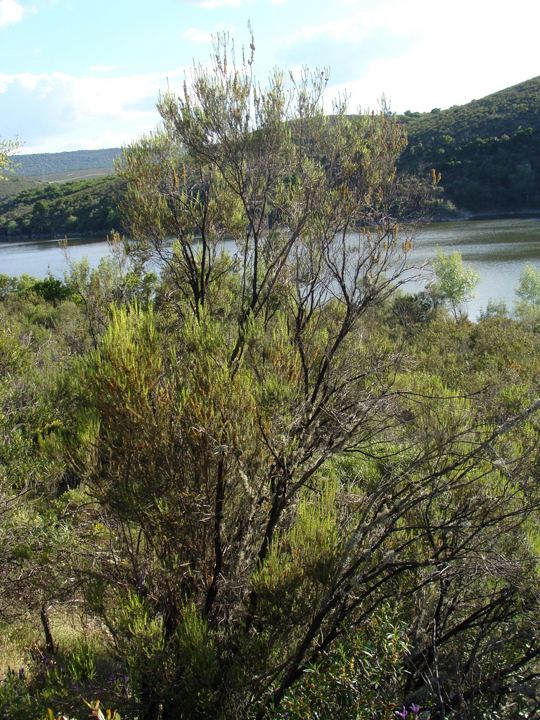
Photos
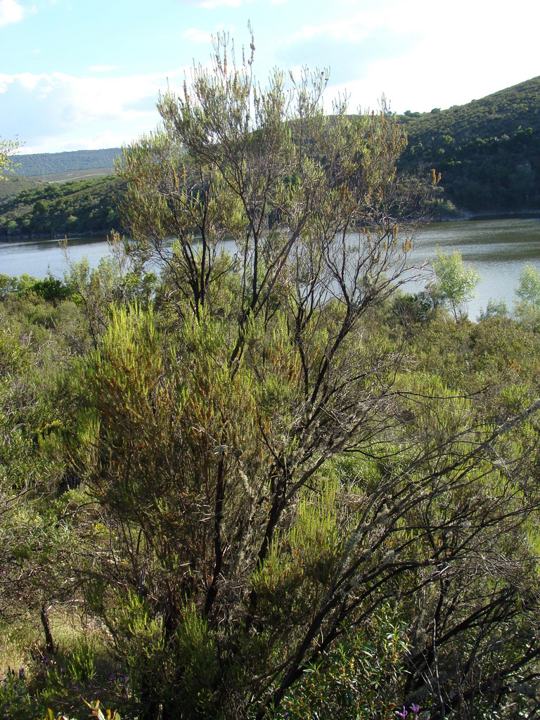
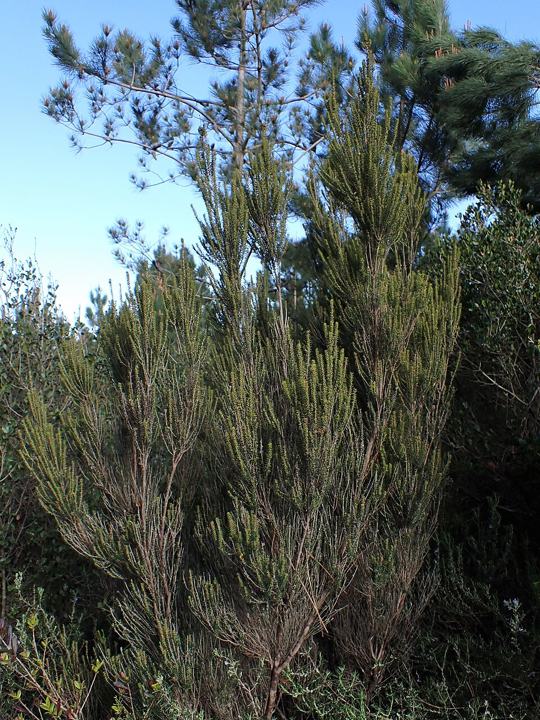
From Wikipedia
Erica scoparia, the green heather or common besom heath, is a shrubby European species of heath in the flowering plant family Ericaceae.
Text from Wikipedia, CC BY-SA 4.0: Erica scoparia
Description
A tall shrub or small tree up to 6 metres tall with evergreen leaves. The trunk is twisted and brown, with rough bark that peels off in long strips. It is easily confused with tree heath (brezo), but has a more compact and robust appearance. The leaves are very similar to those of brezo, somewhat larger, also linear, glossy dark green, arranged more regularly around the branches, forming a six-pointed star when seen from the branch tips, perpendicular and symmetrical to the twigs, and also harder to the touch than those of brezo. In addition, the young shoots of “tejo” are smooth and reddish, whereas those of brezo are whitish, thinner and hairy. The flowers and flowering are less showy than those of brezo, forming crowded lateral racemes, strong reddish-pink in colour, with a small bell-shaped tube. The fruit is a small dark brown capsule that opens on dry summer days.
Propagation and growing
It is propagated by cuttings, which root without difficulty, and by grafting. Cuttings of “tejo” are taken early in autumn; fairly long cuttings of 20 to 25 cm, taken from new growth with a section of old wood at the base. Propagation by seed is little used because of the variation in the offspring, the complicated dormancy requirements and the slow growth of the seedlings. If propagated by seed, the seed must be cleaned of its fleshy coat and stratified. Germination is slow. Seeds per gram: 15; germination rate: 40–60%. It grows equally well in acid and in calcareous soils.
Garden use
A species of great interest for ornamental use and for the use of its branches as rough brooms. It has a moderate to high water requirement and a medium need for hours of light. It grows best at mild to cool temperatures (23–17 ºC) and adapts well to soils without much organic matter but with plenty of moisture. Its root growth is small, so there is no need to fear any destructive capacity underground. It flowers between January and May. It should be fed with organic products once a year. Prune it regularly to give the desired shape; it lends itself to all kinds of pruning. Yellowing and drying of the leaves may be caused by other fungi which generally cause little damage and are therefore not treated; mealybug/scale is its most common pest.
Protection status
Annex III of the Order of 20 February 1991 on the protection of wild flora of the Canary Islands.
Potential vegetation
Brezales de crestería.
Source: Cabildo de Tenerife, “Guía de especies vegetales”, CC BY. Translated from Spanish by us.
Districts
Anaga