
Cockspur coral tree
Erythrina crista–galli L. · Family: Fabaceae
Warm climate; cannot take frost or strong wind and needs full sun. Moist, well-drained soil. Tolerates urban pollution.
Where it grows on Tenerife
Grows in: South coast · North coast · South, 300–1000 m · North, 300–1000 m
Zones are derived approximately from the Cabildo belts.
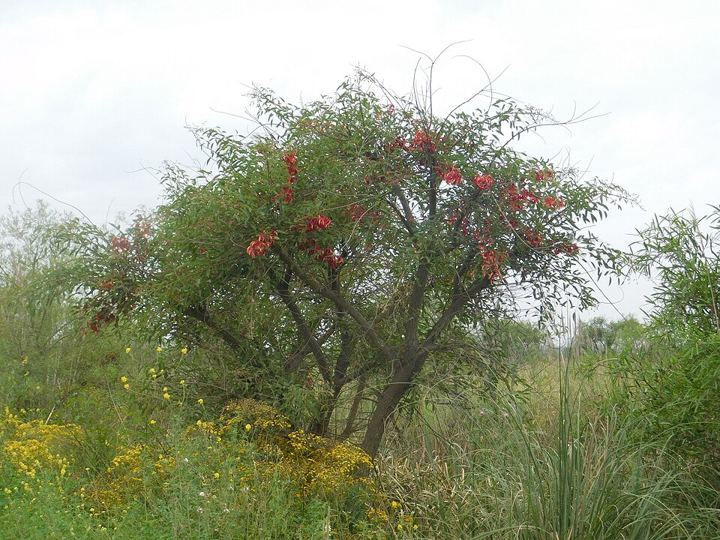
Photos
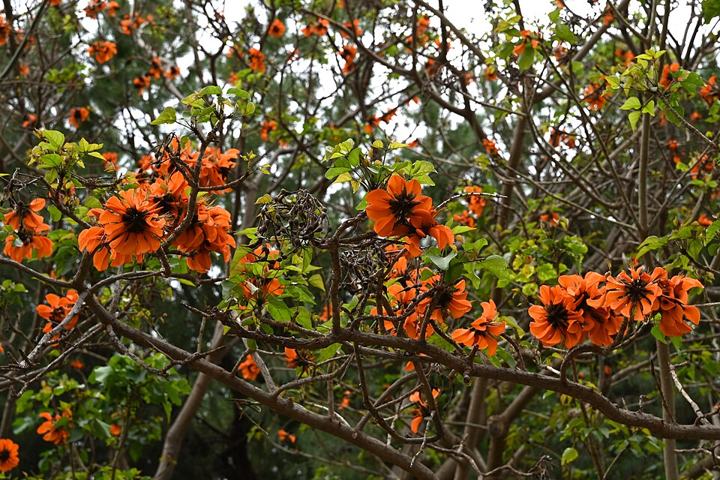
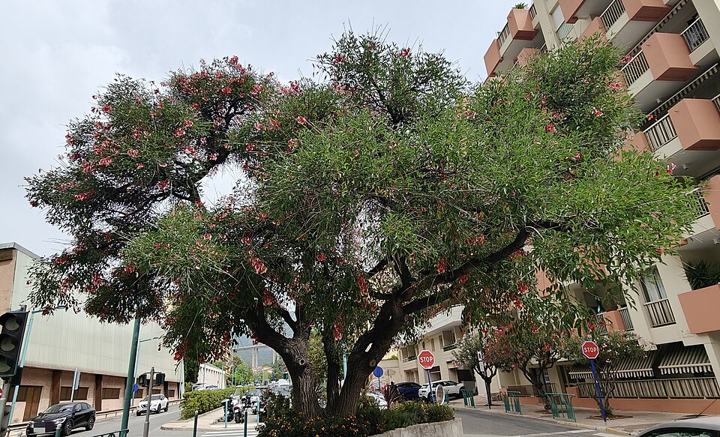
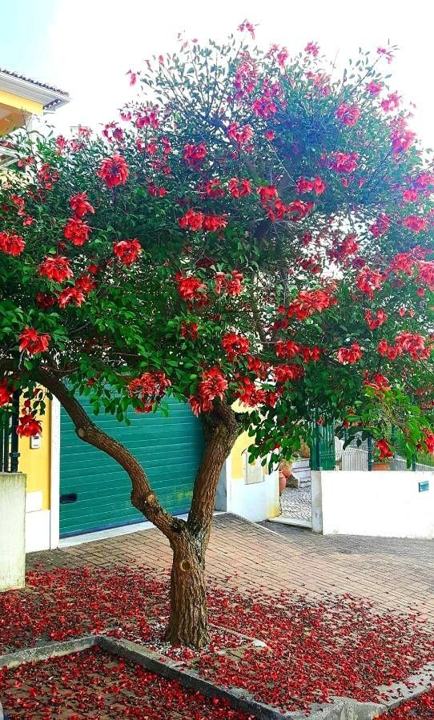
Description
A deciduous tree native to South America (Argentina, Uruguay, Paraguay and Brazil), which can reach 6–8 m in height but sometimes takes a shrubby form. Trunk twisted, bark rough and fissured. Leaves trifoliate, with lanceolate or oblong-lanceolate leaflets, entire, acuminate and hairless, dark green. The petioles, like the twigs, bear spines. Flowers red, solitary or in groups in terminal racemes, with very small wings and a keel with a nectar receptacle at the base, which somewhat resembles a cockscomb. The fruit is a woody brown pod. Flowers from spring to autumn.
Propagation and growing
Its seeds are easily obtained, as the fruit is a dehiscent pod. The seeds, blackish with brown spots, need a moist substrate to germinate, and it is relatively easy to grow. Fast-growing. Propagation by seed or cuttings.
Garden use
Its wood is weak and porous and can be used for carving and mouldings. Its flowers are very showy, making it suitable for gardens and green spaces in general. Although it withstands dry spells very well, it grows much better with abundant watering and prefers mid-altitude (medianías) conditions. Widely used in gardening for its beautiful flowering.
Notes
On Tenerife, and in the Canaries in general, other species of “Erythrina” are grown.
Source: Cabildo de Tenerife, “Guía de especies vegetales”, CC BY. Translated from Spanish by us.
Bioclimatic belts
Warm coastal belt
- Inframediterranean, hyperarid
- Inframediterranean, arid
- Inframediterranean, semi-arid (lower level)
- Inframediterranean, semi-arid (upper level)
- Inframediterranean, dry, without trade-wind fog
- Inframediterranean, dry, with trade-wind fog
Warm mid-slope belt
- Thermomediterranean, semi-arid (lower level)
- Thermomediterranean, semi-arid (upper level), without trade-wind fog
- Thermomediterranean, semi-arid (upper level), with trade-wind fog
- Thermomediterranean, dry, with trade-wind fog
- Thermomediterranean, dry (lower level), without trade-wind fog
- Thermomediterranean, subhumid, with trade-wind fog