
Red-flowering gum
Eucalyptus ficifolia F. J. Muell. · Family: Myratceae
Needs a sunny position. Resistant to cold, heat and drought. Prefers heavy soils and does less well in sandy ones.
Where it grows on Tenerife
Grows in: South coast · North coast · South, 300–1000 m · North, 300–1000 m
Zones are derived approximately from the Cabildo belts.
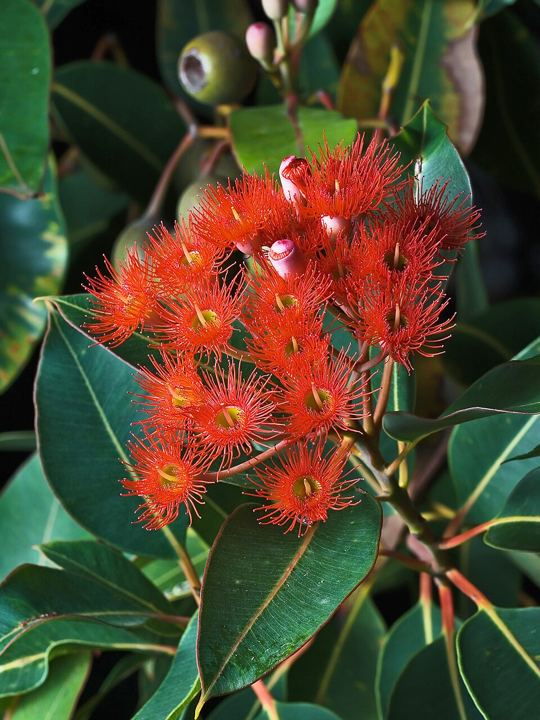
Photos
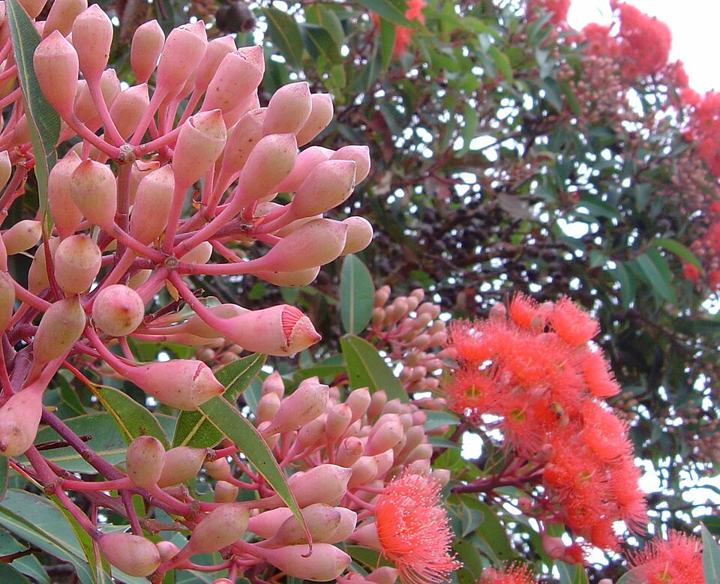
From Wikipedia
Corymbia ficifolia, commonly known as red flowering gum, is a species of small tree that is endemic to the south-west of Western Australia. It has rough, fibrous bark on the trunk and branches, egg-shaped to broadly lance-shape adult leaves, flower buds in groups of seven, bright red, pink or orange flowers and urn-shaped fruit. It has a restricted distribution in the wild but is one of the most commonly planted ornamental eucalypts.
Text from Wikipedia, CC BY-SA 4.0: Corymbia ficifolia
Description
An evergreen tree native to Western Australia, which can reach 9 m in height, with hard, slightly fibrous, light grey bark. Leaves ovate-lanceolate, up to 15 cm long, smooth and leathery. Flowers very decorative, bright red, borne in clusters of 3–7. Fruits urn-shaped, woody. Flowers from spring to autumn.
Propagation and growing
Its seeds are winged; it reproduces easily and is fast-growing. It needs sunny positions and moderate watering. Propagation by seed.
Garden use
The wood is pale yellow, heavy, strong and durable. It is grown as an ornamental tree. It takes pruning and needs little maintenance. It is suitable for parks and gardens, above all because of its attractive intense red flowers. It is a species that sheds leaves, so it can create litter that should be removed. Because of its spectacular flowering it is recommended as a street tree and for parks and gardens.
Notes
Until recently it was a relatively rare tree on Tenerife. The specimen on the Tejina road became famous. Today its use is much more widespread; for example, the trees on the Guajara university campus are spectacular.
Source: Cabildo de Tenerife, “Guía de especies vegetales”, CC BY. Translated from Spanish by us.
Bioclimatic belts
Warm coastal belt
- Inframediterranean, hyperarid
- Inframediterranean, arid
- Inframediterranean, semi-arid (lower level)
- Inframediterranean, semi-arid (upper level)
- Inframediterranean, dry, without trade-wind fog
- Inframediterranean, dry, with trade-wind fog
Warm mid-slope belt
- Thermomediterranean, semi-arid (lower level)
- Thermomediterranean, semi-arid (upper level), without trade-wind fog
- Thermomediterranean, semi-arid (upper level), with trade-wind fog
- Thermomediterranean, dry, with trade-wind fog
- Thermomediterranean, dry (lower level), without trade-wind fog
- Thermomediterranean, subhumid, with trade-wind fog