
Tolda (Euphorbia aphylla)
Euphorbia aphylla Brouss. ex Willd. · Family: Euphorbiaceae
A salt-loving species of rocks and stony slopes near the sea in the north-west of the island.
Where it grows on Tenerife
Grows in: South coast · North coast
Zones are derived approximately from the Cabildo belts.
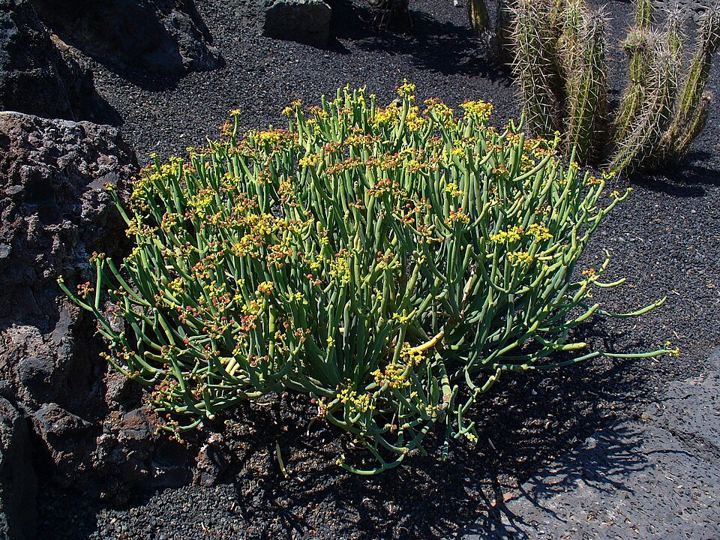
Photos
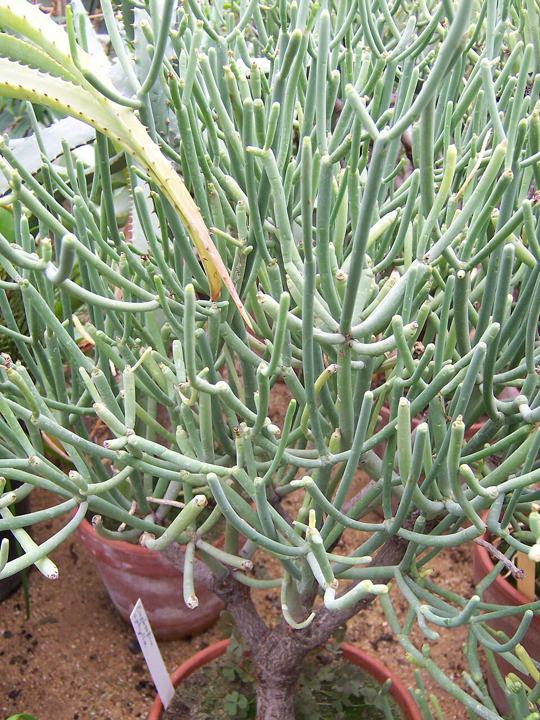
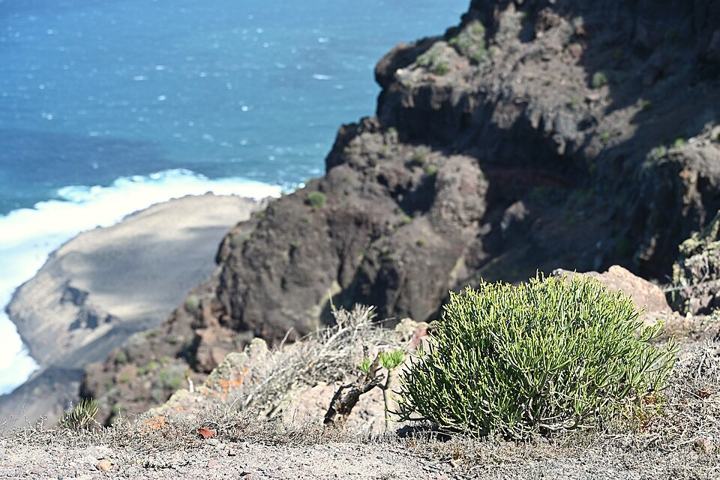
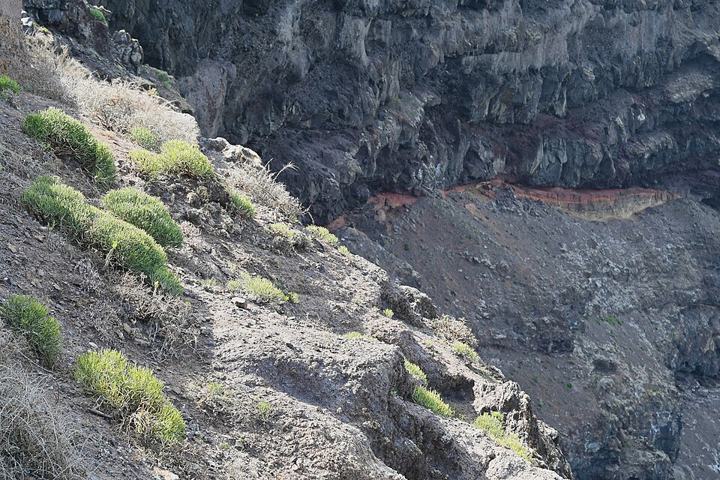
From Wikipedia
Euphorbia aphylla is a species of flowering plant in the family Euphorbiaceae. It is native to the Canary Islands. It was first described in 1809.
Text from Wikipedia, CC BY-SA 4.0: Euphorbia aphylla
Description
Succulent shrub up to 80 cm tall, with a short, thick trunk; stems and branches segmented, slender, leafless, cylindrical, fleshy, with latex, glaucous green. Flowers small, yellow, borne at the tips of the stems. Flowering…
Propagation and growing
The fruits of the tolda are small tricoccous capsules containing three tiny seeds that germinate easily but are difficult to collect because of their size. Perhaps for this reason, and because it propagates so readily by vegetative means, it is usually multiplied by cuttings, which are planted once the poisonous latex has sealed the wound. The cuttings take easily and the plants grow slowly at first, then quite quickly. It is undemanding as to soil, needing full sun, little water and plenty of heat. Its use as an ornamental is spreading, which means it is available in many nurseries.
Garden use
The distinctive feature of the tolda is its complete lack of leaves, which, together with its candelabra-like habit, gives it a strange and attractive appearance. In the wild, on our island it grows only in the northern parts of the Teno Massif…
Notes
It hybridises with "E. atropurpurea" fma. "lutea", with "E. bourgeauana" and with "E. obtusifolia" subsp. "regis-jubae".
Protection status
Annex II of the Order of 20 February 1991 on the protection of wild flora of the Canary Islands.
Potential vegetation
Periploco-Euphorbietum canariensis; Ceropegio dichotomae-Euphorbietum aphyllae.
Source: Cabildo de Tenerife, “Guía de especies vegetales”, CC BY. Translated from Spanish by us.
Bioclimatic belts
Warm coastal belt
- Inframediterranean, semi-arid (lower level)
Districts
Daute · Teno