
Purple spurge (Euphorbia atropurpurea)
Euphorbia atropurpurea (Brouss.) Webb & Berthel. · Family: Euphorbiaceae
Dry sunny rocky slopes, ledges and foothills in the west of the island and the Güímar valley, 200–1,200 m.
Where it grows on Tenerife
Grows in: South coast · North coast · South, 300–1000 m · Above 1000 m
Zones are derived approximately from the Cabildo belts.
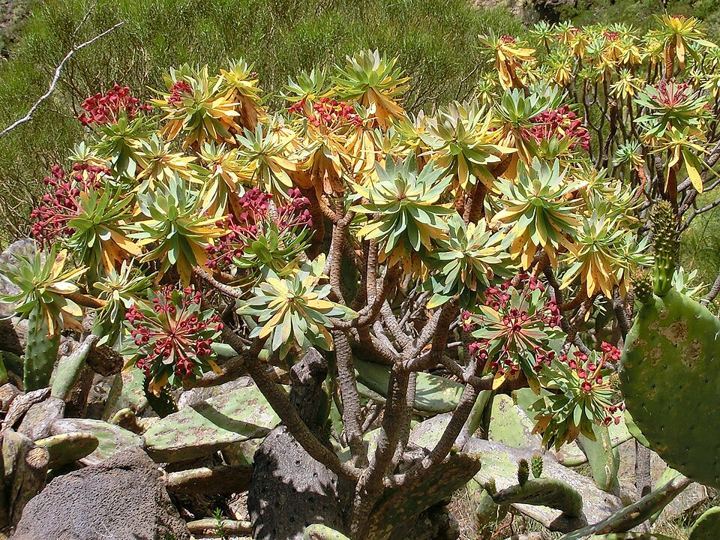
Photos
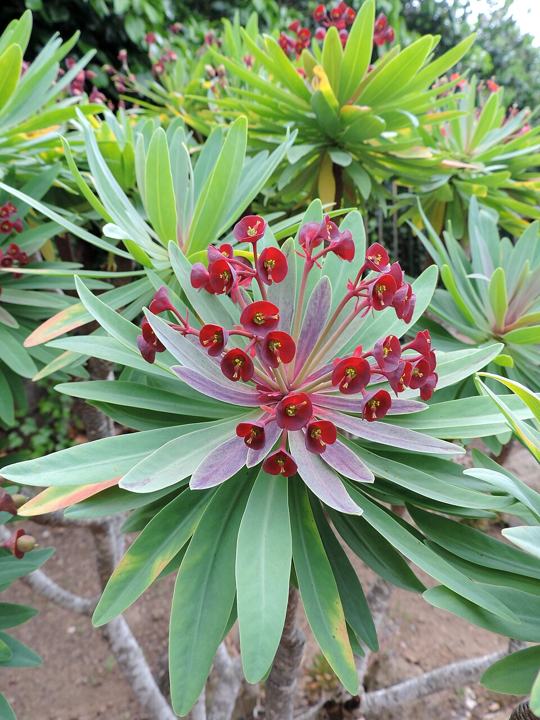
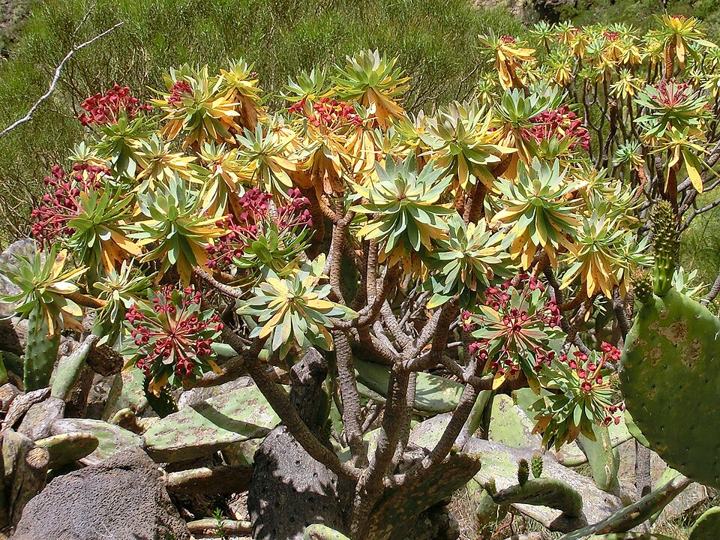
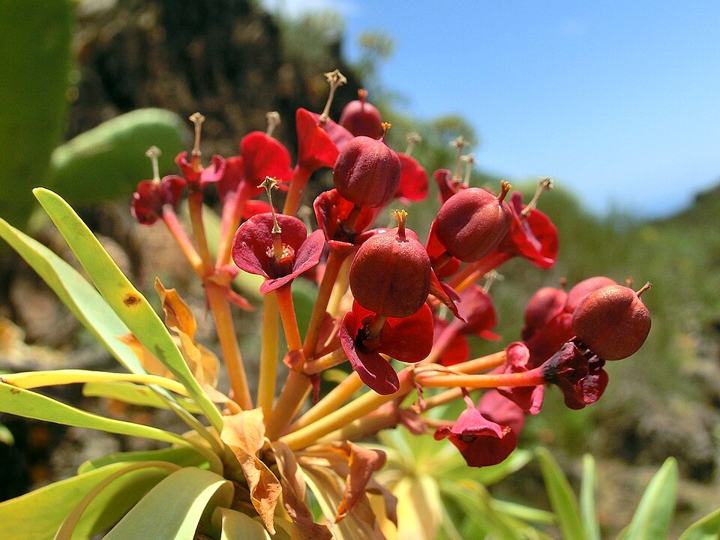
From Wikipedia
Euphorbia atropurpurea, called tabaiba majorera or tabaiba roja in Spanish, is a shrub in the family Euphorbiaceae native to Tenerife in the Canary Islands. It can reach 2 metres in height, and grows in ravines, and on slopes and terraces.
The plant grows best in humid conditions in mid to low altitudes (300-1,200 m) on the south and west parts of the island. It is plentiful in the towns of Teno, Santiago del Teide, and the slope of Güímar.
The shrub can reach over 2 m with succulent brown stems and branches without spines. It has large bluish green leaves, which form a rosette at the end of the branches. The plant flowers from winter to spring (December to May). The flowers have dark red bracts greater than 1 cm in size. These bracts lend the plant its name, atropurpurea (from the Latin ater or "black", and purple). It should not be confused with E. bravoana, which is endemic to the nearby island of La Gomera and also has purple-red bracts. The fruit is a red capsule with three dark brown seeds.
Like other plants in the genus Euphorbia, it produces a toxic white latex if cut.
E. atropurpurea is used as an ornamental plant in gardens for its eye-catching appearance and flowers. It requires little care, but requires sunlight and a certain amount of environmental humidity. It generally spreads by seeds, or more rarely by simply branching out. As most other succulent members of the genus Euphorbia, its trade is regulated under Appendix II of CITES.
In the area of Masca, in Tenerife, hybrids between E. atropurpurea and Euphorbia regis-jubae occur, which the Swedish botanist Eric Ragnor Sventenius named Euphorbia navae in honour of Alonso de Nava y Grimón, founder of the Botanical Garden of La Orotava.
Text from Wikipedia, CC BY-SA 4.0: Euphorbia atropurpurea
Description
Succulent, latex-bearing shrub up to 1.30 m tall, with brown stems and branches. Leaves clustered in terminal rosettes, oval, glaucous green. Umbel-like inflorescences very showy, red-purple. Fruits dark red to brown. Flowers in winter–spring.
Propagation and growing
The fruits of this shrub are tricoccous capsules that burst on hot summer days, forcefully expelling the three seeds they contain to disperse them; it is therefore advisable to collect the fruits before this happens and place them in a covered container in the heat of the sun. The seeds obtained in this way germinate easily, giving vigorous plants that develop without difficulty. They are undemanding as to soil and do best in full sun to avoid etiolation (elongation of the stems). They need moderate to little watering and grow fast, reaching half a metre in height after a year in a container. It is not usually available in native-plant nurseries, and its cultivation should be ordered at least a year in advance.
Garden use
This beautiful tabaiba, with blue-green leaves and striking red-purple flowers from December to May, can reach up to two metres in height. Its aesthetic quality is excellent. Apart from the scientific interest of the endemics of this genus in the Canaries, E. atropurpurea could be an excellent garden plant in temperate regions (A. Bañares B. 1996). It grows naturally on sunny stony and rocky ground between 200 and 1,200 m above sea level and is suitable for landscaping of all kinds within that altitude range. It needs hardly any maintenance or watering.
Notes
Endemic to the island of Tenerife, where two varieties are recognised: var. "atropurpurea" and var. "modesta" (Tejina valley in Guía, 500–800 m above sea level). It hybridises with "E. obtusifolia" subsp. "regis-jubae" and with "E. aphylla". Like almost all…
Protection status
Annex II of the Order of 20 February 1991 on the protection of wild flora of the Canary Islands.
Potential vegetation
Junipero-Oleetum cerasiformis; Euphorbietum atropurpurae.
Source: Cabildo de Tenerife, “Guía de especies vegetales”, CC BY. Translated from Spanish by us.
Bioclimatic belts
Warm coastal belt
- Inframediterranean, semi-arid (upper level)
- Inframediterranean, dry, without trade-wind fog
Warm mid-slope belt
- Thermomediterranean, semi-arid (lower level)
- Thermomediterranean, semi-arid (upper level), without trade-wind fog
- Thermomediterranean, dry (lower level), without trade-wind fog
Temperate belt of laurel and pine forest
- Mesomediterranean, lower, semi-arid (upper level), without trade-wind fog
Districts
Teno · South-west · Güímar Valley