
Sweet spurge (tabaiba dulce)
Euphorbia balsamifera Aiton · Family: Euphorbiaceae
Stony slopes, lava fields and coastal cliffs in the most arid parts of the southern slope; also in warm spots on the north coast.
Where it grows on Tenerife
Grows in: South coast · North coast
Zones are derived approximately from the Cabildo belts.
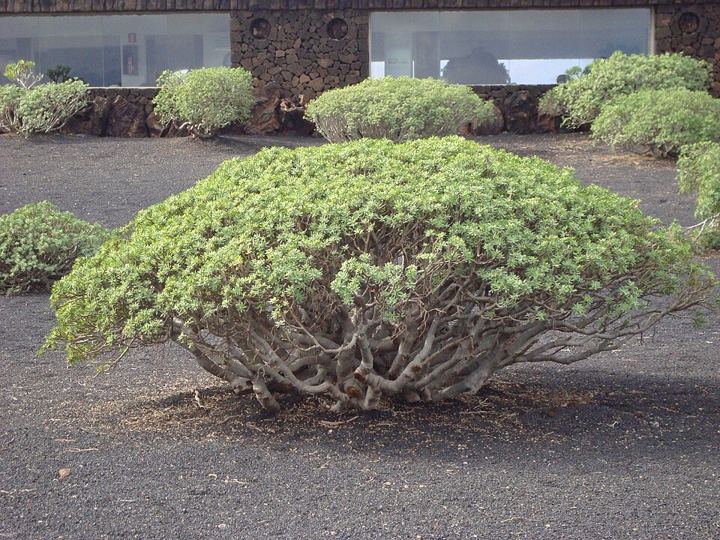
Photos
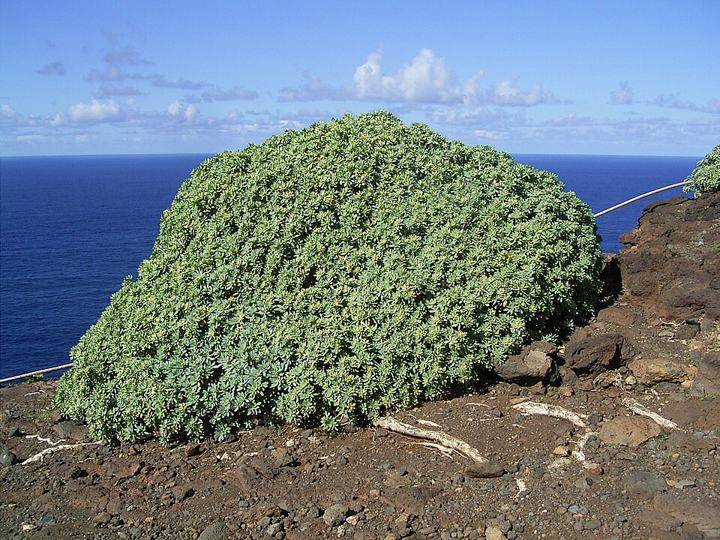
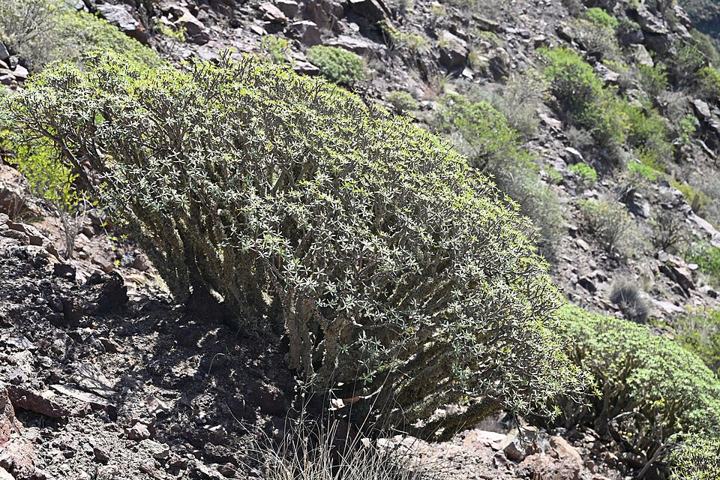
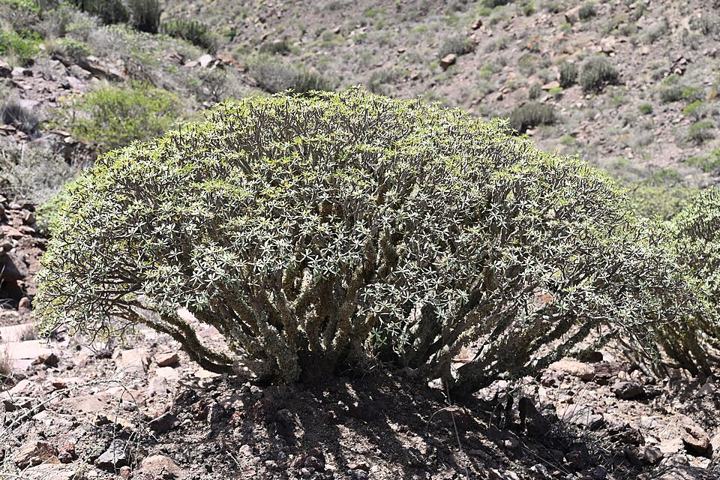
From Wikipedia
Euphorbia balsamifera (balsam spurge) is a flowering plant in the spurge family Euphorbiaceae. It is distributed in the Canary Islands and the western Sahara. It is the vegetable symbol of the island of Lanzarote. Euphorbia adenensis has been treated as a subspecies of this species.
Text from Wikipedia, CC BY-SA 4.0: Euphorbia balsamifera
Description
Succulent, latex-bearing shrub up to 2 m tall, although in wind-swept coastal sites the plants are low, with branches spreading along the ground. Stems knotty, greyish; crown rounded. Leaves in rosettes at the branch tips, oblong-spatulate, light green to glaucous, 2–3.5 cm long. Flowers small, greenish, in solitary terminal inflorescences. Fruits spherical, reddish. Flowers in winter–spring.
Propagation and growing
This shrub with succulent stems produces the fruits typical of all the spurge family: tricoccous capsules with three seeds that are forcefully expelled when the capsule bursts on hot days; they must therefore be collected before this happens and exposed to the heat of the sun in a closed container so that the seeds can be gathered, which will germinate without difficulty. The plants are hardy and vigorous but need warm climates, very sunny positions and well-drained soils, as they are affected by cold and excess moisture. It can also easily be propagated by cuttings left to dry beforehand so that the wound heals, in summer or in sufficiently warm places. Growth is slow and it takes several years to reach half a metre in height. It is usually available in native-plant nurseries.
Garden use
This globe-shaped tabaiba can reach up to three metres in height, and although its flowering is not very showy, its overall appearance is very beautiful. In summer it loses almost all its foliage, but this highlights its thick, twisted and widely branched succulent stems, giving it a special appeal at this time of year. It has great conservation value and its use in restoring tabaibal and cardonal scrub is essential. It is highly suitable for landscaping of all kinds that recreates dry habitats below 500 m above sea level. It needs no watering or maintenance and is very drought-resistant; moreover, it is the only one of our tabaibas whose latex is not toxic.
Notes
It is the plant symbol of the island of Lanzarote and is found on all the islands of the archipelago and also in North Africa.
Protection status
Annex II of the Order of 20 February 1991 on the protection of wild flora of the Canary Islands.
Potential vegetation
Ceropegio fuscae-Euphorbietum balsamiferae; Periploco-Euphorbietum canariensis subas. euphorbietosum balsamiferae.
Source: Cabildo de Tenerife, “Guía de especies vegetales”, CC BY. Translated from Spanish by us.
Bioclimatic belts
Warm coastal belt
- Inframediterranean, hyperarid
- Inframediterranean, arid
- Inframediterranean, semi-arid (lower level)
Districts
Anaga · Metropolitan area (Santa Cruz and La Laguna) · Acentejo · La Orotava Valley · Daute · Teno · South-west · Abona · South-east · Güímar Valley