
Canary Island spurge (cardón)
Euphorbia canariensis L. · Family: Euphorbiaceae
Common in dry sunny places of the lowlands: rocky slopes, cliffs and lava fields. Does not cope well with humid air.
Where it grows on Tenerife
Grows in: South coast · North coast · South, 300–1000 m · Above 1000 m
Zones are derived approximately from the Cabildo belts.
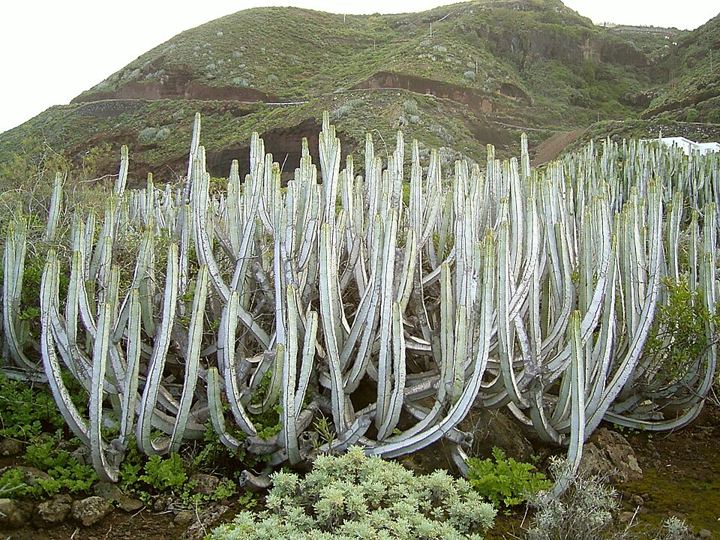
Photos
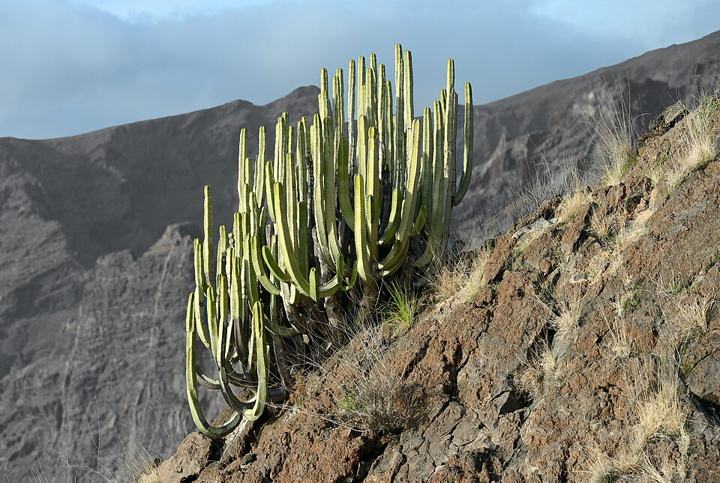
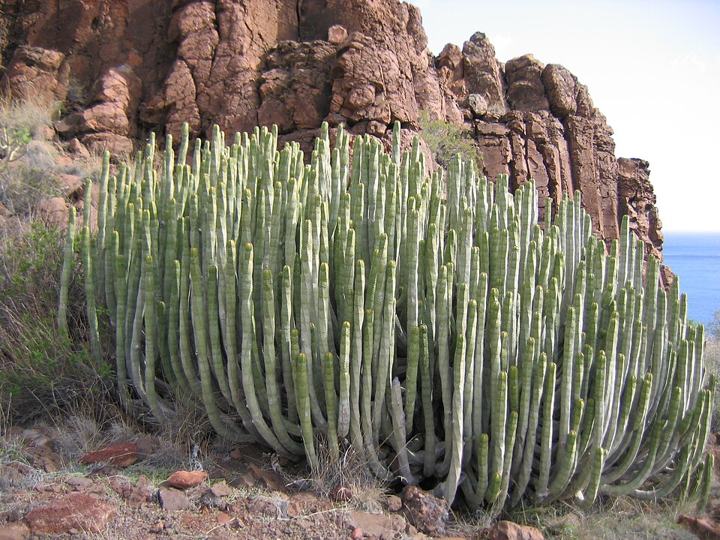
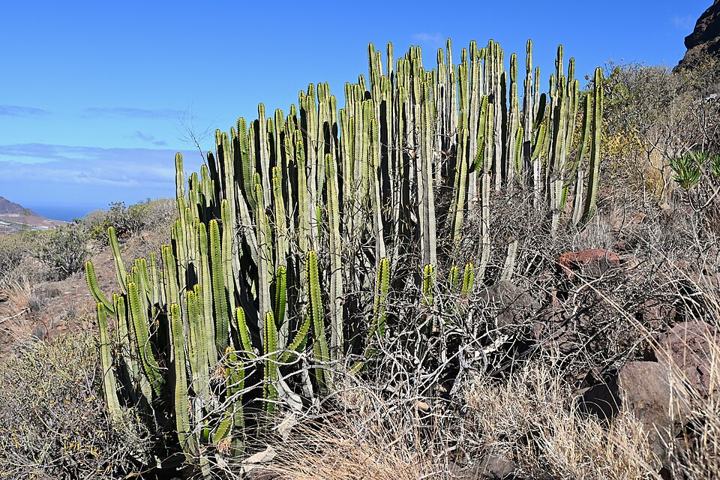
From Wikipedia
Euphorbia canariensis, commonly known as the Canary Island spurge, Hercules club or in Spanish cardón, is a succulent member of the genus Euphorbia and family Euphorbiaceae endemic to the Canary Islands. It is the plant symbol of the island of Gran Canaria.
Text from Wikipedia, CC BY-SA 4.0: Euphorbia canariensis
Description
Succulent shrub 2–4 m tall, with toxic latex, much-branched, cactus-like and candelabra-shaped, with four- or five-angled stems with spiny edges. Flowers reddish green and capsular fruits red or brown at the tips of the stems. Flowers in spring–summer.
Propagation and growing
The roots are thick and corky and may occasionally show above the substrate. In the wild, its root system spreads widely through the upper soil layers to capture moisture better, because of the low rainfall usual in its range. Mature specimens can cover a large area. It is propagated by seed; propagation by cuttings does not usually give good results. It tolerates urban conditions well. Available at the La Laguna nursery. The three-valved capsular fruits of this cactus-shaped shrub show that it belongs to the spurge family despite its appearance. Each fruit contains 3 seeds that are forcefully expelled on hot summer days, so the fruits must be collected before this happens and exposed to the heat of the sun in a closed container so that the seeds can be gathered, which will germinate without difficulty. Seedlings grow extremely slowly, taking several years to reach half a metre in height; for this reason it is usually propagated by cuttings, which must be left in the sun for a few days so that the wound heals. They will then root without difficulty, but should not be watered much to avoid rotting. Cultivation is simple, as the plant is undemanding as to soil and highly drought-resistant. It is usually available in nurseries, as it is widely used in local gardening.
Garden use
It is very decorative in gardens as a specimen plant, always in the sunniest spots. Once established in a suitable place it can survive almost without water, but it tolerates and even appreciates moderate watering and feeding. This candelabra-shaped shrub, reaching up to 3 m in height, flowers in spring–summer and produces showy reddish-brown fruits. The roots are thick and corky and may occasionally show above the substrate. In the wild, its root system spreads widely through the upper soil layers to capture moisture better, because of the low rainfall usual in its range. Mature specimens can cover a large area. It has enormous ornamental value for its original and beautiful appearance and for its drought resistance. Its forestry value is also high, as it is a species of great ecological importance: many other plant and animal species in its habitat use the shelter of its structure to grow. A most interesting species for restoring the degraded cardonal scrub of our island. It is very decorative in gardens as a specimen plant, always in the sunniest spots, and also on banks and raised or terraced ground. It tolerates urban conditions well and, once established in a suitable place, can survive almost without water, but it tolerates and even appreciates moderate watering and feeding.
Notes
No hybrids are known. Although collecting them is laborious, seeds are readily obtained. It is the plant symbol of the island of Gran Canaria. Its latex is highly poisonous.
Protection status
Annex II of the Order of 20 February 1991 on the protection of wild flora of the Canary Islands.
Potential vegetation
Habitat principal Periploco laevigatae-Euphorbietum canariensis. Además, interviene en Ceropegio dichotomae-Euphorbietum aphyllae y en Ceropegio fuscae-Euphorbietum balsamiferae.
Source: Cabildo de Tenerife, “Guía de especies vegetales”, CC BY. Translated from Spanish by us.
Bioclimatic belts
Warm coastal belt
- Inframediterranean, semi-arid (lower level)
- Inframediterranean, semi-arid (upper level)
- Inframediterranean, dry, without trade-wind fog
Warm mid-slope belt
- Thermomediterranean, semi-arid (lower level)
- Thermomediterranean, semi-arid (upper level), without trade-wind fog
- Thermomediterranean, dry (lower level), without trade-wind fog
Temperate belt of laurel and pine forest
- Mesomediterranean, lower, semi-arid (upper level), without trade-wind fog
Districts
Anaga · Metropolitan area (Santa Cruz and La Laguna) · Acentejo · La Orotava Valley · Daute · Teno · South-west · Abona · South-east · Güímar Valley