
Bitter spurge (tabaiba amarga)
Euphorbia obtusifolia Poir. in Link · Family: Euphorbiaceae
Very abundant on dry, stony ground of the low and middle zones, climbing sunny slopes above 1,000 m. Quickly colonises abandoned land.
Where it grows on Tenerife
Grows in: South coast · North coast · South, 300–1000 m
Zones are derived approximately from the Cabildo belts.
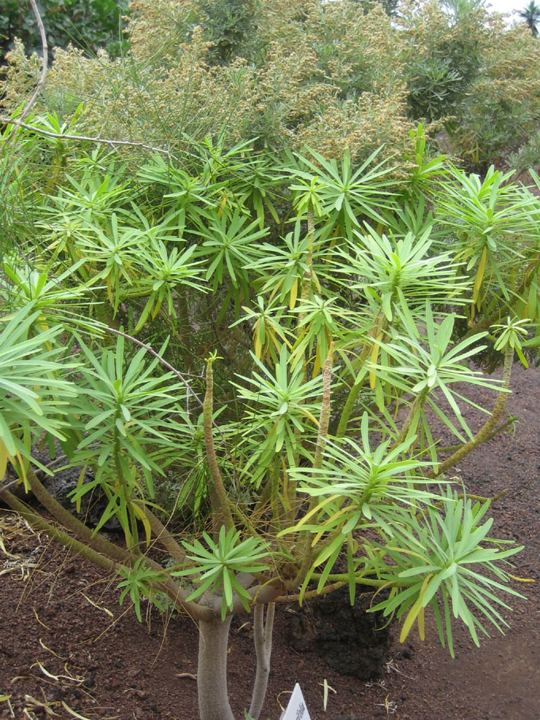
Photos
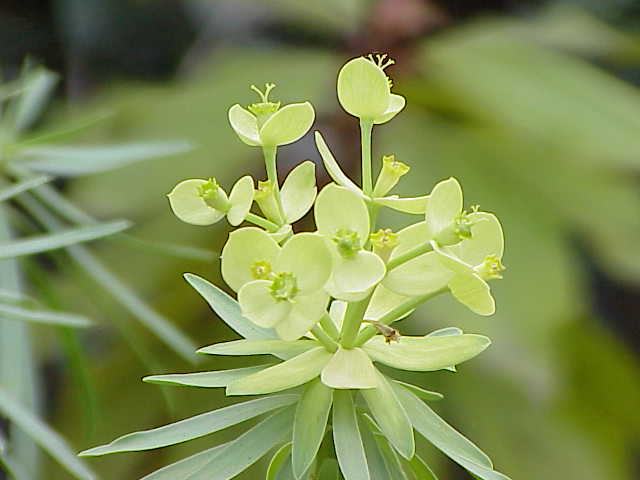
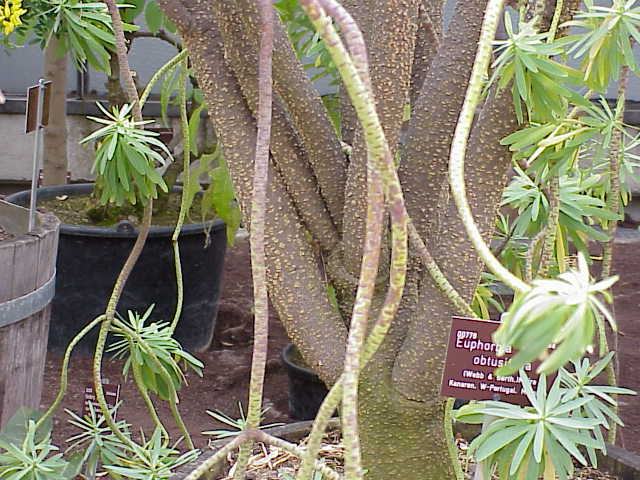
From Wikipedia
The scientific name Euphorbia obtusifolia has been used for at least three species of Euphorbia:
Euphorbia obtusifolia Lam. is a synonym of Euphorbia terracina L., native from Macaronesia through Hungary and the Mediterranean to the Arabian Peninsula
Euphorbia obtusifolia Poir. is an illegitimate name that has been applied to:
Euphorbia lamarckii Sweet – of which it is a synonym; native to the western Canary Islands (Tenerife, La Gomera, La Palma and El Hierro); also known by the synonym Euphorbia broussonetii
Euphorbia regis-jubae J.Gay – with which it has been confused; native to the eastern Canary Islands (Gran Canaria, Lanzarote and Fuerteventura), west Morocco and north-western Western Sahara
Text from Wikipedia, CC BY-SA 4.0: Euphorbia obtusifolia
Description
Succulent, latex-bearing shrub up to 2 m tall, with a thick trunk. Stems light brown and young branches pale green. Leaves narrowly oblong, 5–8 cm long, deep green. Inflorescences terminal, umbel-like, with small greenish-yellow flowers. Fruits light brown or reddish. Flowers in spring–summer. The fruits are small capsules (less than 1 cm in diameter), greenish at first and reddish when ripe.
Propagation and growing
The three-valved capsular fruits (tricoccous capsules) of this shrub must be collected before the seeds are expelled, as with the other spurges covered here, in order to obtain seeds that will germinate easily, giving vigorous plants with normal growth and development, undemanding as to soil and resistant to lack of moisture. After a year in a container the plant can reach half a metre in height. It is not usually available in nurseries. In its first year in cultivation it can reach a metre in height. Propagation by seed. Germination is helped by light mechanical scarification to remove the caruncle. The best germination rates are obtained at 21 °C. Sowing should be done in standard substrate with some picón (volcanic gravel). A plant for revegetating low-lying areas, ideal for poor soils. A very hardy, drought-resistant plant that needs no watering. Only a few supplementary waterings after planting would be advisable for good establishment.
Garden use
This tabaiba, up to two metres tall, thrives abundantly on disturbed ground and abandoned fields over a wide altitude range (10–1000 m above sea level). It is a very tough and aggressive plant. Of doubtful value as an ornamental, it has long been used in roadside landscaping. It needs no maintenance or watering. It can be found colonising abandoned farmland.
Notes
Its sticky latex is strongly corrosive and toxic. Two subspecies are recognised, "E. obtusifolia" subsp. "obtusifolia" and "E. obtusifolia" subsp. "regis-jubae", which other authors treat as separate species. At present the legitimate name…
Protection status
Not listed.
Potential vegetation
Ceropegio fuscae-Euphorbietum balsamiferae; Periploco laevigatae-Euphorbietum canariensis; Junipero canariensis-Oleetum cerasiformis.
Source: Cabildo de Tenerife, “Guía de especies vegetales”, CC BY. Translated from Spanish by us.
Bioclimatic belts
Warm coastal belt
- Inframediterranean, hyperarid
- Inframediterranean, arid
- Inframediterranean, semi-arid (lower level)
- Inframediterranean, semi-arid (upper level)
- Inframediterranean, dry, without trade-wind fog
Warm mid-slope belt
- Thermomediterranean, semi-arid (lower level)
- Thermomediterranean, semi-arid (upper level), without trade-wind fog
- Thermomediterranean, dry (lower level), without trade-wind fog
Districts
Anaga · Metropolitan area (Santa Cruz and La Laguna) · Acentejo · La Orotava Valley · Daute · Teno · South-west · Abona · South-east · Güímar Valley