
Poinsettia
Euphorbia pulcherrima Willd. ex Klotzsch · Family: Euphorbiaceae
Warm climate, tolerates dry spells. Needs strong light for colour but not direct sun. Accepts most soils, preferably fertile and well drained.
Where it grows on Tenerife
Grows in: South coast · North coast · South, 300–1000 m · North, 300–1000 m
Zones are derived approximately from the Cabildo belts.
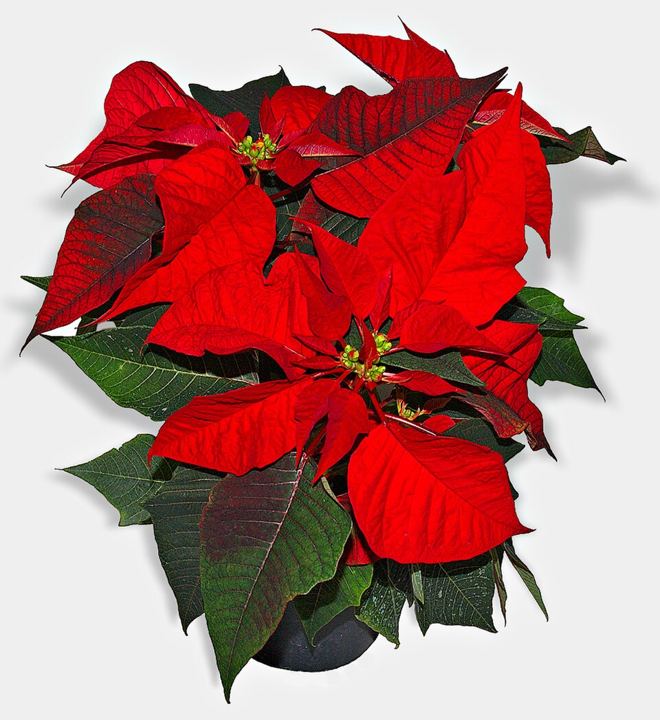
Photos
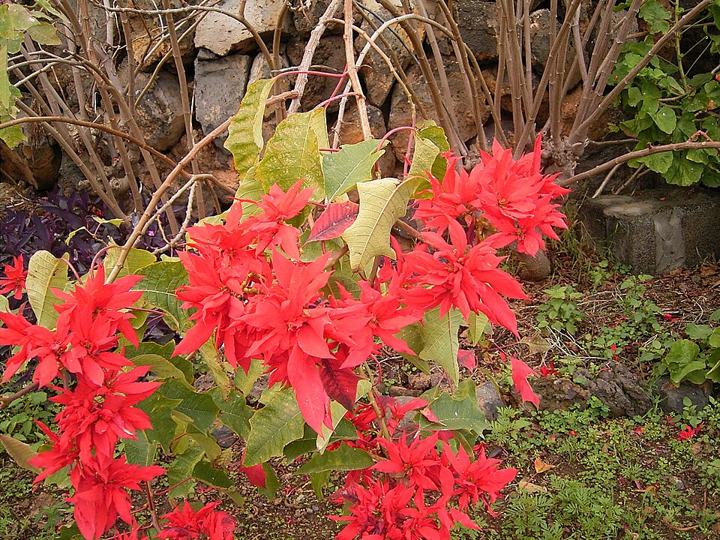
From Wikipedia
The poinsettia (; Euphorbia pulcherrima) is a commercially important flowering plant species of the diverse spurge family Euphorbiaceae. Indigenous to Mexico and Central America, the poinsettia was first described by Europeans in 1834. It is particularly well known for its red and green foliage and is widely used in Christmas floral displays. It derives its common English name from Joel Roberts Poinsett, the first United States minister to Mexico, who is credited with introducing the plant to the US in the 1820s; however, there have been recent efforts to rename the flower to its Nahuatl name, "cuetlaxōchitl", due to Poinsett's involvement in slavery and the Trail of Tears. Poinsettias are shrubs or small trees, with heights of 0.6 to 4 m (2.0 to 13.1 ft). Though often stated to be highly toxic, the poinsettia is not dangerous to pets or children. Exposure to the plant, even consumption, most often results in no effect, though it can cause nausea, vomiting, or diarrhea.
Wild poinsettias occur from Mexico to southern Guatemala, growing on mid-elevation, Pacific-facing slopes. One population in the Mexican state of Guerrero is much further inland, however, and is thought to be the ancestor of most cultivated populations. Wild poinsettia populations are highly fragmented, as their habitat is experiencing largely unregulated deforestation. They were cultivated by the Aztecs for use in traditional medicine. They became associated with the Christmas holiday and are popular seasonal decorations. Every year in the United States, approximately 70 million poinsettias of many cultivated varieties are sold in a six-week period. Many of these poinsettias are grown by Paul Ecke Ranch, which serves half the worldwide market and 70 percent of the US market.
Text from Wikipedia, CC BY-SA 4.0: Poinsettia
Description
Deciduous shrub, native to Mexico, which can reach 4 m in height. Leaves lanceolate or ovate-elliptic, with entire or lobed-sinuate margins. Green, with prominent paler veins. Flowers very small, borne in terminal cyathia surrounded by red lanceolate bracts, which can be as large as the leaves. Nectar glands yellow. There are various cultivars differing in colour (cream, yellow, red...) and in the shape of the bracts. Flowers in winter.
Propagation and growing
It is usually propagated by cuttings. There are numerous cultivars of different varieties, needing plenty of water and hard pruning after flowering. It prefers sites not overly exposed to excessive sun. It flowers from November. Its cultivation has become widespread in the archipelago. A moderately growing plant that needs a warm climate and is very sensitive to frost, as well as to draughts and wind.
Garden use
It is an ornamental species par excellence, widely used in green spaces and landscaped areas, both rural and urban. Nevertheless, it is not unusual to see plants growing semi-wild along road and track verges. Its main maintenance task is to ensure a certain level of soil moisture and to carry out the appropriate pruning after flowering. Commercially it is mostly used as a pot plant; growing it in gardens is less common. In the Islands it is not uncommon to find it as part of the roadside flora.
Notes
None.
Source: Cabildo de Tenerife, “Guía de especies vegetales”, CC BY. Translated from Spanish by us.
Bioclimatic belts
Warm coastal belt
- Inframediterranean, hyperarid
- Inframediterranean, arid
- Inframediterranean, semi-arid (lower level)
- Inframediterranean, semi-arid (upper level)
- Inframediterranean, dry, without trade-wind fog
- Inframediterranean, dry, with trade-wind fog
Warm mid-slope belt
- Thermomediterranean, semi-arid (lower level)
- Thermomediterranean, semi-arid (upper level), without trade-wind fog
- Thermomediterranean, semi-arid (upper level), with trade-wind fog
- Thermomediterranean, dry, with trade-wind fog
- Thermomediterranean, dry (lower level), without trade-wind fog
- Thermomediterranean, subhumid, with trade-wind fog