
Silky oak
Grevillea robusta A. Cunn. ex R. Br. · Family: Proteaceae
Prefers a warm climate in full sun or partial shade; flowers less without enough light. Tolerates most soils, the seaside, urban pollution, cold and drought.
Where it grows on Tenerife
Grows in: South coast · North coast · South, 300–1000 m · North, 300–1000 m · Above 1000 m
Zones are derived approximately from the Cabildo belts.
Photos
From Wikipedia
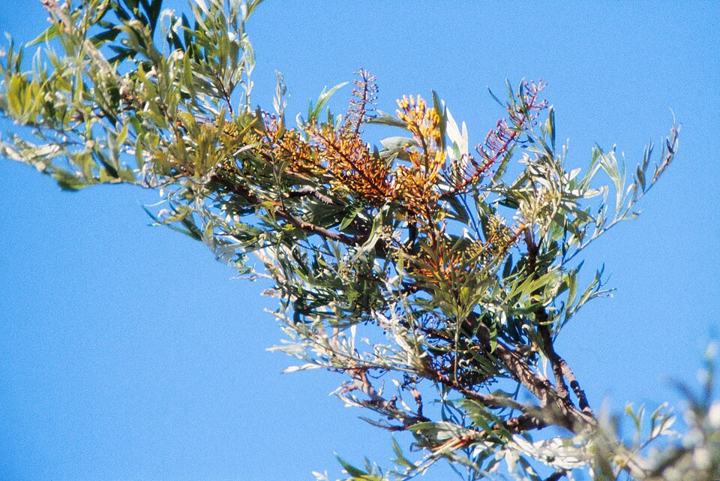
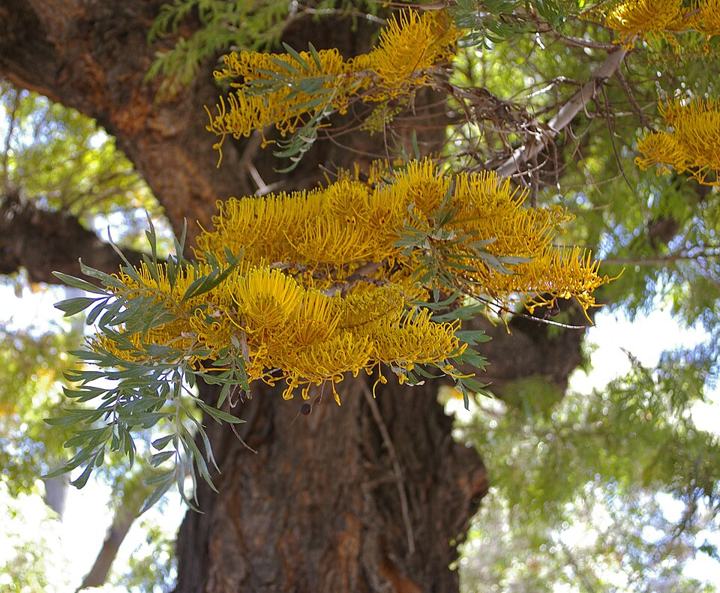
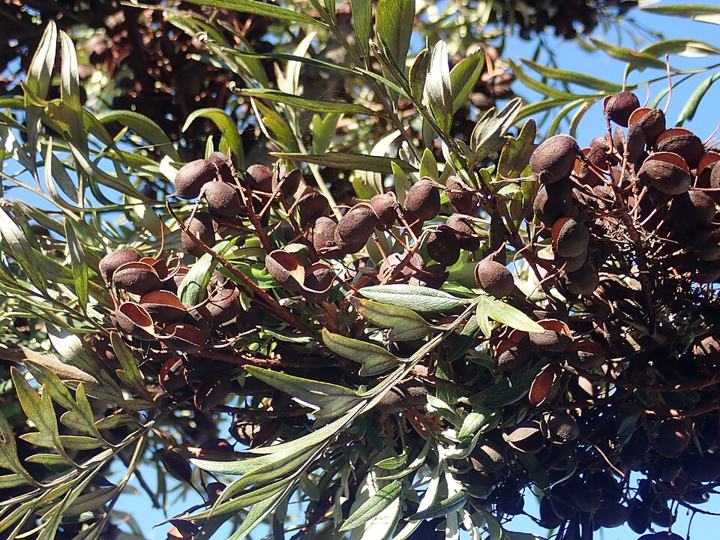
Grevillea robusta, commonly known as the southern silky oak, silk oak or silky oak, silver oak or Australian silver oak, is a species of flowering plant in the family Proteaceae and is endemic to eastern Australia. It is a tree with deeply dissected, divided leaves, golden yellow to orange flowers with red blotches and flattened, elliptic to oval fruit.
Text from Wikipedia, CC BY-SA 4.0: Grevillea robusta
Description
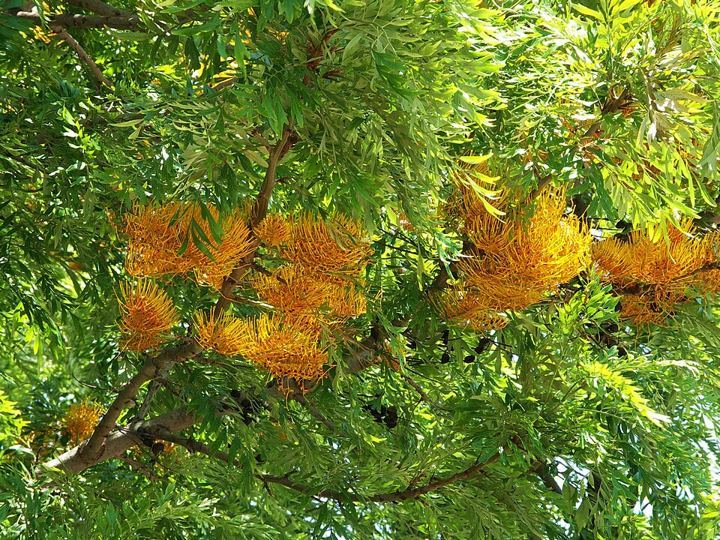
An evergreen or semi-deciduous tree native to eastern Australia, of large size, which can reach 50 m in the wild, although in cultivation it rarely exceeds 25 m. Crown pyramidal, with almost horizontal or slightly upward-angled branches. Bark dark grey, fissuring with age. Young twigs covered in hairs that give them a velvety look. Adult leaves petiolate and pinnately lobed, with some lobes themselves lobed. Upper surface dark green and underside silvery-tomentose, being covered in whitish hairs. Flowers very showy, golden yellow, in racemes up to 15 cm long. Flowers in spring–summer.
Propagation and growing
It is normally propagated by seed, which is winged. It is relatively easy to grow, although when young it needs plenty of water. It is fast-growing and needs sunny positions. It is a deciduous species, flowering and fruiting in April and May. Propagation by seed and cuttings.
Garden use
Because of its rapid growth (it can reach 30 metres in height) and its striking flowering, in golden-yellow spikes, it is recommended for gardening and is therefore seen in parks, gardens and green spaces. It can also be recommended for roadsides, roundabouts and junctions. It is not demanding in maintenance. An extremely decorative tree for both its flowers and its leaves, it is grown in parks and gardens and also as a street tree. It must be sheltered from wind, which could break the branches and spoil the symmetry of mature specimens. It accepts pruning and clipping to obtain a shrubby plant, although this must be done with some care.
Notes
Several other species of the genus are also grown as ornamentals on the islands.
Source: Cabildo de Tenerife, “Guía de especies vegetales”, CC BY. Translated from Spanish by us.
Bioclimatic belts
Warm coastal belt
- Inframediterranean, semi-arid (lower level)
- Inframediterranean, semi-arid (upper level)
- Inframediterranean, dry, without trade-wind fog
- Inframediterranean, dry, with trade-wind fog
Warm mid-slope belt
- Thermomediterranean, semi-arid (lower level)
- Thermomediterranean, semi-arid (upper level), without trade-wind fog
- Thermomediterranean, semi-arid (upper level), with trade-wind fog
- Thermomediterranean, dry, with trade-wind fog
- Thermomediterranean, dry (lower level), without trade-wind fog
- Thermomediterranean, subhumid, with trade-wind fog
- Thermomediterranean, dry (upper level), without trade-wind fog
- Thermomediterranean, humid, with trade-wind fog
Temperate belt of laurel and pine forest
- Mesomediterranean, lower, dry, with trade-wind fog
- Mesomediterranean, lower, dry, without trade-wind fog
- Mesomediterranean, lower, subhumid, with trade-wind fog
- Mesomediterranean, lower, subhumid, without trade-wind fog
- Mesomediterranean, lower, humid, with trade-wind fog