
Large-leaved St John's wort
Hypericum grandifolium Choisy · Family: Hypericaceae
Common in the humid zones of the islands, mainly in laurel forest and mixed pine forest.
Where it grows on Tenerife
Grows in: North, 300–1000 m · Above 1000 m
Zones are derived approximately from the Cabildo belts.
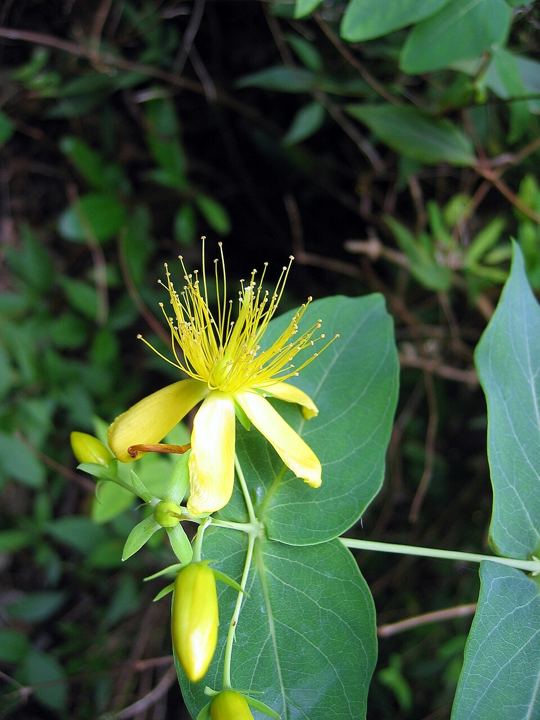
Photos
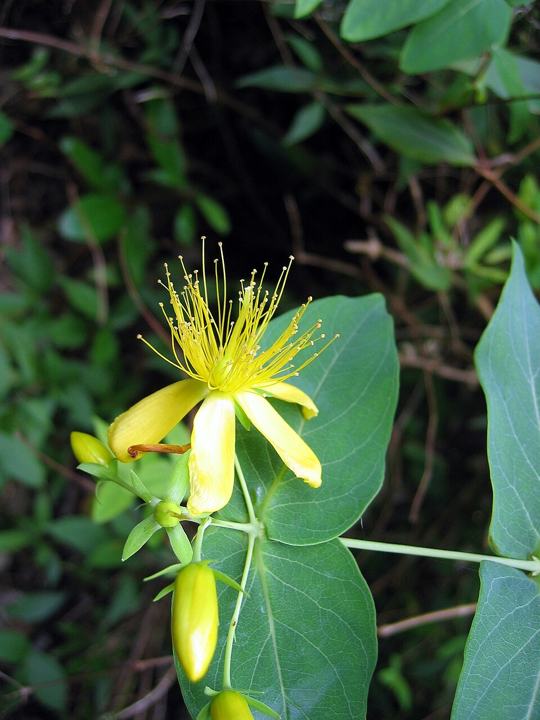
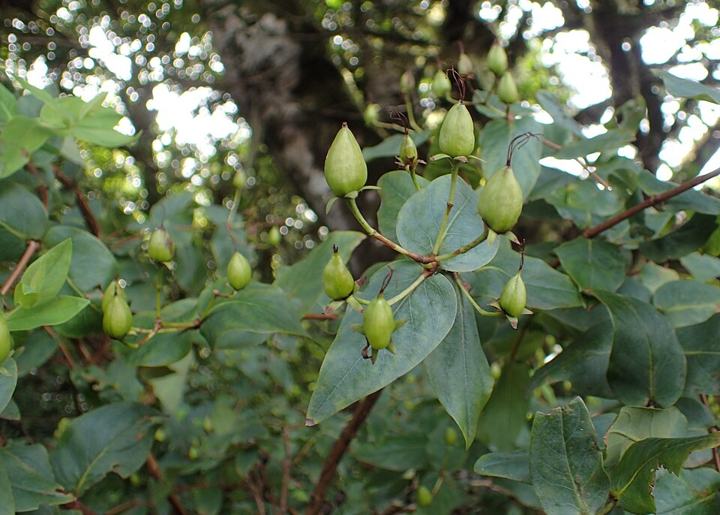
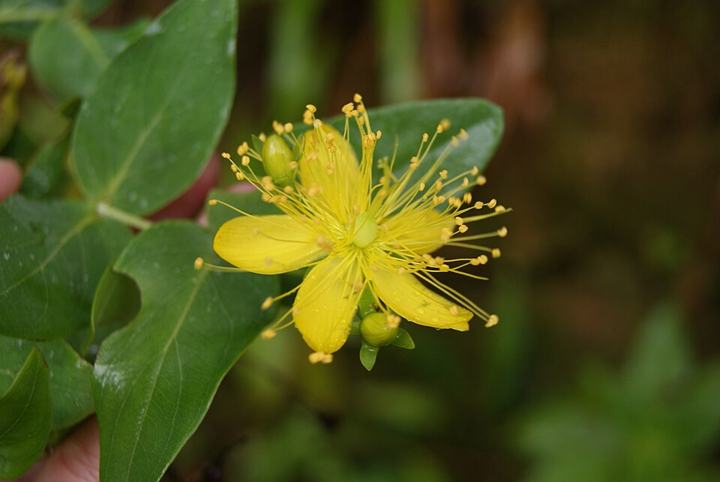
From Wikipedia
Hypericum grandifolium, the large-leaved St John's wort, is a species of flowering plant in the family Hypericaceae. The plant is a bushy shrub that can grow to almost 2 meters tall. It has large leaves, golden yellow petals, and seed capsules that split open. H. grandifolium is native to the Canary Islands and Madeira in Macaronesia, but has become invasive in other regions, including California, after escaping from cultivation as an ornamental plant. It is parasitized by wasps and fungi, and is capable of reproducing through its rhizomes.
First described in 1821 by Jacques Choisy, the ambiguity of its original description meant that the species was often misidentified. Specimens were variously called H. elatum, H. anglicum, Androsaemum webbianum, and others. The species was placed into section Androsaemum of Hypericum by Norman Robson in 1984, and it is most closely related in appearance and classification to the other species in the section, especially H. androsaemum, H. hircinum, and H. × inodorum. The species is not used in modern medical applications, but may have anticancer potential and could be used to treat ear edemas.
Text from Wikipedia, CC BY-SA 4.0: Hypericum grandifolium
Description
A shrub reaching over 1 m tall, with reddish-brown stems and branches, broadly ovate leaves and large yellow flowers in loose, few-flowered inflorescences. Fruit a hard capsule, dark chestnut brown when ripe. Flowers from spring to autumn.
Propagation and growing
This shrub produces abundant, easily collected capsules containing a multitude of tiny seeds which, mixed with soil and sown on the surface in seed trays, germinate easily. Growing it is straightforward, but this plant is somewhat more demanding as to soil than the "granadillo", needing loose soils with more moisture; it is not very cold-hardy and prefers sunny positions. It has a somewhat trailing habit, so young plants are best staked. Growth is fast, and after a year in cultivation it can exceed half a metre in height. It is not usually available in native-plant nurseries, but growing it can be ordered 4 or 5 months in advance.
Garden use
This species has a beautiful summer flowering (sometimes lasting into autumn) of intense yellow, with large, showy flowers, which gives it some value as an ornamental plant for cool, moist parks and gardens. It is an interesting species for monteverde (laurel forest) restoration. It needs well-drained soils and hardly any maintenance. It tolerates pruning perfectly well and needs watering during the dry season of the first year after planting.
Notes
Also found on Madeira.
Protection status
Not listed.
Potential vegetation
Orlas heliófilas de monte verde (Lauro-Perseetum indicae) y pinares húmedos (Sideritido solutae-Pinetum canariensis ericesotum arboreae).
Source: Cabildo de Tenerife, “Guía de especies vegetales”, CC BY. Translated from Spanish by us.
Bioclimatic belts
Warm mid-slope belt
- Thermomediterranean, subhumid, with trade-wind fog
- Thermomediterranean, humid, with trade-wind fog
Temperate belt of laurel and pine forest
- Mesomediterranean, lower, dry, with trade-wind fog
- Mesomediterranean, lower, subhumid, with trade-wind fog
- Mesomediterranean, lower, humid, with trade-wind fog
Districts
Anaga · Metropolitan area (Santa Cruz and La Laguna) · Acentejo · La Orotava Valley · Daute · Teno · South-east · Güímar Valley