
Canary holly (acebiño)
Ilex canariensis Poir. · Family: Aquifoliaceae
Typical of laurel forest, dry and humid, and of heath on ridges swept by wind and mist.
Where it grows on Tenerife
Grows in: North coast · North, 300–1000 m · Above 1000 m
Zones are derived approximately from the Cabildo belts.
Photos
From Wikipedia
Ilex canariensis, the small-leaved holly, is an endemic species of holly native to Macaronesian islands. It is a species of plant in the family Aquifoliaceae. It is found in the Macaronesian islands of Madeira (Portugal) and Canary Islands (Spain).
Text from Wikipedia, CC BY-SA 4.0: Ilex canariensis
Description
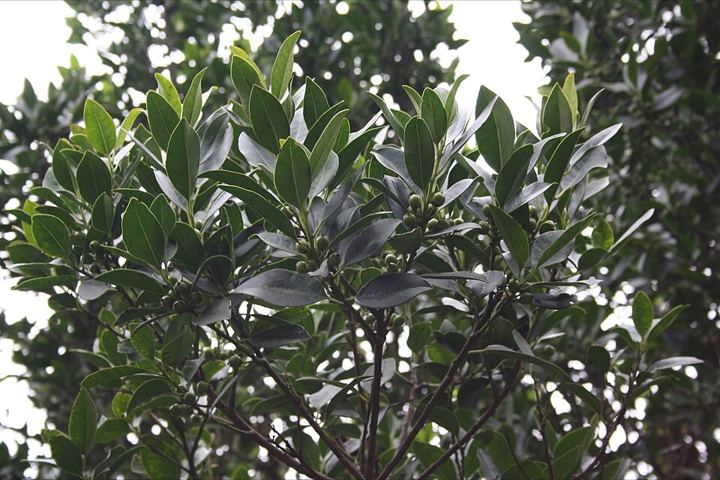
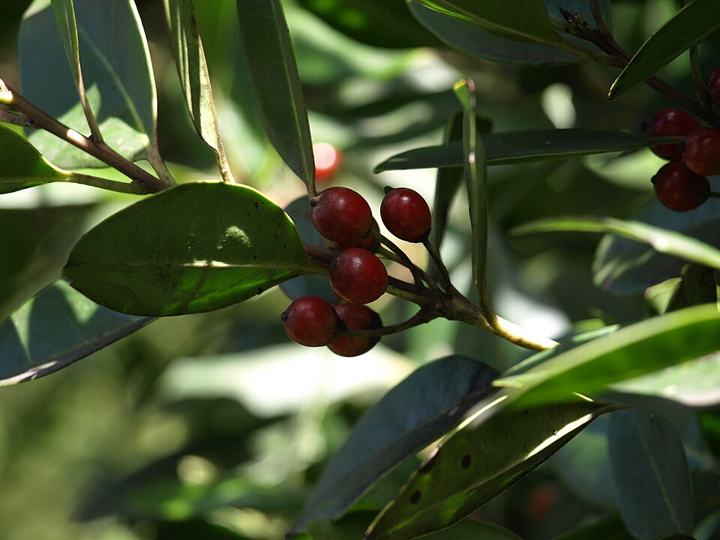
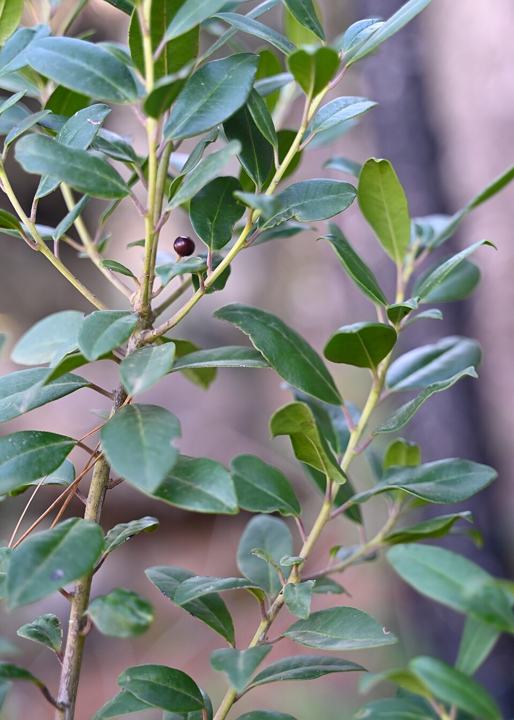
A small evergreen tree 6–10 m tall, with a straight trunk, smooth whitish-grey bark and a much-branched crown. Leaves alternate, ovate-elliptic, 5–8 cm long, leathery, hairless, deep green and glossy on the upper surface, with the margin usually entire, though sometimes bearing a few small spines. Flowers small and white; fruits spherical, intense red. Flowers in spring and summer.
Propagation and growing
The fruits (attractively red at Christmas) of the female specimens of this beautiful tree contain several very hard seeds which generally take more than a year to germinate, and germination is also very low and irregular. The plants grow slowly and cultivation is somewhat tricky, as this species is particularly susceptible to fungi, aphids and scale insects (coccids). After one year in a container the plants do not usually exceed half a metre in height. It is not very demanding as regards growing media and soils, and mature specimens show great “stump vigour”, withstanding heavy pruning. The difficulty it presents in germination and cultivation is probably why it is not usually available in nurseries, at least not in sufficient quantity.
Garden use
A tree of high ornamental value for its beauty and its attractive intense red fruit in winter. Because it is susceptible to aphids, it is not advisable to plant it where many ants have been noted. It needs watering and ongoing maintenance for at least the first two years after planting. Once established in the ground it becomes a very robust and hardy species. In suitable areas it needs moderate watering at first after planting; it can reach a good height, up to ten metres, making it ideal as a shade tree. Recommended for recreational areas and squares. It accepts moderate pruning and does best in soils with some moisture.
Notes
This species, also found on Madeira, shows some morphological variability in our archipelago, so the origin of specimens to be planted near natural populations of the species should be checked.
Protection status
Annex III of the Order of 20 February 1991 on the protection of wild flora of the Canary Islands.
Potential vegetation
Visneo mocanerae-Arbutetum canariensis; Lauro-Perseetum indicae; Ilici canariensis-Ericetum platycodonis.
Source: Cabildo de Tenerife, “Guía de especies vegetales”, CC BY. Translated from Spanish by us.
Bioclimatic belts
Warm coastal belt
- Inframediterranean, dry, with trade-wind fog
Warm mid-slope belt
- Thermomediterranean, semi-arid (upper level), with trade-wind fog
- Thermomediterranean, dry, with trade-wind fog
- Thermomediterranean, subhumid, with trade-wind fog
- Thermomediterranean, humid, with trade-wind fog
Temperate belt of laurel and pine forest
- Mesomediterranean, lower, dry, with trade-wind fog
- Mesomediterranean, lower, subhumid, with trade-wind fog
- Mesomediterranean, lower, humid, with trade-wind fog
Districts
Anaga · Metropolitan area (Santa Cruz and La Laguna) · Acentejo · La Orotava Valley · Daute · Teno · Güímar Valley