
Canary foxglove
Isoplexis canariensis (L.) J. W. Loudon · Family: Scrophulariaceae
Typical of the laurel forest, growing among shrubs in cool shady spots.
Where it grows on Tenerife
Grows in: North coast · North, 300–1000 m · Above 1000 m
Zones are derived approximately from the Cabildo belts.
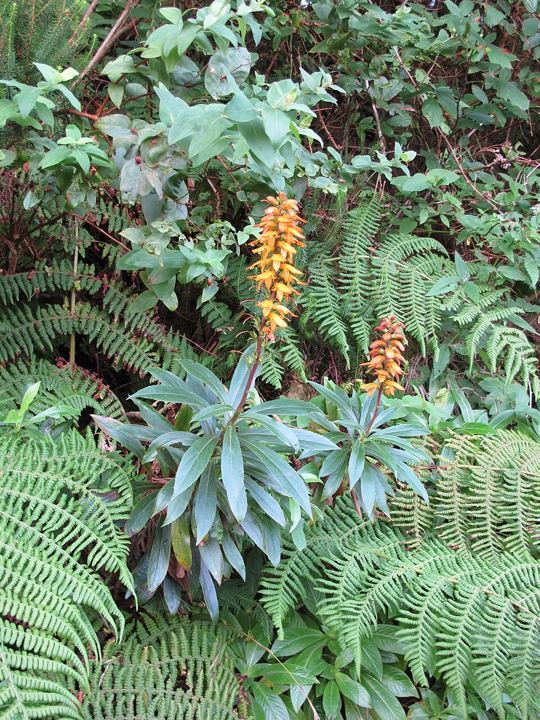
Photos
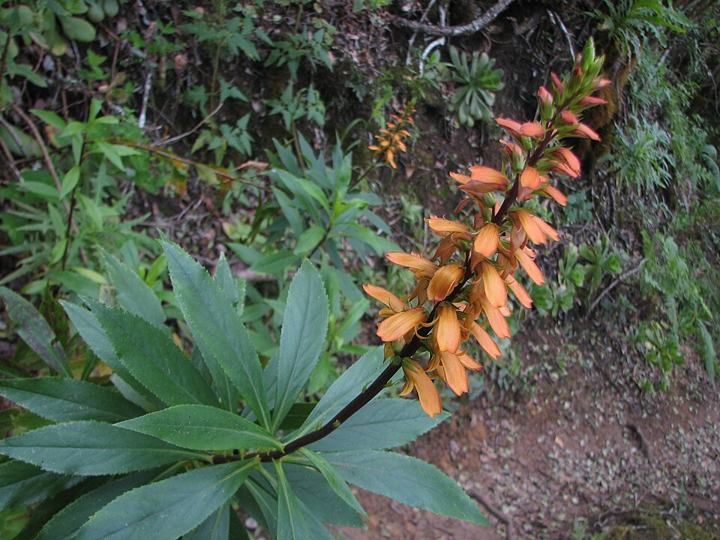
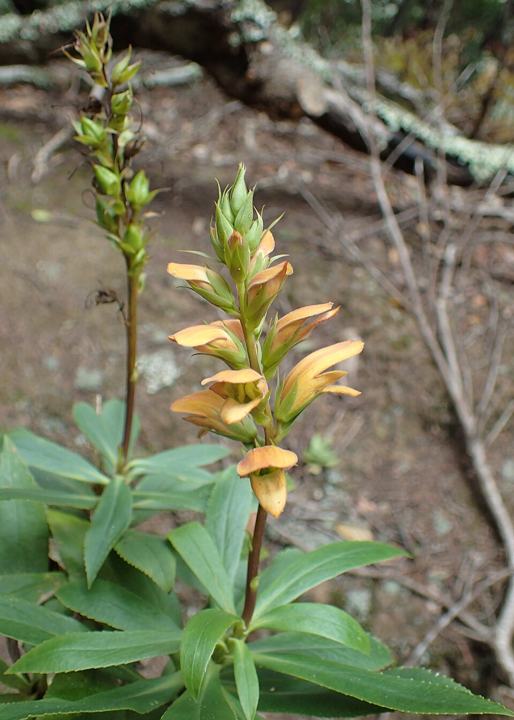
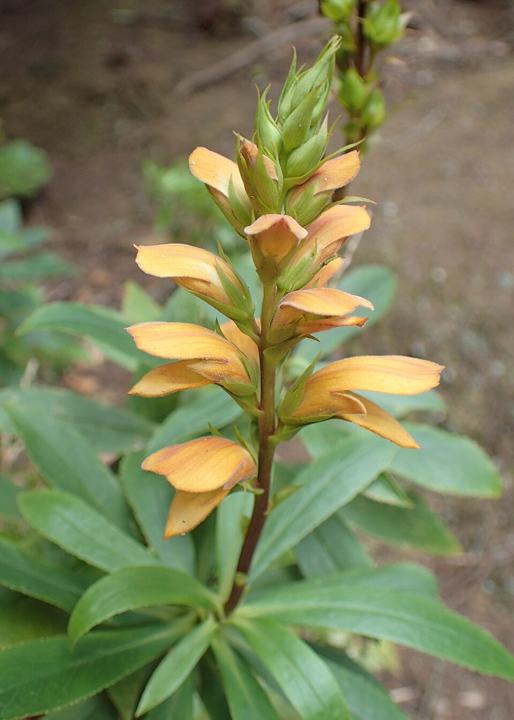
From Wikipedia
Digitalis canariensis (common name: Canary Island foxglove) is a member of the genus Digitalis.
Text from Wikipedia, CC BY-SA 4.0: Digitalis canariensis
Description
A shrub up to 1.5 m tall. Leaves ovate-lanceolate, with serrated margins, somewhat downy beneath. Flowers large and showy, borne in dense terminal racemes, with an orange corolla. Flowers in spring.
Propagation and growing
The dry fruits of this small shrub contain numerous small seeds that germinate with some difficulty and unevenly; germination might be improved by using the same method applied successfully to Canarina canariensis (soaking in 0.2% potassium nitrate for 24 hours, then sieving and drying the seeds, which are mixed with soil and sown in seed trays). The resulting plants are difficult to grow in containers, as they are very sensitive to lack of moisture and easily dry out and wilt. They need cool, moist soils rich in organic matter and a sunny position with some air humidity. It is not usually available in native-plant nurseries, and growing it must be ordered 8 or 9 months in advance.
Garden use
Any difficulties in growing and maintaining this species are more than made up for by its spectacular spring flowering: beautiful orange to brick-red flowers grouped in upright terminal racemes. It has a wide altitude range (500–1,000 m above sea level) and occurs in small populations (few individuals per population), so although it is fairly evenly distributed on Tenerife, the total number of plants makes it an uncommon species, and its use and cultivation therefore have conservation value. Its height, which rarely exceeds 1.5 m, and its moderate spread also make it a very manageable species for all kinds of planting in suitable areas. It is undoubtedly one of the most beautifully flowering shrubs of the monteverde (laurel forest).
Notes
Other species of the genus grow on Gran Canaria (2) and Madeira (1). All species are of medicinal interest for their cardiotonic properties. Their toxic properties should not be forgotten.
Protection status
Annex II of the Order of 20 February 1991 on the protection of wild flora of the Canary Islands.
Potential vegetation
Visneo-Arbutetum canariensis; Lauro-Perseetum indicae.
Source: Cabildo de Tenerife, “Guía de especies vegetales”, CC BY. Translated from Spanish by us.
Bioclimatic belts
Warm coastal belt
- Inframediterranean, dry, with trade-wind fog
Warm mid-slope belt
- Thermomediterranean, semi-arid (upper level), with trade-wind fog
- Thermomediterranean, dry, with trade-wind fog
- Thermomediterranean, subhumid, with trade-wind fog
- Thermomediterranean, humid, with trade-wind fog
Temperate belt of laurel and pine forest
- Mesomediterranean, lower, dry, with trade-wind fog
- Mesomediterranean, lower, subhumid, with trade-wind fog
- Mesomediterranean, lower, humid, with trade-wind fog
Districts
Anaga · Metropolitan area (Santa Cruz and La Laguna) · Acentejo · La Orotava Valley · Daute · South-west · South-east · Güímar Valley