
Verode (Kleinia neriifolia)
Kleinia neriifolia Haw. · Family: Asteraceae
Very common in dry lowland scrub, reaching 800–1,000 m on dry sunny slopes. Typical of spurge scrub.
Where it grows on Tenerife
Grows in: South coast · North coast · South, 300–1000 m
Zones are derived approximately from the Cabildo belts.
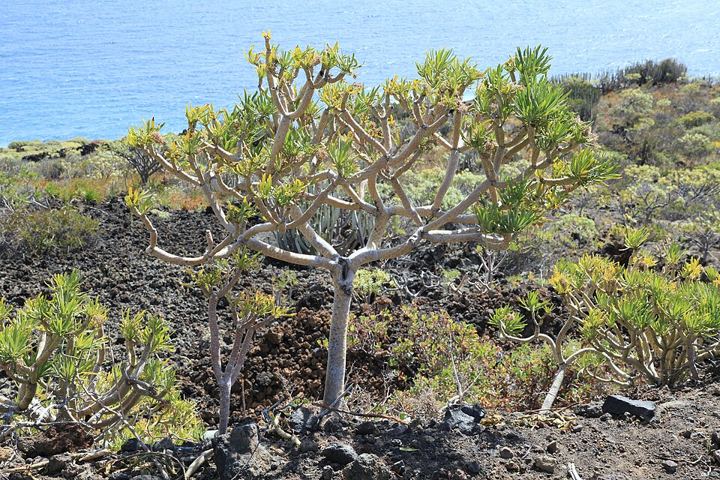
Photos
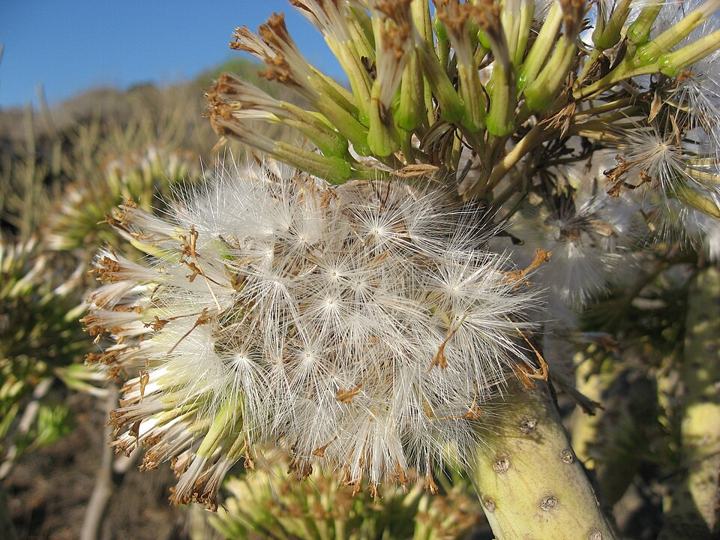
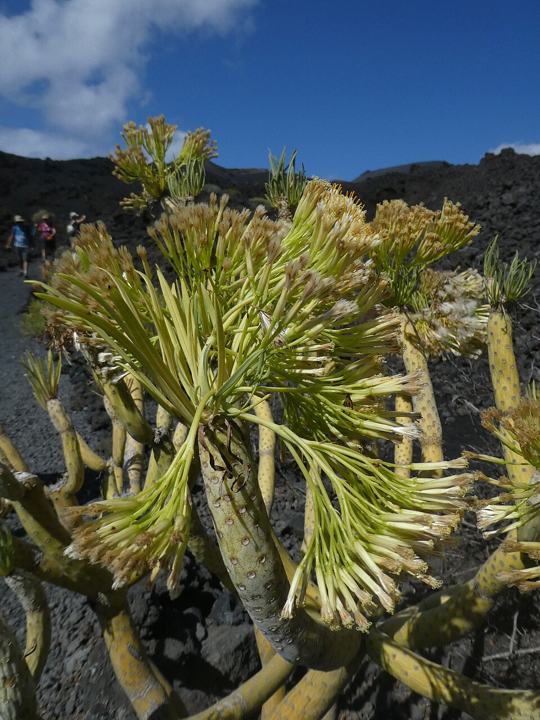
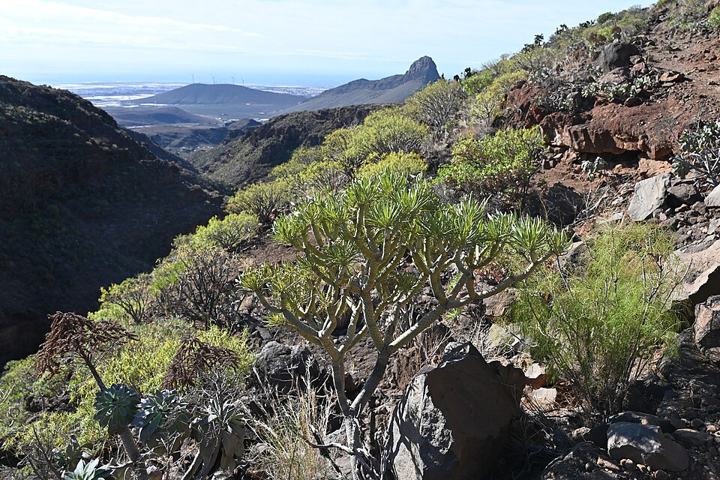
From Wikipedia
Kleinia neriifolia, known in Spanish as verode or berode, is a species of flowering plant in the daisy family (Asteraceae). It is endemic to the Canary Islands. It was formerly named Senecio kleinia.
Text from Wikipedia, CC BY-SA 4.0: Kleinia neriifolia
Description
Branched shrub 1–2 m tall, with succulent, jointed, cylindrical stems, green or greyish in colour. Leaves linear-lanceolate, up to 12 cm long, glaucous, fleshy and deciduous; they appear in autumn, after the flowers. Flowers pale yellow, in long, very slender flower heads arranged in terminal umbel-like inflorescences. Flowers from spring to autumn.
Propagation and growing
The berode fruits in winter; its fruits are achenes with feathery pappus that aids their dispersal by wind. The seeds germinate normally, and it can also be propagated vegetatively by cuttings, which take easily. The plants are very attractive to slugs, snails and insects that bore into the succulent stem and devour its contents, hollowing it out and causing it to rot; for this reason it is not easy to grow in humid conditions. Its leaves are also attacked by fungi that make them wither, and its stems become deformed with excess moisture. In drier areas it is much easier to grow, proving drought-resistant and undemanding as to soil. Planted in gardens, it usually self-seeds abundantly. It is usually available in nurseries, though not in sufficient numbers. Its cultivation must be ordered 4 or 5 months in advance.
Garden use
This fleshy-stemmed member of the daisy family has a habit reminiscent of the tabaibas. It thrives in the middle and lower zones of the northern (50–400 m above sea level) and southern (50–1000 m above sea level) slopes of the island, although it finds its optimum in the tabaibal-cardonal zone. It flowers in summer and autumn. It is an interesting species for ornamental use in gardens recreating xerophytic habitats, but it can also be used successfully in landscaping at mid-altitudes, taking care not to overwater or overfeed it so that it does not lose its natural habit and grace. It needs no special maintenance or watering.
Notes
According to KUNKEL (1978b), there is some variability in leaf morphology between islands, as plants from Lanzarote and Fuerteventura usually have broad leaves and those from La Palma narrow ones. The clear sap of its stems is dangerous if it gets…
Protection status
Not listed.
Potential vegetation
Ceropegio fuscae-Euphorbietum balsamiferae; Periploco laevigatae-Euphorbietum canariensis; Junipero canariensis-Oleetum cerasiformis.
Source: Cabildo de Tenerife, “Guía de especies vegetales”, CC BY. Translated from Spanish by us.
Bioclimatic belts
Warm coastal belt
- Inframediterranean, hyperarid
- Inframediterranean, arid
- Inframediterranean, semi-arid (lower level)
- Inframediterranean, semi-arid (upper level)
- Inframediterranean, dry, without trade-wind fog
Warm mid-slope belt
- Thermomediterranean, semi-arid (lower level)
- Thermomediterranean, semi-arid (upper level), without trade-wind fog
- Thermomediterranean, dry (lower level), without trade-wind fog
Districts
Anaga · Metropolitan area (Santa Cruz and La Laguna) · Acentejo · La Orotava Valley · Daute · Teno · South-west · Abona · South-east · Güímar Valley