
Canary lavender
Lavandula canariensis Mill. · Family: Lamiaceae
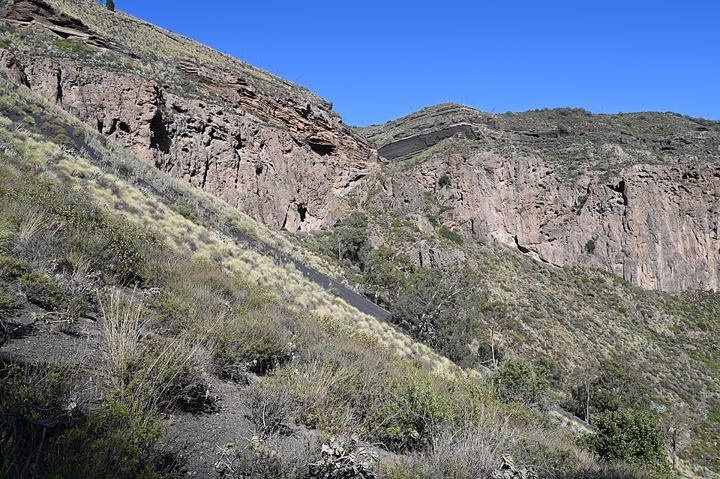
Stony slopes and cliffs in dry sunny places, 200–800 m.
Where it grows on Tenerife
Grows in: South coast · North coast · South, 300–1000 m
Zones are derived approximately from the Cabildo belts.
Photos
From Wikipedia
Lavandula canariensis (common name, Canary Island lavender) is a species of flowering plant in the family Lamiaceae, native to the Canary Islands. It was first described by Philip Miller in 1768.
Text from Wikipedia, CC BY-SA 4.0: Lavandula canariensis
Description
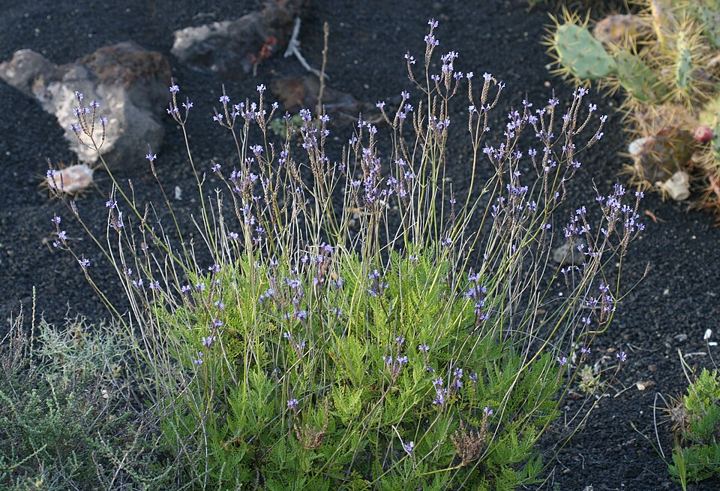
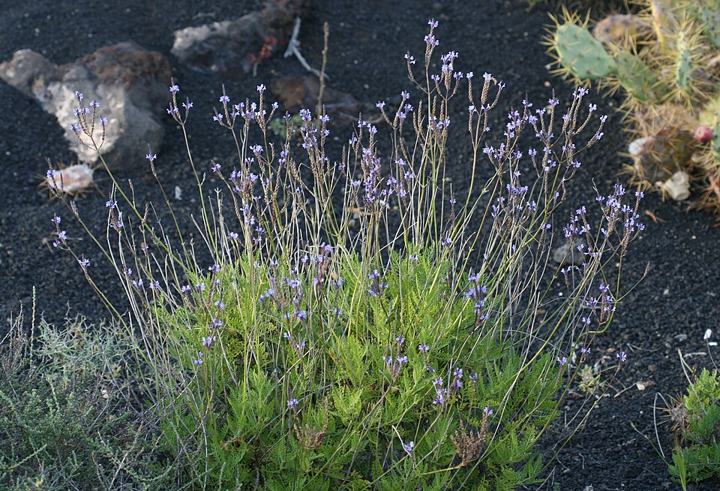
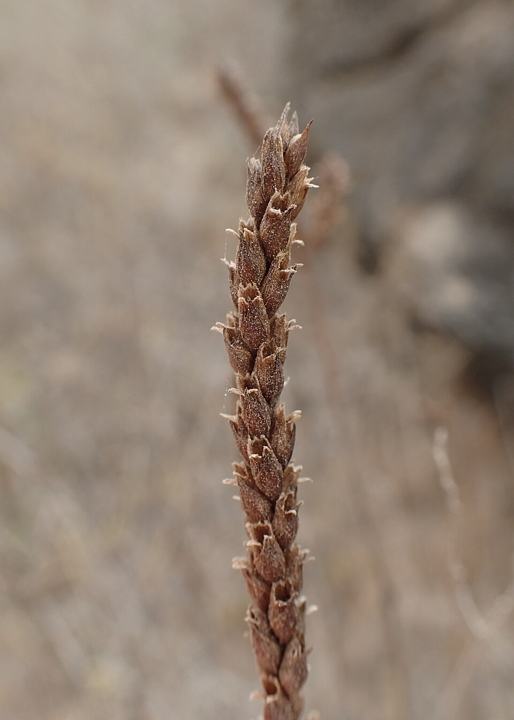
A branched shrub up to 1.5 m tall, with glabrous stems. Leaves ovate, once or twice divided, 4–7 cm long, dark green. Inflorescences are branched spikes up to 10 cm long, with pinkish and bluish flowers. Flowers in winter and spring.
Propagation and growing
The abundant seeds of this "mato risco" can be collected in summer; mixed with soil and sown in seed trays, they germinate unevenly, so it is best to sow thickly. The plants are slow-growing, undemanding as to soil and watering, and easy to grow in containers. This species is usually available in nurseries, as it is widely used as an ornamental. Because the genus tends to hybridise, the species to be grown and the seed used for propagation must be chosen carefully. Plants should be ordered from nurseries specialising in native flora a year in advance.
Garden use
This decorative shrub is the commonest species of the genus and is also present on all the islands. It is most abundant in the tabaibal-cardonal zone (spurge scrub), but also appears in areas of thermophilous woodland. Its abundant bluish flowering in winter and spring gives it undoubted value as an ornamental plant. Its many well-known medicinal properties and the soft fragrance of its foliage add to its qualities, making it an excellent species for all kinds of landscaping between 200 and 800 m altitude. It hybridises with the vulnerable "Lavandula buchii" Webb, so appropriate precautions should be taken to avoid unwanted crosses between the two, although they are occasionally found together in the wild. It needs no special maintenance and should not be watered, except for watering in at planting.
Notes
It hybridises naturally with "Lavandula buchii" Webb; both can be used for ornamental purposes, but it is recommended to use them separately.
Protection status
Not listed.
Potential vegetation
Periploco-Euphorbietum canariensis; Junipero-Oleetum cerasiformis.
Source: Cabildo de Tenerife, “Guía de especies vegetales”, CC BY. Translated from Spanish by us.
Bioclimatic belts
Warm coastal belt
- Inframediterranean, semi-arid (lower level)
- Inframediterranean, semi-arid (upper level)
- Inframediterranean, dry, without trade-wind fog
Warm mid-slope belt
- Thermomediterranean, semi-arid (lower level)
- Thermomediterranean, semi-arid (upper level), without trade-wind fog
- Thermomediterranean, dry (lower level), without trade-wind fog
Districts
Anaga · Metropolitan area (Santa Cruz and La Laguna) · Acentejo · La Orotava Valley · Daute · Teno · South-west · Abona · South-east · Güímar Valley