
Southern magnolia
Magnolia grandiflora L. · Family: Magnoliaceae
Suffers in frost and does best in a mild, humid climate. The best specimens on the island are at mid elevations on the northern slope.
Where it grows on Tenerife
Grows in: South coast · North coast · South, 300–1000 m · North, 300–1000 m · Above 1000 m
Zones are derived approximately from the Cabildo belts.
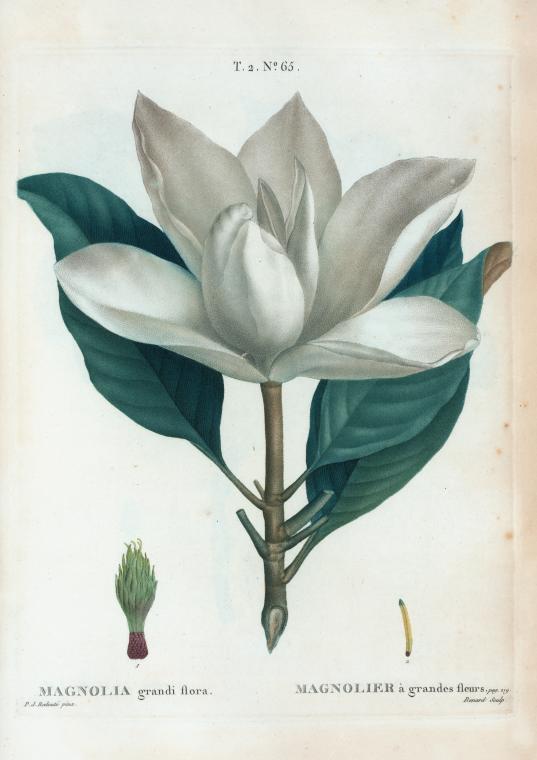
Photos
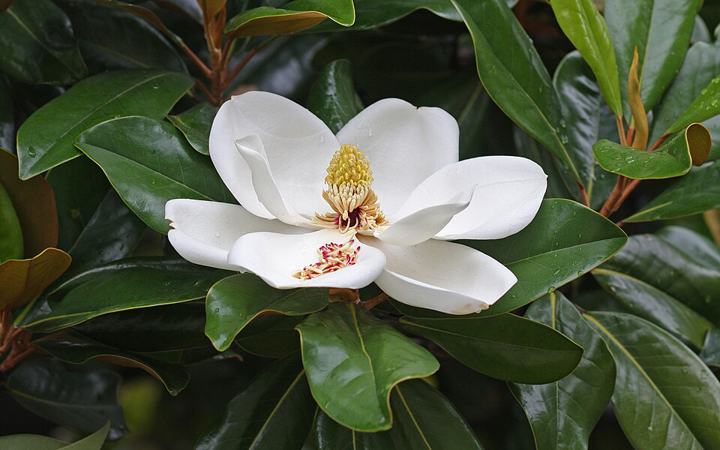
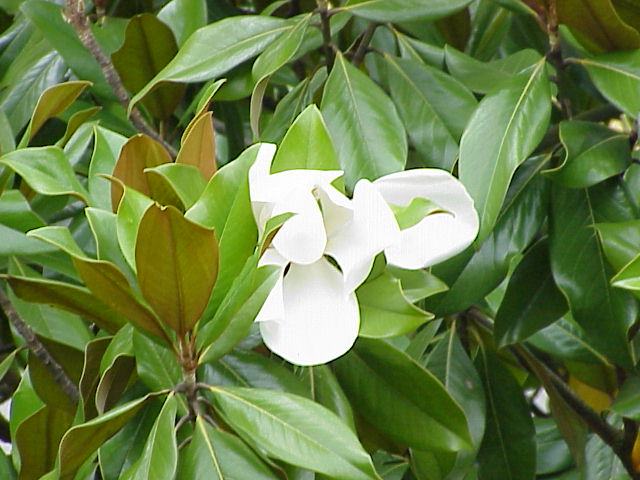
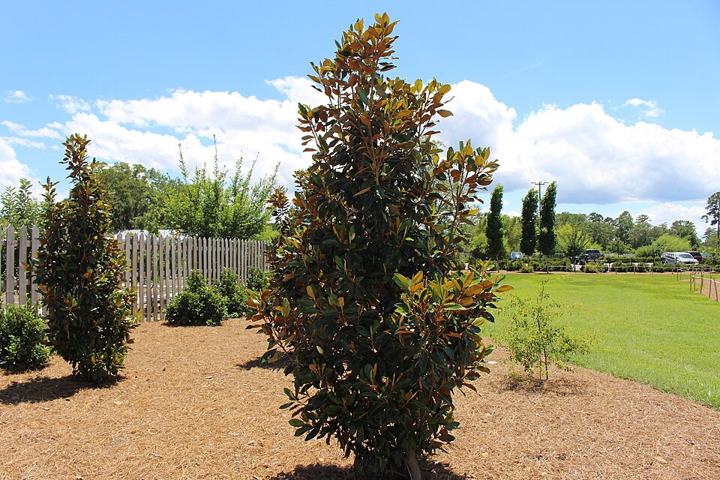
From Wikipedia
Magnolia grandiflora, commonly known as the southern magnolia or bull bay, is a flowering tree in the family Magnoliaceae native to the Southeastern United States coastal plain, from Virginia to central Florida, and west to East Texas. Reaching 27.5 m (90 ft) in height, it is a large, striking evergreen tree, with large, dark-green leaves up to 20 cm (7+3⁄4 in) long and 12 cm (4+3⁄4 in) wide, and large, white, fragrant flowers up to 30 cm (12 in) in diameter.
Although endemic to the evergreen lowland subtropical forests on the Gulf and South Atlantic coastal plain, M. grandiflora is widely cultivated in warmer areas around the world. The timber is hard and heavy, and has been used commercially to make furniture, pallets, and veneer.
Text from Wikipedia, CC BY-SA 4.0: Magnolia grandiflora
Description
Robust evergreen tree, native to the south-eastern United States, which can reach 30 m in height, with a trunk of greyish, almost smooth bark, an ovoid or pyramidal crown and rust-coloured twigs. Leaves large, 12-25 cm long, leathery, elliptic or ovate, often with a wavy margin, deep green and glossy above and with reddish-brown hairs beneath. Flowers solitary, very large, creamy white and fragrant. Fruit ovoid, resembling a cone. Flowers in spring and summer, fruiting in autumn.
Propagation and growing
A slow-growing species. Plants raised from seed flower after about 20 years, and those propagated vegetatively from the fifth year onwards. It needs a rich, somewhat cool, deep, loose, well-drained soil with a certain degree of moisture; it prefers acid, humus-rich soils, although it tolerates slightly chalky soils, which can be corrected by adding plenty of peat or ericaceous (heath) soil. It prefers full sun or partial shade. It needs plenty of room to grow, as it has a very extensive root system and a broad crown. It can be propagated by seed, grafting, cuttings and layering. Available from commercial nurseries. It is normally reproduced from its seeds, which are red. It requires not too sunny positions, cool sites and moist soils. Common throughout Spain, with numerous cultivars.
Garden use
During its first years it needs regular watering, more generous in summer. Transplanting is delicate and should be done with a root ball in spring and autumn. It tolerates formative pruning, with which perfectly conical or high-crowned specimens can be obtained, although it should not be overdone. It tolerates urban pollution. It can be attacked by certain insects and fungi and suffer various forms of chlorosis, although it has no major pest or disease problems. It is the most frequently grown magnolia. A magnificent tree for its habit, its evergreen foliage and its highly fragrant flowers. Widely used as a specimen tree in parks and gardens or in rows along walks and avenues. Its wood is hard and heavy, and so used in basketry. The bark has medicinal properties. It is a very popular ornamental, not only for its habit and foliage but also for its flowers, which are creamy white, of considerable size and give off a pleasant scent, making it ideal for gardens, squares and parks.
Notes
When not in flower it is often mistaken for some “Ficus” species. It is the magnolia par excellence, highly prized in gardening for its attractive foliage and its large, striking flowers with a penetrating scent.
Source: Cabildo de Tenerife, “Guía de especies vegetales”, CC BY. Translated from Spanish by us.
Bioclimatic belts
Warm coastal belt
- Inframediterranean, semi-arid (lower level)
- Inframediterranean, semi-arid (upper level)
- Inframediterranean, dry, without trade-wind fog
- Inframediterranean, dry, with trade-wind fog
Warm mid-slope belt
- Thermomediterranean, semi-arid (lower level)
- Thermomediterranean, semi-arid (upper level), without trade-wind fog
- Thermomediterranean, semi-arid (upper level), with trade-wind fog
- Thermomediterranean, dry, with trade-wind fog
- Thermomediterranean, dry (lower level), without trade-wind fog
- Thermomediterranean, subhumid, with trade-wind fog
- Thermomediterranean, dry (upper level), without trade-wind fog
- Thermomediterranean, humid, with trade-wind fog
Temperate belt of laurel and pine forest
- Mesomediterranean, lower, semi-arid (upper level), without trade-wind fog
- Mesomediterranean, lower, dry, with trade-wind fog
- Mesomediterranean, lower, dry, without trade-wind fog
- Mesomediterranean, lower, subhumid, with trade-wind fog
- Mesomediterranean, lower, subhumid, without trade-wind fog
- Mesomediterranean, lower, humid, with trade-wind fog
- Mesomediterranean, upper, dry, without trade-wind fog
- Mesomediterranean, upper, subhumid, without trade-wind fog
- Mesomediterranean, upper, humid, without trade-wind fog