
Palo de sangre (Marcetella)
Marcetella moquiniana (Webb & Berth.) Svent. · Family: Rosaceae
Cliffs and rocky slopes in the thermophilous woodland belt, 300–600 m.
Where it grows on Tenerife
Grows in: South coast · North coast · South, 300–1000 m · Above 1000 m
Zones are derived approximately from the Cabildo belts.
Photos
Description
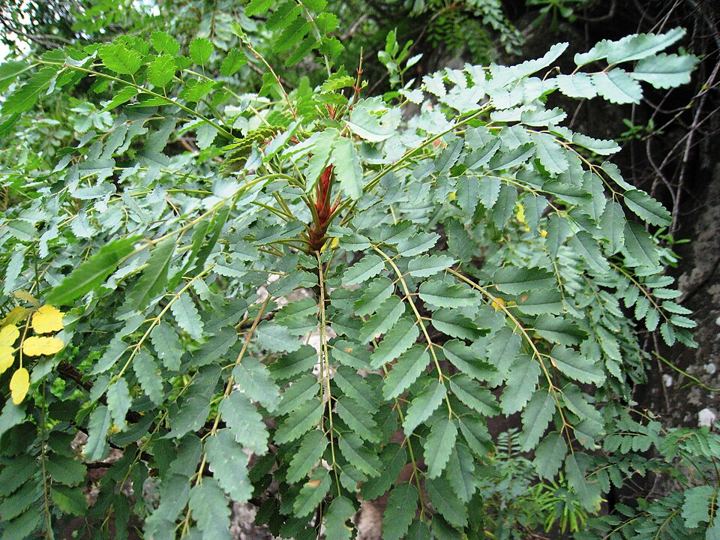
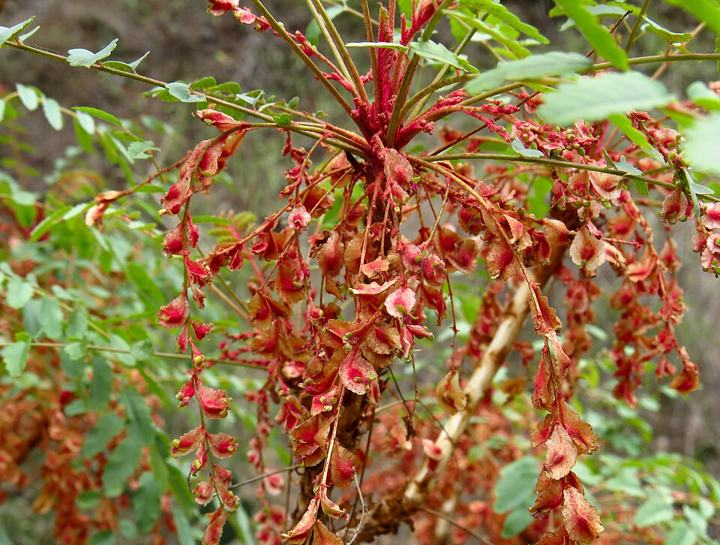
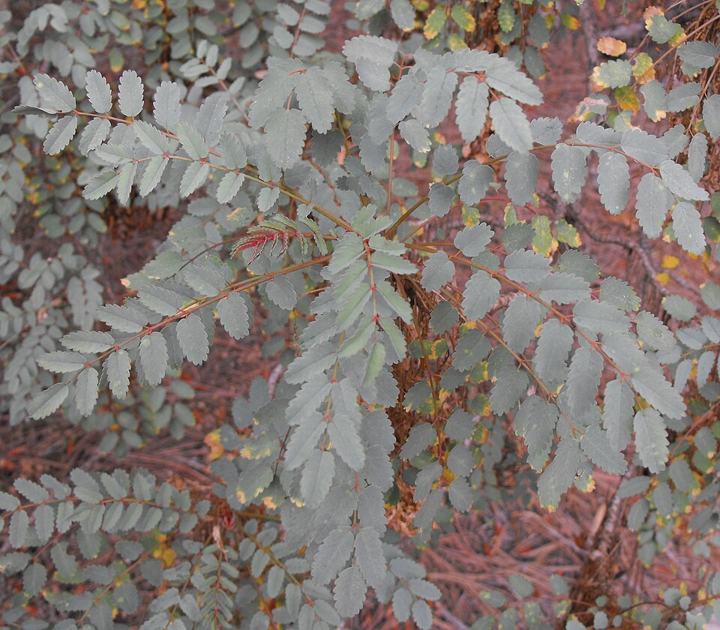
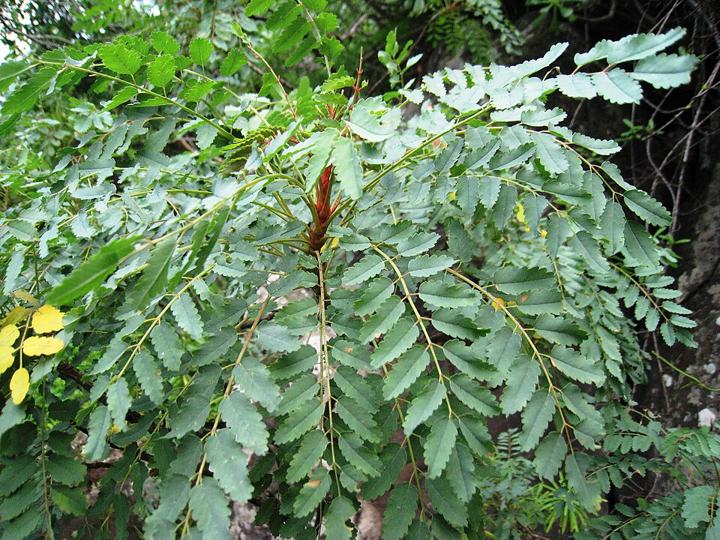
Shrub or small tree up to 4 m tall, with scaly bark and a reddish-brown trunk and branches, the upper ones with red glandular hairs. Leaves in terminal rosettes, compound, imparipinnate, 12-20 cm long, with 7-15 stalked leaflets 1.5-2.5 cm long, with serrated margins, glaucous green. Flowers unisexual in catkin-like racemes, the male ones greenish-yellow and the female ones purplish-red. Fruits dry, winged, brownish. Flowers in summer-autumn.
Propagation and growing
In late summer and autumn the female plants of this species bear clusters of dry, brown fruits with wings that aid their dispersal by the wind. Without any prior treatment, fast-growing, undemanding seedlings come up; for this reason it is usually available in nurseries, and after a year of cultivation the plant can reach more than half a metre in height. Propagation by seed and by cuttings.
Garden use
This decorative small tree has a lovely umbrella-shaped, bluish-green crown with reddish tones at the branch tips and a beautifully twisted light brown trunk, which give it a pleasing appearance; this, together with its ease of cultivation and the little maintenance it needs, gives it high value as an ornamental plant for parks, gardens and roadsides. It takes pruning and shaping perfectly well. It is advisable to stake young plants for the first few months so that the wind does not blow them over.
Notes
In the lowlands (Santa Cruz, for example) the species suffers at the end of spring and is affected by pests (aphids, whitefly, etc.). It is therefore recommended for the medianías (mid-altitude zone).
Protection status
Annex II of the Order of 20 February 1991 on the protection of wild flora of the Canary Islands.
Potential vegetation
Junipero-Oleetum cerasiformis.
Source: Cabildo de Tenerife, “Guía de especies vegetales”, CC BY. Translated from Spanish by us.
Bioclimatic belts
Warm coastal belt
- Inframediterranean, semi-arid (upper level)
- Inframediterranean, dry, without trade-wind fog
Warm mid-slope belt
- Thermomediterranean, semi-arid (lower level)
- Thermomediterranean, semi-arid (upper level), without trade-wind fog
- Thermomediterranean, dry (lower level), without trade-wind fog
Temperate belt of laurel and pine forest
- Mesomediterranean, lower, semi-arid (upper level), without trade-wind fog
Districts
Anaga · Metropolitan area (Santa Cruz and La Laguna) · Acentejo · La Orotava Valley · Daute · Teno · South-west · Güímar Valley