
Canary maytenus (peralillo)
Maytenus canariensis (Loes.) G. Kunkel & Sunding · Family: Celastraceae
Typical of mid-elevation thermophilous woodland, in ravines and on slopes, 200–1,000 m.
Where it grows on Tenerife
Grows in: South coast · North coast · South, 300–1000 m · North, 300–1000 m
Zones are derived approximately from the Cabildo belts.
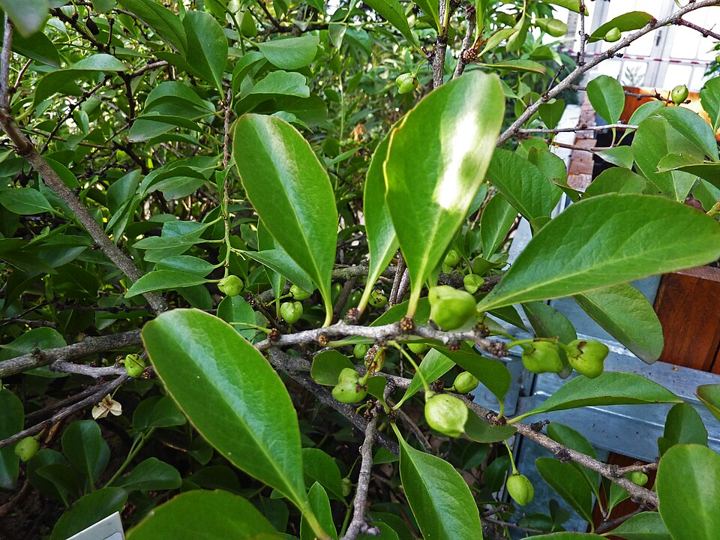
Photos
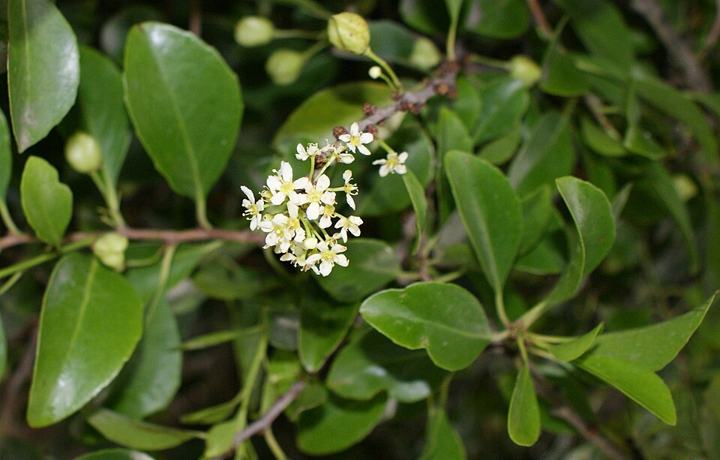
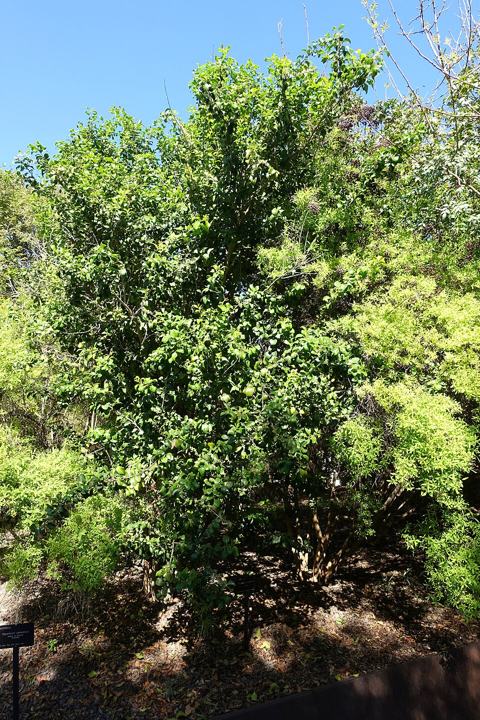
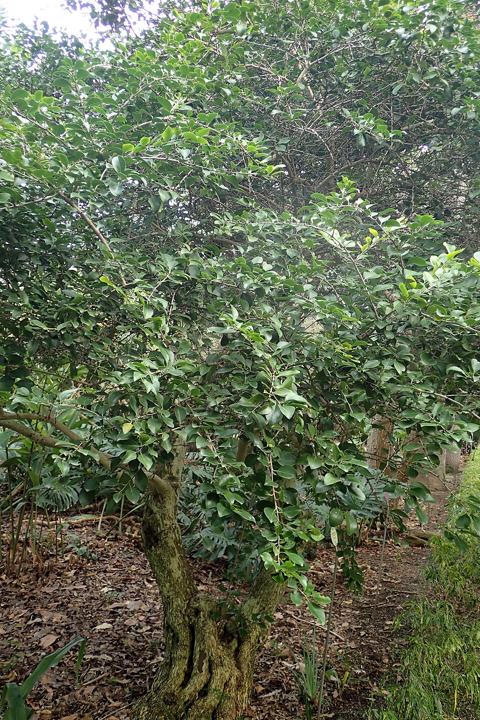
From Wikipedia
Gymnosporia cassinoides is a species of flowering plant in the family Celastraceae. It is a near threatened shrub or tree endemic to the Canary Islands.
Text from Wikipedia, CC BY-SA 4.0: Gymnosporia cassinoides
Description
Small tree up to 4-5 m tall, abundantly branched, with dark grey bark. Leaves somewhat leathery, glossy, obovate, 4-8 cm long, with a toothed-serrated margin. Flowers small and numerous, pale yellowish-green. Fruit globose, greenish. Flowers in winter-spring.
Propagation and growing
Propagated by seed and by cuttings. The fruits of this small tree contain several dark, hard, glossy seeds that germinate easily. The seedlings are vigorous and grow steadily, taking on a somewhat creeping habit, so it is advisable to use stakes when growing it in containers. It does best in a mild climate, in partial to full sun, on clay-loam soils with a neutral to acid pH and with moderate watering (A. Delgado 1986). Growth is slow, and it can reach a metre in height after two years provided it is staked. It is not easy to find in nurseries, though there is no reason for this other than the little regard for, or lack of knowledge of, this species.
Garden use
The colour and gloss of its leaves and its abundant flowering give it high value as an ornamental small tree (up to 7 m). Its dense, persistent foliage and abundant branching allow it to be shaped by pruning, so it can be used in hedges. Its conservation value is also high, given its relative scarcity in the wild today. This species is highly recommended for gardening because of its wide habitat range (200-800 m above sea level), its robustness and the few cultivation and maintenance requirements it has.
Notes
The species has been studied for its notable medicinal interest.
Protection status
Annex II of the Order of 20 February 1991 on the protection of wild flora of the Canary Islands.
Potential vegetation
Junipero-Oleetum cerasiformis; Visneo-Arbutetum canariensis.
Source: Cabildo de Tenerife, “Guía de especies vegetales”, CC BY. Translated from Spanish by us.
Bioclimatic belts
Warm coastal belt
- Inframediterranean, semi-arid (upper level)
- Inframediterranean, dry, without trade-wind fog
- Inframediterranean, dry, with trade-wind fog
Warm mid-slope belt
- Thermomediterranean, semi-arid (lower level)
- Thermomediterranean, semi-arid (upper level), without trade-wind fog
- Thermomediterranean, semi-arid (upper level), with trade-wind fog
- Thermomediterranean, dry, with trade-wind fog
- Thermomediterranean, dry (lower level), without trade-wind fog
Districts
Anaga · Metropolitan area (Santa Cruz and La Laguna) · Acentejo · La Orotava Valley · Daute · Teno · South-west · Abona · South-east · Güímar Valley