
Faya (firetree)
Morella faya (Aiton) Wilbur · Family: Myricaceae
A typical, tough species of the laurel forest, both mature and degraded; also found in mixed pine forest.
Where it grows on Tenerife
Grows in: North coast · North, 300–1000 m · South, 300–1000 m · Above 1000 m
Zones are derived approximately from the Cabildo belts.
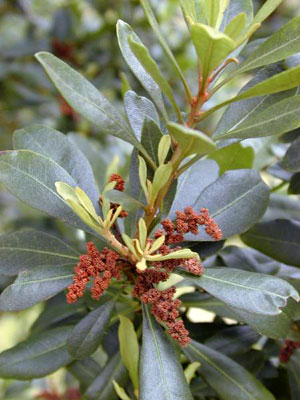
Photos
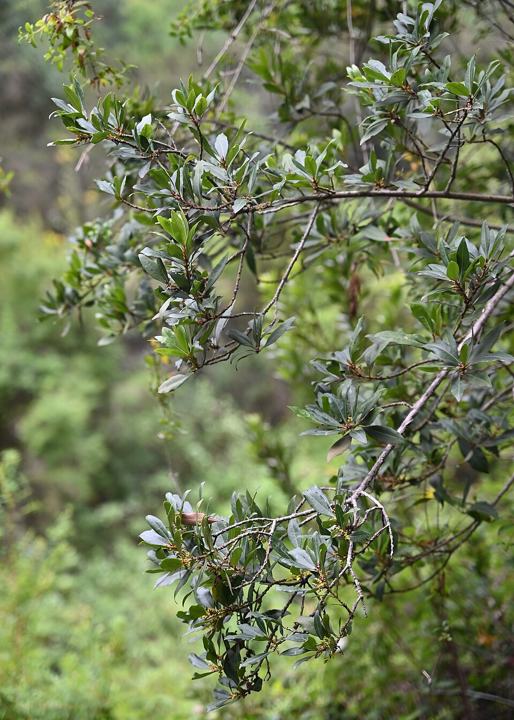
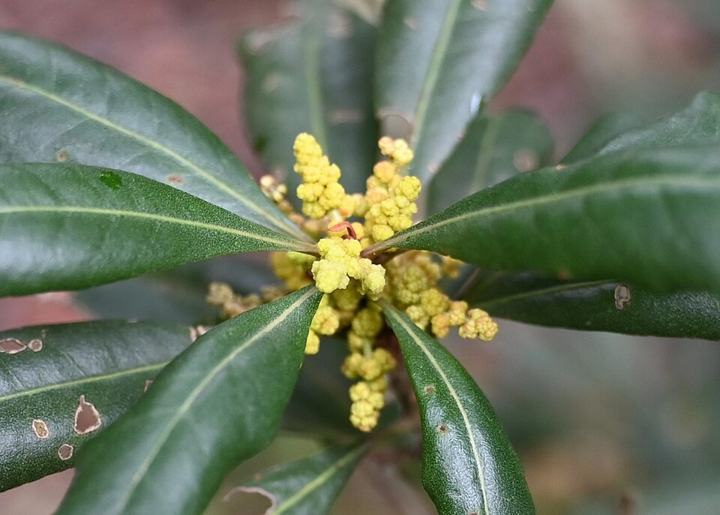
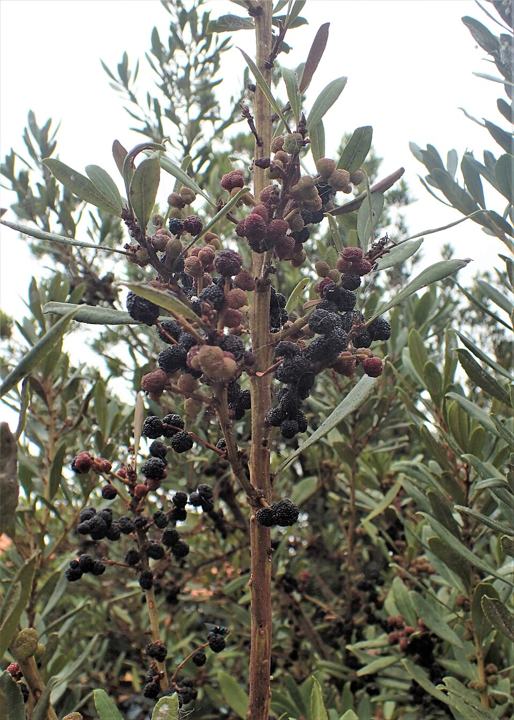
From Wikipedia
Myrica faya (firetree, faya or haya; syn. Morella faya (Ait.) Wilbur) is a species of Myrica, native to Macaronesia (the Azores, Madeira, and the Canary Islands), and possibly also western coastal mainland Portugal.
Text from Wikipedia, CC BY-SA 4.0: Myrica faya
Description
Small evergreen, dioecious tree up to 8-10(-12) m tall, with a distinct trunk or branching from the base, dark grey fissured bark and a broad crown. Leaves oblanceolate, 4-1 cm long, leathery, dark green, with an entire or wavy-crenate margin. Flowers very small, in branched catkins, the male ones yellowish-green and the female ones pinkish. Fruits fleshy, subglobose, reddish-black. Flowers in spring and summer.
Propagation and growing
The edible fruits of the female specimens of this shrub or tree, called “creces” or “fitos”, are gathered in summer and usually contain four seeds, which are extracted by soaking the fruits in water to remove the pulp. Seedlings are delicate and susceptible to fungal attack. The plants have some tendency to chlorosis. Growing them in full sun is recommended to prevent etiolation (legginess). They are fast-growing plants that need plenty of moisture. After one year in a container they can exceed half a metre in height. Once rooted in the ground they become very vigorous. They are usually available in native-plant nurseries, though perhaps not in sufficient quantity. Propagated by seed and by basal shoots.
Garden use
This species has a great capacity to resprout, so it tolerates pruning very well and is suitable for hedging. Its greatest use is in reforestation of laurel forest (monteverde), where it has already proved its worth, showing wide altitudinal adaptability (400-1500 m above sea level). Lately it has also become increasingly common as an ornamental plant along roads, where it has proved equally well suited. Once established it needs little care apart from watering during the dry season of the first year. Growing it is not always advisable, as in some parts of the world it is considered a weed. It is undemanding as to soil and needs some atmospheric humidity for optimal growth; it withstands periods of drought well and tolerates pruning. It does not tolerate severe cold.
Notes
On the islands of El Hierro, La Gomera and La Palma there is another very interesting species (“Myrica rivas-martinezii”). An Ibero-Macaronesian species, it is also found in the Madeira and Azores archipelagos and in southern Portugal. Its fruits, the “creces”…
Protection status
Annex III of the Order of 20 February 1991 on the protection of wild flora of the Canary Islands.
Potential vegetation
Visneo-Arbutetum canariensis; Lauro-Perseetum indicae; Diplazio-Ocoteetum foetentis; Ilici-Ericetum platycodonis; Sideritido-Pinetum canariensis subas. ericetosum arboreae.
Source: Cabildo de Tenerife, “Guía de especies vegetales”, CC BY. Translated from Spanish by us.
Bioclimatic belts
Warm coastal belt
- Inframediterranean, dry, with trade-wind fog
Warm mid-slope belt
- Thermomediterranean, semi-arid (upper level), with trade-wind fog
- Thermomediterranean, dry, with trade-wind fog
- Thermomediterranean, subhumid, with trade-wind fog
- Thermomediterranean, dry (upper level), without trade-wind fog
- Thermomediterranean, humid, with trade-wind fog
Temperate belt of laurel and pine forest
- Mesomediterranean, lower, dry, with trade-wind fog
- Mesomediterranean, lower, dry, without trade-wind fog
- Mesomediterranean, lower, subhumid, with trade-wind fog
Districts
Anaga · Metropolitan area (Santa Cruz and La Laguna) · Acentejo · La Orotava Valley · Daute · Teno · Abona · South-east