
Canary tree mallow (Navaea)
Navaea phoenicea Venr. (Webb & Berthel) · Family: Malvaceae
Rocky slopes, cliffs and inaccessible crags in the thermophilous woodland belt.
Where it grows on Tenerife
Grows in: South coast · North coast · South, 300–1000 m
Zones are derived approximately from the Cabildo belts.
From Wikipedia
Malva phoenicea, often still known under the synonyms Lavatera phoenicea and Navaea phoenicea, is a large shrub of the family Malvaceae and tribe Malveae, endemic to the island of Tenerife in the Canary Islands.
Text from Wikipedia, CC BY-SA 4.0: Malva phoenicea
Description
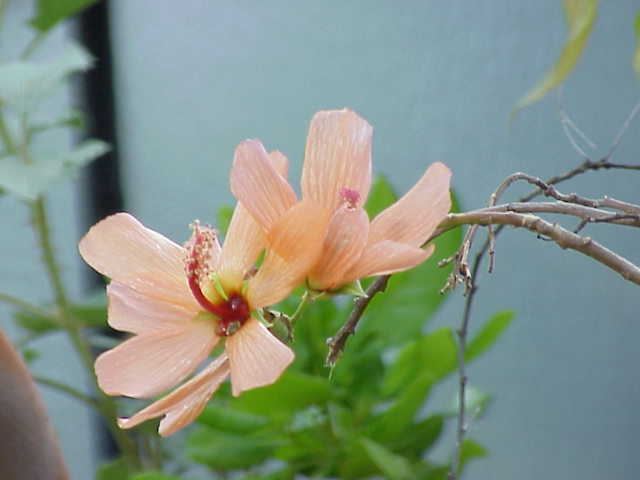
Tall shrub that can reach 3-5 m in height, abundantly branched. Leaves palmate, with narrow lobes. Flowers showy, in small racemes or solitary, salmon pink. Flowers in winter-spring.
Propagation and growing
This mallow fruits in summer, the fruits containing numerous flattened seeds stacked in a circle like slices of a ring, which germinate easily without any treatment, producing plants somewhat sturdier than "L. Acerifolia" and undemanding as to soil (although they prefer acid soils). Grown in a container, it needs moderate but regular watering, as it suffers if short of water; it needs a semi-shaded position and grows fast, reaching half a metre in height after a year of growing in a container. The leaves are often attacked by certain insects whose larvae bore cavities in the leaf tissue (parenchyma), causing large blotches that spoil and disfigure the leaves. This shrub lives for nearly twenty years and is not usually available in native-plant nurseries.
Garden use
Its flowers are reminiscent of those of Hibiscus rosa sinensis, so it is a species of some ornamental value. It does well in coastal places and is therefore resistant to periods of drought. It is fast-growing and tolerates pruning. Easy maintenance. It can be planted along promenades, on roundabouts and in gardens in general, forming hedges or small groups. This rare and scarce Tenerife endemic can reach up to 3 m in height and grows naturally on cliffs, stony slopes and escarpments between 250 and 700 m above sea level. Its thick woody trunk, branching early from the base, bears drooping branches in mature plants, which in winter and spring are adorned with abundant flowering of very beautiful orange-salmon flowers. Listed as an endangered species, its scarcity and rarity give it extremely high conservation and scientific value. Propagation for garden use is one of the measures proposed for the conservation of the species. For all these reasons, this species deserves to be rated as a favourite for all kinds of landscaping. It should not be pruned if you want it to develop its characteristic weeping habit, which shows off the beauty of its flowers, and since it achieves a large spread in cultivation, it needs wide spacing (around three metres). It needs no maintenance apart from moderate watering.
Notes
Native to Anaga and Teno; it has recently been placed in the genus "Navaea", phylogenetically more ancestral than "Lavatera" (E. Barquín, pers. comm.). It may be pollinated by birds.
Protection status
Annex III (species of interest for Canary ecosystems) of the Canary Catalogue of Protected Species.
Potential vegetation
Junipero-Oleetum cerasiformis.
Source: Cabildo de Tenerife, “Guía de especies vegetales”, CC BY. Translated from Spanish by us.
Bioclimatic belts
Warm coastal belt
- Inframediterranean, semi-arid (upper level)
- Inframediterranean, dry, without trade-wind fog
Warm mid-slope belt
- Thermomediterranean, semi-arid (lower level)
- Thermomediterranean, semi-arid (upper level), without trade-wind fog
- Thermomediterranean, dry (lower level), without trade-wind fog
Districts
Anaga