
Ponytail palm
Nolina recurvata (Lem.) Hemsl. · Family: Agavaceae
A species of arid zones that tolerates drought. Sun or partial shade. Prefers fertile, well-drained soil.
Where it grows on Tenerife
Grows in: South coast · North coast · South, 300–1000 m · North, 300–1000 m
Zones are derived approximately from the Cabildo belts.
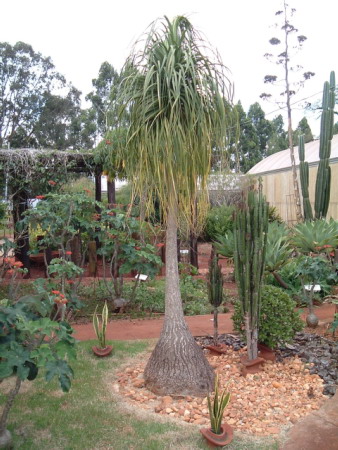
From Wikipedia
Beaucarnea recurvata, the elephant's foot or ponytail palm, is a species of flowering plant in the family Asparagaceae. The species is endemic to eastern Mexico; according to IUCN it is now confined to the state of Veracruz, but Plants of the World Online also cites it as occurring in Oaxaca, Puebla, San Luis Potosí, and Tamaulipas. Despite its common name, it is not closely related to the true palms (Arecaceae). It has become popular in Europe and worldwide as an ornamental plant. There are 350-year-old Beaucarneas registered in Mexico.
Text from Wikipedia, CC BY-SA 4.0: Beaucarnea recurvata
Description
A succulent shrub or small tree, native to Mexico, which can reach 9 m in height, with a trunk swollen at the base and sparsely branched in the upper part. Leaves linear, arranged in terminal rosettes, 1 to almost 2 m long, recurved, thin, flat and green, with slightly serrated margins. Flowers creamy white, very small and numerous, grouped in ovoid panicles. Flowers mainly in spring.
Propagation and growing
A very slow-growing species; it is very difficult to find large specimens. It can be grown both in pots and in gardens directly in the ground. It needs semi-shade or shady spots. It requires moist soils rich in organic matter, although it tolerates periods of drought well. Slow-growing. Propagated by seed and cuttings.
Garden use
Suitable for squares and gardens in general, both in pots and directly in the ground. It can be planted as a specimen or in groups. Watering should be moderate. Sold as a houseplant, it is grown for its elegant habit in gardens and succulent collections. It needs good watering while it is growing.
Notes
None given.
Source: Cabildo de Tenerife, “Guía de especies vegetales”, CC BY. Translated from Spanish by us.
Bioclimatic belts
Warm coastal belt
- Inframediterranean, hyperarid
- Inframediterranean, arid
- Inframediterranean, semi-arid (lower level)
- Inframediterranean, semi-arid (upper level)
- Inframediterranean, dry, without trade-wind fog
- Inframediterranean, dry, with trade-wind fog
Warm mid-slope belt
- Thermomediterranean, semi-arid (lower level)
- Thermomediterranean, semi-arid (upper level), without trade-wind fog
- Thermomediterranean, semi-arid (upper level), with trade-wind fog
- Thermomediterranean, dry, with trade-wind fog
- Thermomediterranean, dry (lower level), without trade-wind fog
- Thermomediterranean, subhumid, with trade-wind fog