
Canary wild olive (acebuche)
Olea cerasiformis Rivas-Mart. & del Arco · Family: Oleaceae
Typical of mid-elevation thermophilous woodland: ravines, slopes and dry sunny cliffs, 200–600 m.
Where it grows on Tenerife
Grows in: South coast · North coast · South, 300–1000 m
Zones are derived approximately from the Cabildo belts.
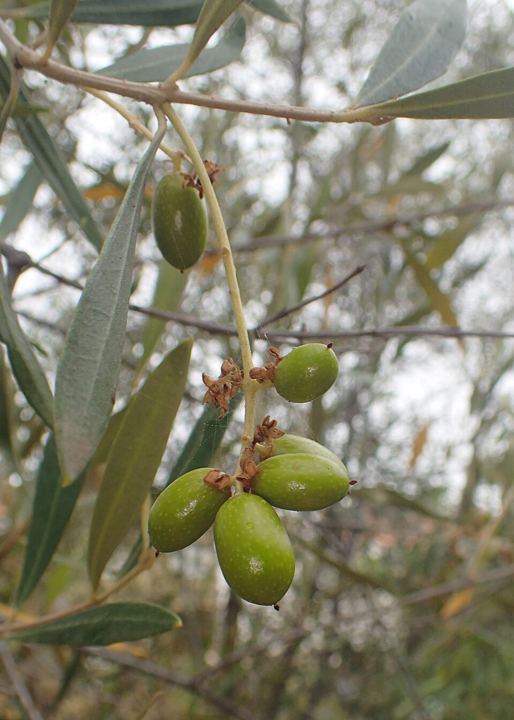
Photos
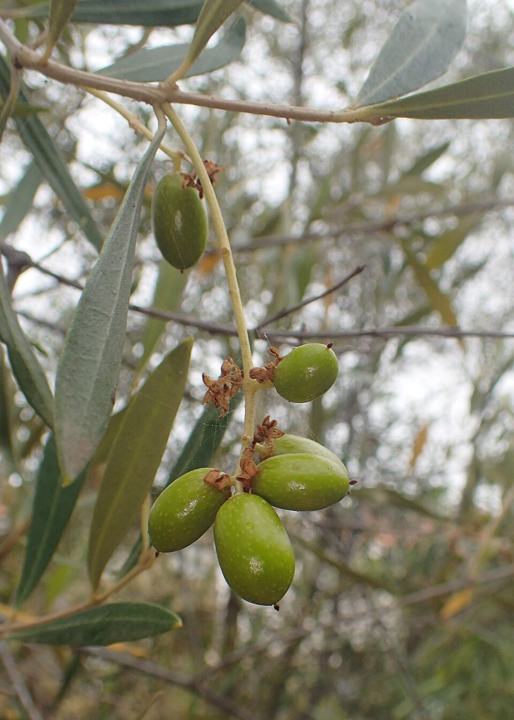
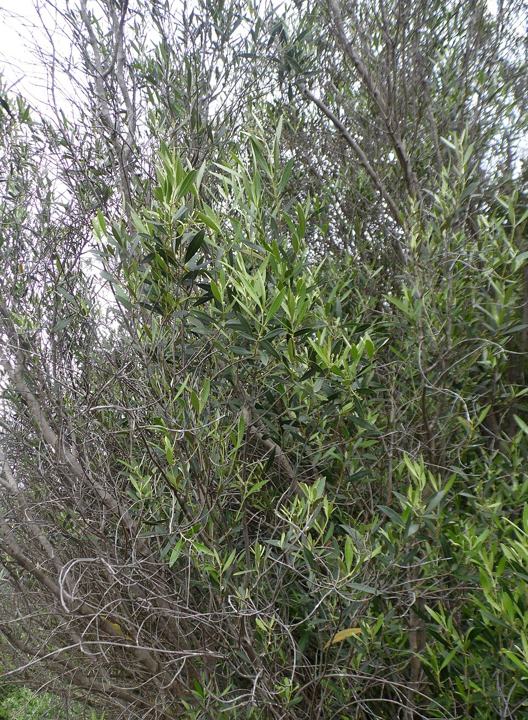
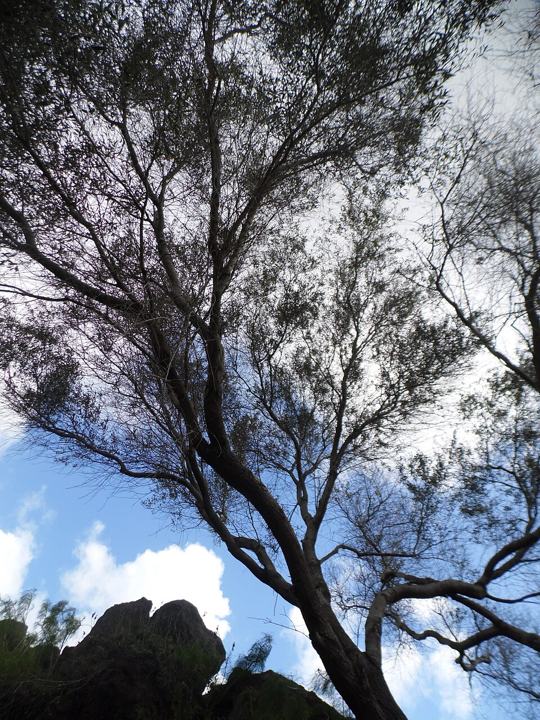
Description
Shrub or small tree, much branched, which can exceed 6 m in height, with grey bark. Leaves green, glossy on the upper side and white-scaly beneath, lanceolate, 4-8 cm long. Flowers small, whitish, in short axillary inflorescences. Fruit ellipsoid, fleshy, dark brown and glossy when ripe. Flowers in spring.
Propagation and growing
Its fruit, a small edible black olive, encloses a hard seed that is very difficult to germinate. Somewhat better success can be had by sowing seeds collected from the ground from the previous season. It can also be propagated vegetatively from cuttings using rooting hormones. The plants are vigorous and do not usually cause problems once germinated. Growth is very slow, and it takes several years for the plant to reach one metre in height. Because germination is difficult, it is not usually available in nurseries, and it must be ordered well in advance.
Garden use
This small tree has great ornamental value and looks very beautiful in gardens when used as a single specimen. It is highly resistant to lack of moisture and has high conservation value, since wild specimens are scarce because of the felling it suffered in the past for its prized wood, which burns well even when green. It needs no special care or maintenance. It is an essential element in restoring the thermophilous woodland, now almost vanished from the landscape of our islands. It is an evergreen tree that can reach heights of up to 15 metres. Its wood has long been highly valued, especially in turnery, for walking sticks, various household utensils and staffs for the “juego del palo” (traditional Canarian stick-fighting). Grown as a fruit tree, it yields oil. As an ornamental it is a rewarding species, as it accepts poor soils and also withstands long periods of drought. It takes very well to pruning and transplanting. It is ideal for gardens, squares and parks; it can also be used on slopes to check erosion, since in the wild it grows in rocky places and on cliffs. Moderate watering is recommended at first after planting. It needs little maintenance.
Notes
It is valued for its medicinal (blood-pressure-lowering) properties, and, together with palm fronds or “palmitos”, it is traditionally blessed on Palm Sunday.
Protection status
Annex II of the Order of 20 February 1991 on the protection of wild flora of the Canary Islands.
Potential vegetation
Junipero-Oleetum cerasiformis.
Source: Cabildo de Tenerife, “Guía de especies vegetales”, CC BY. Translated from Spanish by us.
Bioclimatic belts
Warm coastal belt
- Inframediterranean, semi-arid (upper level)
- Inframediterranean, dry, without trade-wind fog
Warm mid-slope belt
- Thermomediterranean, semi-arid (lower level)
- Thermomediterranean, semi-arid (upper level), without trade-wind fog
- Thermomediterranean, dry (lower level), without trade-wind fog
Districts
Anaga · Metropolitan area (Santa Cruz and La Laguna) · Acentejo · La Orotava Valley · Daute · Teno · South-west · Abona · South-east · Güímar Valley