
Dama (Parolinia intermedia)
Parolinia intermedia Svent. & Bramwell · Family: Brassicaceae
Dry sunny clay-and-stone slopes, old basalts and recent lava fields, 50–400 m in the west and south-west of the island.
Where it grows on Tenerife
Grows in: South coast · North coast
Zones are derived approximately from the Cabildo belts.
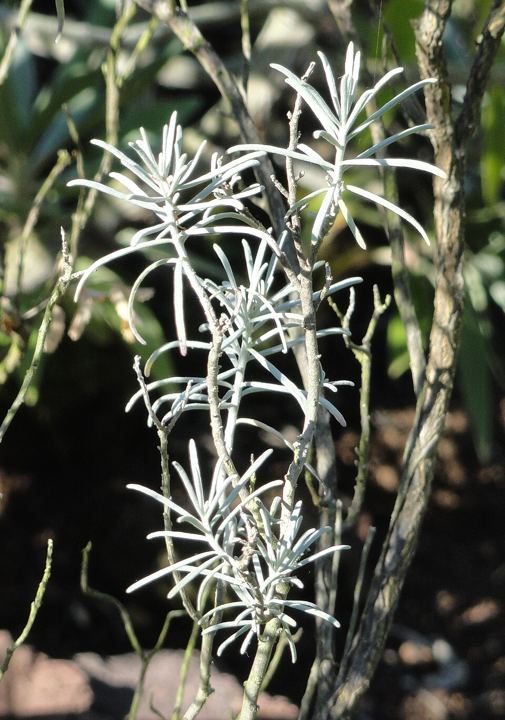
Photos
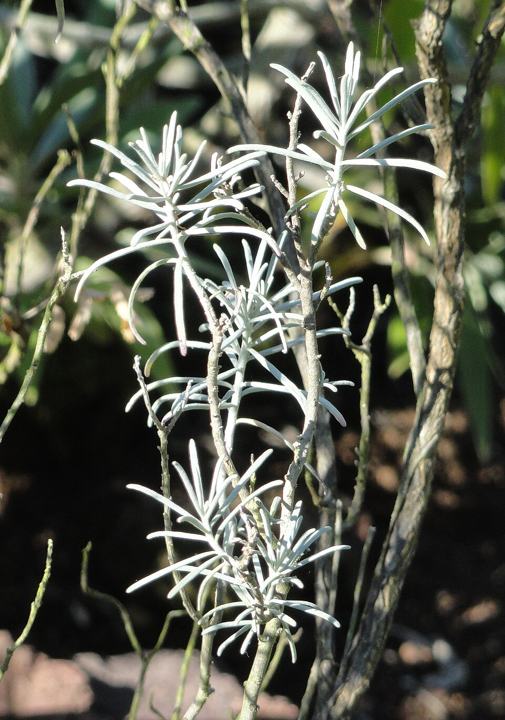
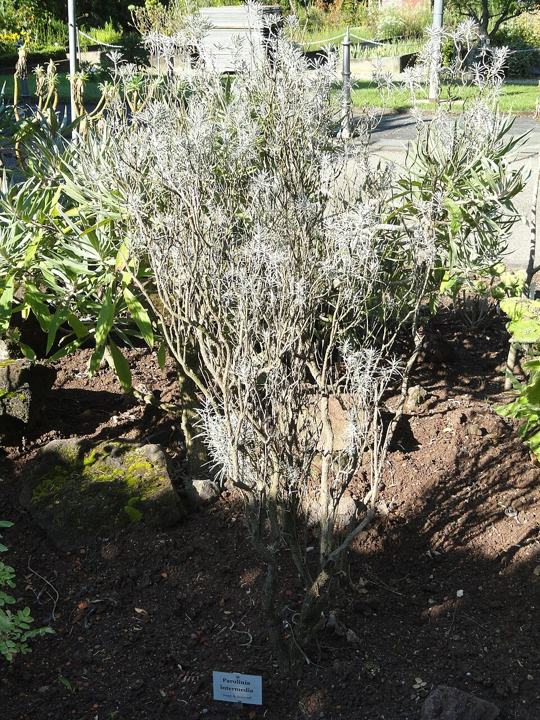
From Wikipedia
Parolinia intermedia is a species of flowering plants in the family Brassicaceae. It is native to the island of Tenerife in the Canary Islands of Spain.
Text from Wikipedia, CC BY-SA 4.0: Parolinia intermedia
Description
A shrub up to 1.3 m tall, with erect branches. Leaves linear. Inflorescences are racemes of pink flowers. Fruits elongated, ending in two pronounced bifid appendages. Flowers in spring and fruits in summer.
Propagation and growing
The fruits of the "dama" are elongated siliques containing between 10 and 20 small seeds that germinate easily, producing vigorous, fast-growing plants that are undemanding as to soil and need full sun with moderate watering. They are easy plants to grow and handle, and they soon become woody. It is not usually available in native-flora nurseries, and plants must be ordered at least a year in advance.
Garden use
This pretty, broom-like shrub flowers in spring, with showy racemes of small pink flowers. It is a rare and vulnerable Tenerife endemic and therefore has high conservation and scientific value, all the more so as the genus is endemic to the Canaries. Its value as an ornamental is also high, thanks to its beautiful flowering and the unusual look of its fine, elongated, almost cylindrical leaves. For all these reasons it is an excellent species for landscaping along the whole west and south-west side of the island, between 50 and 400 m above sea level. It needs no special maintenance or watering and tolerates moderate pruning.
Notes
Endemic to the island of Tenerife, found in the Teno area (Buenavista), Chío, Playa Santiago (Guía de Isora) and Montaña de Guaza (Arona). Its relative rarity and botanical interest, together with the absence of other species of the same genus on the island, stimulate…
Protection status
Annex II of the Order of 20 February 1991 on the protection of wild flora of the Canary Islands.
Potential vegetation
Ceropegio-Euphorbietum balsamiferae; Periploco-Euphorbietum canariensis.
Source: Cabildo de Tenerife, “Guía de especies vegetales”, CC BY. Translated from Spanish by us.
Bioclimatic belts
Warm coastal belt
- Inframediterranean, hyperarid
- Inframediterranean, arid
- Inframediterranean, semi-arid (lower level)
Districts
Teno · South-west · Abona · South-east