
Canary Island date palm
Phoenix canariensis hort. ex Chabaud · Family: Arecaceae
Dry sunny slopes and ravine beds of the low and middle zones, often forming palm groves. Typical of thermophilous woodland.
Where it grows on Tenerife
Grows in: South coast · North coast · South, 300–1000 m · North, 300–1000 m
Zones are derived approximately from the Cabildo belts.
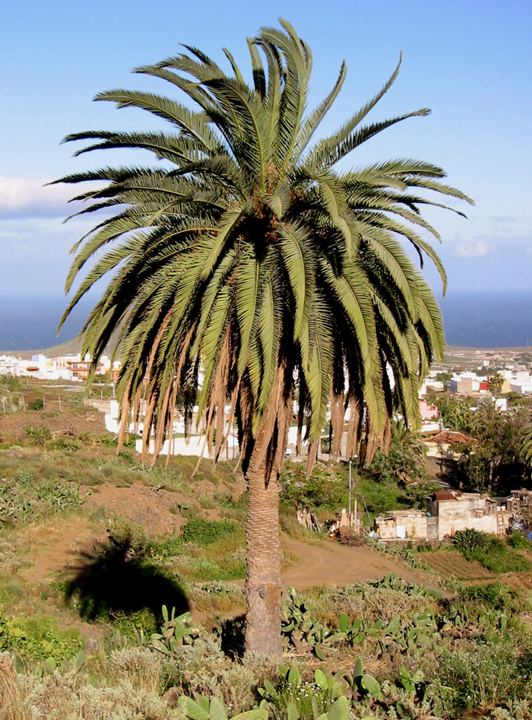
Photos
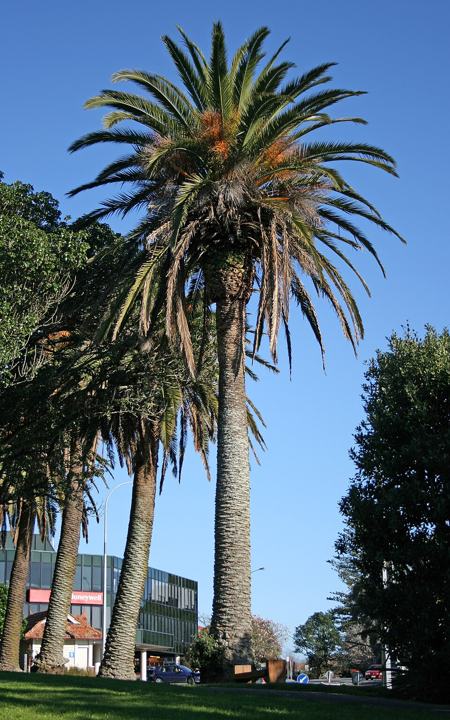
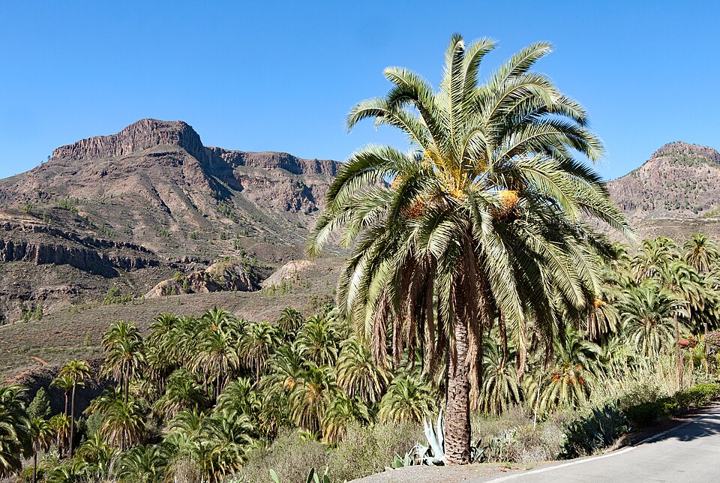
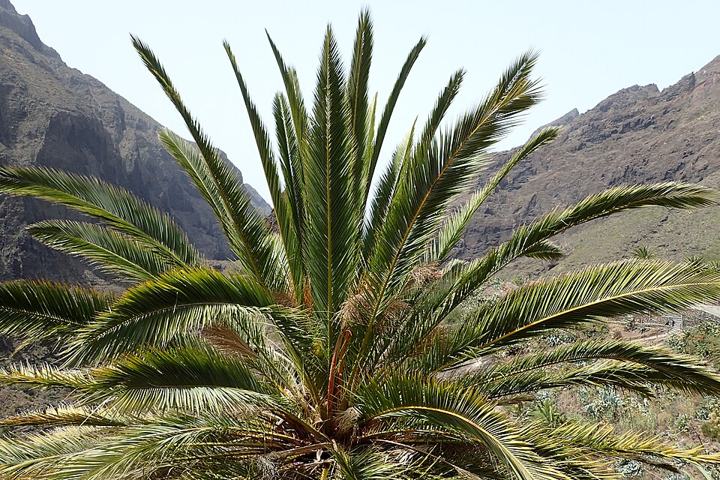
From Wikipedia
Phoenix canariensis, the Canary Island date palm, is a species of flowering plant in the palm family Arecaceae, native to the Canary Islands off the coast of Northwestern Africa. It is a relative of Phoenix dactylifera, the true date palm. It is the natural symbol of the Canary Islands, together with the canary Serinus canaria.
Text from Wikipedia, CC BY-SA 4.0: Phoenix canariensis
Description
A dioecious palm up to 20 m tall, with a thick, straight trunk covered by the remains of the leaf bases. Leaves large, pinnate, green and arching, gathered in a large terminal crown, with a spiny-based rachis and crowded, linear, pointed leaflets. The lower leaflets are transformed into strong spines. Cream flowers in much-branched panicles arising among the leaves. Fruits are orange berries. Flowers in late spring and summer.
Propagation and growing
The dates (“támaras”) of the female specimens of this monocot have little pulp and, although edible, are not highly prized. The single, typically grooved seed they contain germinates very easily in one or two months. For cultivation it needs a mild climate, a sunny position and sandy loam soils with neutral to basic pH (J. C. Delgado 1986). It is usually available in nurseries, and cultivation takes between two and four years depending on the number of leaves and size required for the specimens. It prefers warm conditions and sunny positions, although it is one of the palms that best withstand cold. It needs deep, relatively moist soils. Propagation by seed.
Garden use
The ornamental use of this emblematic plant, the plant symbol of the Canary archipelago, has been widespread for many years, not only on the islands but also in the rest of the world. It is a species that adapts easily to different types of soil, climates and environments, except very cold climates and coastal settings directly exposed to salt spray (maresía). It needs little maintenance, but it should be watered during the dry season of the first year after planting. It requires annual pruning, which should not be excessive so as not to detract from the beauty of its form, taking care to remove the poisonous spines at the base of the leaves. A species of great ornamental value, as shown by its presence in island gardens. It is very hardy, as it adapts very well to different environments except coastal areas very close to the sea, where the influence of the “maresía” can harm its physiological development. It does not tolerate very low temperatures or frost and needs little care. Dry leaves should be removed from time to time, and it can be transplanted, but with specific measures to avoid damaging its root ball. Seeds are easy to collect. Ideal for roundabouts, parks and gardens in general; it can be planted as single specimens or in groups like palm groves. Grown in various parts of the world, it is quite common in parks and gardens as a single feature specimen, as well as in rows along promenades and avenues. Resistant to wind and to proximity to the sea. It tolerates urban pollution. The ornamental use of this emblematic plant, the plant symbol of the Canary archipelago, has been widespread for many years, not only on the islands but also in the rest of the world. It is a species that adapts easily to different types of…
Notes
It hybridises with “Phoenix dactylifera” and possibly with “P. atlantica” and “P. sylvestris”. Its leaflets are used to make mats and other handicrafts. Its fruits, although edible, are of poor quality, so they are used for…
Protection status
Annex II of the Order of 20 February 1991 on the protection of wild flora of the Canary Islands.
Potential vegetation
Junipero-Oleetum cerasiformis; Periploco laevigatae-Phoenicetum canariensis.
Source: Cabildo de Tenerife, “Guía de especies vegetales”, CC BY. Translated from Spanish by us.
Bioclimatic belts
Warm coastal belt
- Inframediterranean, semi-arid (lower level)
- Inframediterranean, semi-arid (upper level)
- Inframediterranean, dry, without trade-wind fog
- Inframediterranean, dry, with trade-wind fog
Warm mid-slope belt
- Thermomediterranean, semi-arid (lower level)
- Thermomediterranean, semi-arid (upper level), without trade-wind fog
- Thermomediterranean, semi-arid (upper level), with trade-wind fog
- Thermomediterranean, dry, with trade-wind fog
- Thermomediterranean, dry (lower level), without trade-wind fog
- Thermomediterranean, subhumid, with trade-wind fog
Districts
Anaga · Metropolitan area (Santa Cruz and La Laguna) · Acentejo · La Orotava Valley · Daute · Teno · South-west · Abona · South-east · Güímar Valley