
Palo blanco (Picconia excelsa)
Picconia excelsa (Aiton) DC. · Family: Oleaceae
Typical of the laurel forest, tolerant of varying humidity, at 600–1,000 m.
Where it grows on Tenerife
Grows in: North coast · North, 300–1000 m · Above 1000 m
Zones are derived approximately from the Cabildo belts.
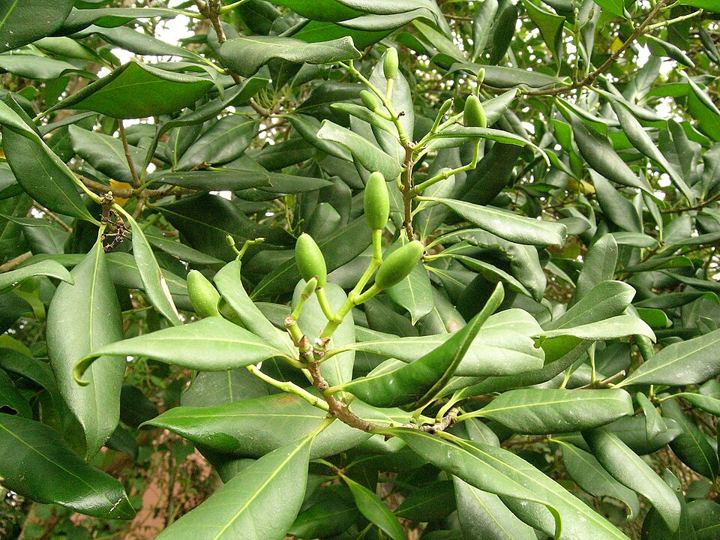
Photos
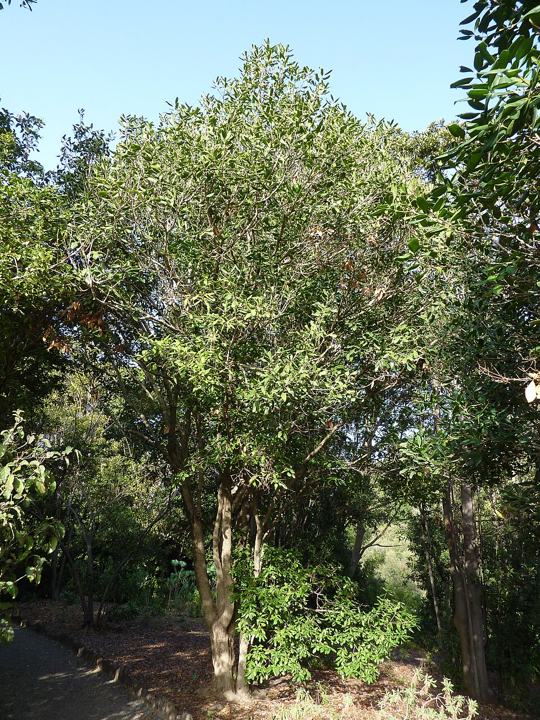
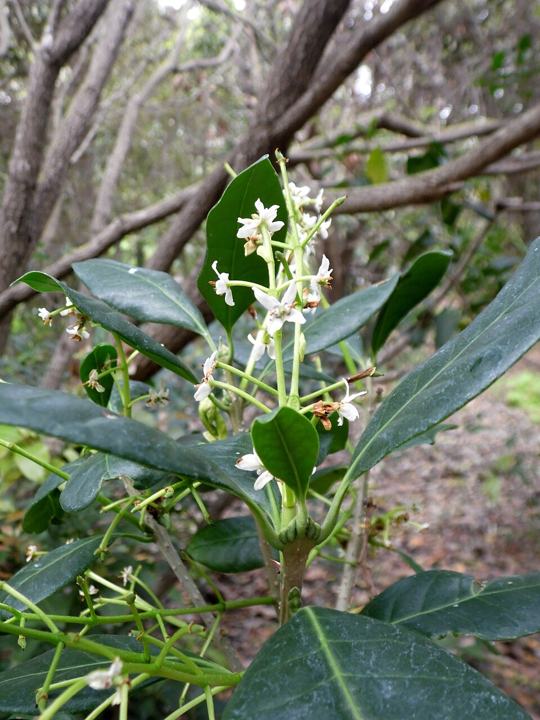
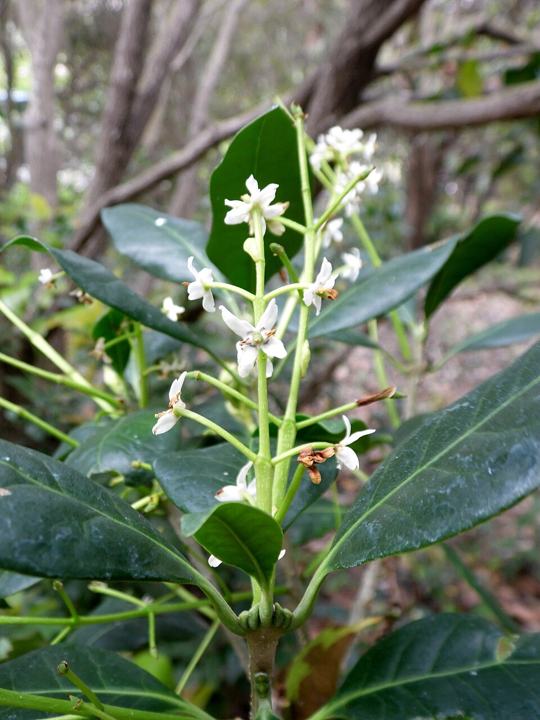
From Wikipedia
Picconia excelsa, commonly known as palo blanco, pau blanco, or branqueiro, is a species of tree in the family Oleaceae. It is endemic to Macaronesia, occurring only on Madeira and the Canary Islands.
Text from Wikipedia, CC BY-SA 4.0: Picconia excelsa
Description
Evergreen tree 10-15 m tall, with greyish, rough bark. Leaves opposite, leathery, ovate-elliptic, 6-10 cm long, dark green and glossy, with slightly rolled margins. Flowers white, in terminal or subterminal racemose inflorescences. Fruit oblong-ovoid, black. Flowers in spring.
Propagation and growing
The fruits of this species ripen during the summer: dark “olives” containing a seed that is somewhat difficult to germinate. The emerging seedlings are sturdy and grow quickly. It is a species undemanding as to soil, with great vigour and resistance to very sunny, dry conditions. Although there is no reason for it, this plant is not usually found in native-plant nurseries in sufficient quantity and must be ordered at least a year and a half in advance. After one year in a container it can exceed half a metre in height.
Garden use
This beautiful, magnificent tree has excellent ornamental qualities thanks to the gloss of its leathery leaves of a characteristic green, its showy, abundant white spring flowering and the attractive whitish colour of its thick trunk. Its conservation value is also high because of its present scarcity, and it is an interesting species from a scientific point of view, since its closest phylogenetic relatives are found in eastern Australia (genus “Notelaea”). It is a vigorous, fast-growing and very hardy species that needs little care once planted. It needs moderate watering during the dry season of the first year. An evergreen tree reaching between ten and fifteen metres in height, its wood has been used in cabinet-making and construction. It is a species of the thermophilous laurel forest (monteverde), although it can be found throughout that forest's range, so it needs humid conditions and fertile soils; planting in not overly sunny areas is recommended, which is why it is recommended for recreational areas and squares. It tolerates moderate pruning.
Notes
Also present in Madeira. Its wood is used in cabinet-making.
Protection status
Annex II of the Order of 20 February 1991 on the protection of wild flora of the Canary Islands.
Potential vegetation
Visneo-Arbutetum canariensis; Lauro-Perseetum indicae; Diplazio-Ocoteetum foetentis.
Source: Cabildo de Tenerife, “Guía de especies vegetales”, CC BY. Translated from Spanish by us.
Bioclimatic belts
Warm coastal belt
- Inframediterranean, dry, with trade-wind fog
Warm mid-slope belt
- Thermomediterranean, semi-arid (upper level), with trade-wind fog
- Thermomediterranean, dry, with trade-wind fog
- Thermomediterranean, subhumid, with trade-wind fog
- Thermomediterranean, humid, with trade-wind fog
Temperate belt of laurel and pine forest
- Mesomediterranean, lower, dry, with trade-wind fog
- Mesomediterranean, lower, subhumid, with trade-wind fog
Districts
Anaga · Metropolitan area (Santa Cruz and La Laguna) · La Orotava Valley · Daute · Güímar Valley