
Canary Island pine
Pinus canariensis C. Sm. ex DC. in Buch · Family: Pinaceae
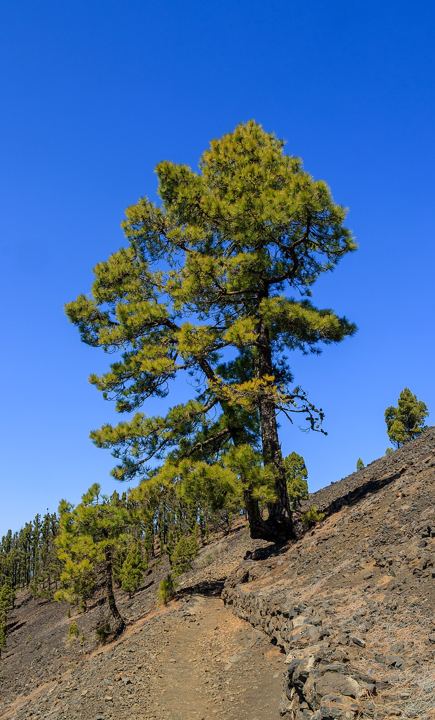
The dominant species of Canary pine forests; on Tenerife it forms large stands at 1,200–2,000 m, occurs higher and descends almost to the coast, as around Icod.
Where it grows on Tenerife
Grows in: South coast · North coast · South, 300–1000 m · North, 300–1000 m · Above 1000 m
Zones are derived approximately from the Cabildo belts.
Photos
From Wikipedia
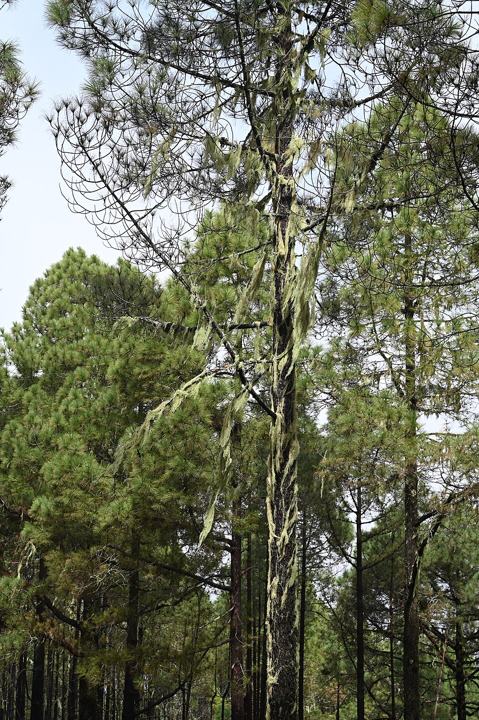
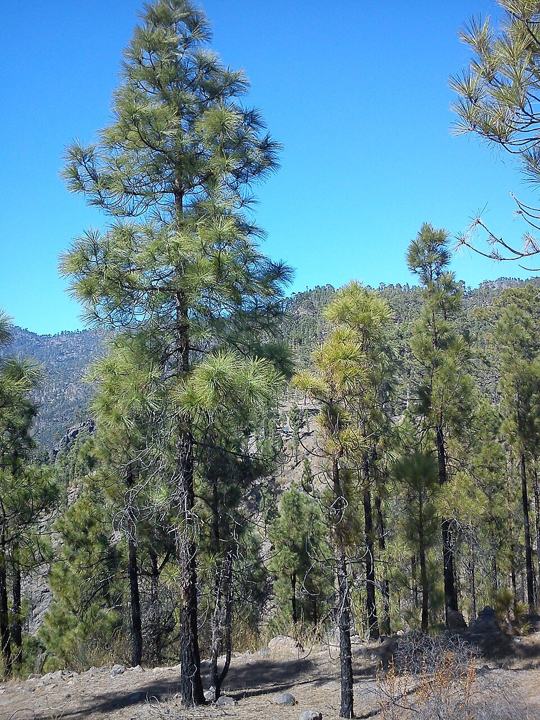
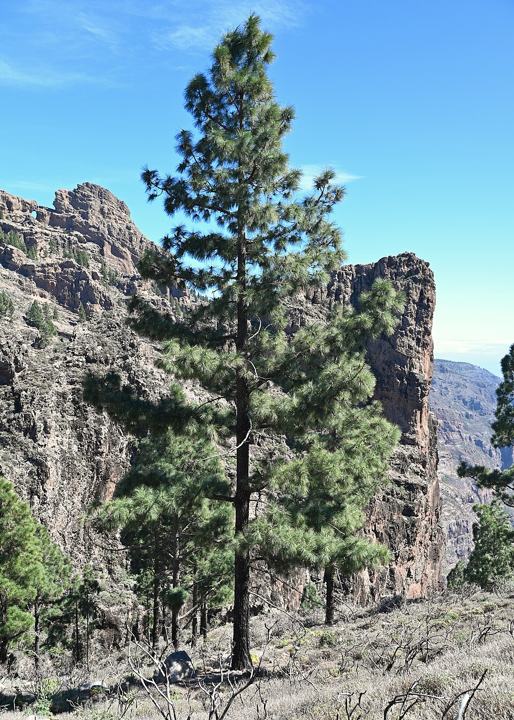
Pinus canariensis, the Canary Island pine or Canary pine, is a species of conifer in the family Pinaceae. A pine, it is a large tree, endemic to the outer Canary Islands of the Atlantic Ocean.
Text from Wikipedia, CC BY-SA 4.0: Pinus canariensis
Description
Tree 20-30 m tall, though it can far exceed that height, with a straight trunk, thick reddish-brown bark and a dense crown. Needles in bundles of three, 20-30 cm long, slender, sharp-pointed, light green. Male cones oblong-ovoid, clustered, yellowish-brown. Female cones solitary, ovate-conical, 15-20 cm long, very short-stalked and symmetrical, glossy brown. Flowers in spring.
Propagation and growing
The female “inflorescences” (strobili) of the Canary Island pine, once fertilised and after ripening for two years, turn into cones containing countless winged seeds (two per cone scale). These seeds, collected in summer, are stored in a dry place and sown with the first rains after soaking them in water for 24 hours; they germinate easily and quickly. Seedlings are vigorous and hardy but slow-growing, not reaching half a metre in height after a year in a container. They are delicate to transplant, and the roots should not be bared when doing so. Once planted out in the ground, growth is faster, especially in the first years. It is usually available in nurseries in sufficient quantity.
Garden use
This majestic endemic pine has a broad ecological range (300-2000 m above sea level) and great resistance to lack of moisture. It needs hardly any care and can reach gigantic sizes. It has been widely used in reforestation within the pine-forest zone and, regrettably, in other vegetation zones too. It ought to be used more often in landscaping of infrastructure, since its emblematic character, majestic habit and great hardiness and adaptability make it an ideal species for this purpose. It is an important species in that it represents, or characterises, a particular bioclimatic zone. It is resistant to cold and to excessive heat, and undemanding as to soil, its roots growing and developing in both stony and clayey ground. It is easy to grow, tolerates pruning and, in suitable areas, only needs watering after planting. It is recommended for squares, gardens, roundabouts or slopes, provided its roots cannot damage the ground surface over time. Transplanting it beyond a certain size is not advisable, as such work can seriously damage its roots.
Notes
It is one of the most elegant pines. It yields a highly prized resinous heartwood (“tea”) and has the peculiarity of forming buds on old wood, which cover it with needles and give it a very ornamental appearance, an effect that can be enhanced by deliberate pruning…
Protection status
Annex III of the Order of 20 February 1991 on the protection of wild flora of the Canary Islands.
Potential vegetation
Sideritido solutae-Pinetum canariensis.
Source: Cabildo de Tenerife, “Guía de especies vegetales”, CC BY. Translated from Spanish by us.
Bioclimatic belts
Warm coastal belt
- Inframediterranean, dry, without trade-wind fog
- Inframediterranean, dry, with trade-wind fog
Warm mid-slope belt
- Thermomediterranean, semi-arid (lower level)
- Thermomediterranean, semi-arid (upper level), without trade-wind fog
- Thermomediterranean, semi-arid (upper level), with trade-wind fog
- Thermomediterranean, dry, with trade-wind fog
- Thermomediterranean, dry (lower level), without trade-wind fog
- Thermomediterranean, subhumid, with trade-wind fog
- Thermomediterranean, dry (upper level), without trade-wind fog
Temperate belt of laurel and pine forest
- Mesomediterranean, lower, semi-arid (upper level), without trade-wind fog
- Mesomediterranean, lower, dry, with trade-wind fog
- Mesomediterranean, lower, dry, without trade-wind fog
- Mesomediterranean, lower, subhumid, with trade-wind fog
- Mesomediterranean, lower, subhumid, without trade-wind fog
- Mesomediterranean, lower, humid, with trade-wind fog
- Mesomediterranean, upper, dry, without trade-wind fog
- Mesomediterranean, upper, subhumid, without trade-wind fog
- Mesomediterranean, upper, humid, without trade-wind fog
Districts
Anaga · Metropolitan area (Santa Cruz and La Laguna) · Acentejo · La Orotava Valley · Daute · South-west · Abona · South-east · Güímar Valley · Central massif (Teide)