
Balo (Plocama)
Plocama pendula Aiton · Family: Rubiaceae
Dry scrub of the lowlands and coast, dry stony slopes and open ravine beds.
Where it grows on Tenerife
Grows in: South coast · North coast
Zones are derived approximately from the Cabildo belts.
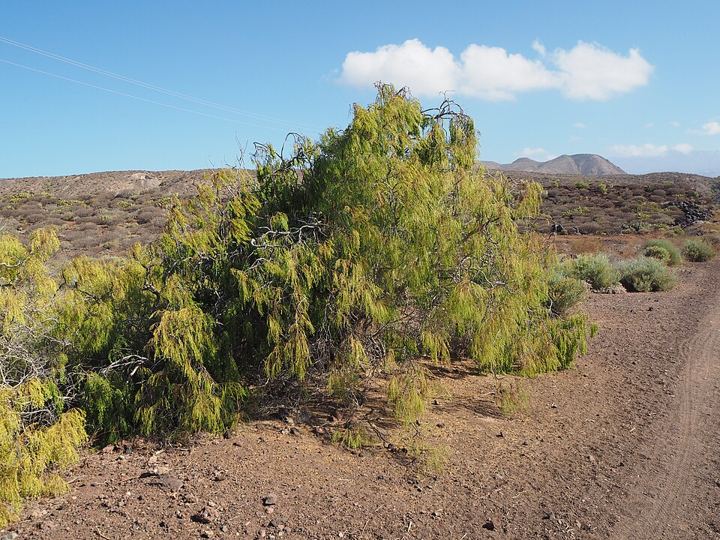
Photos
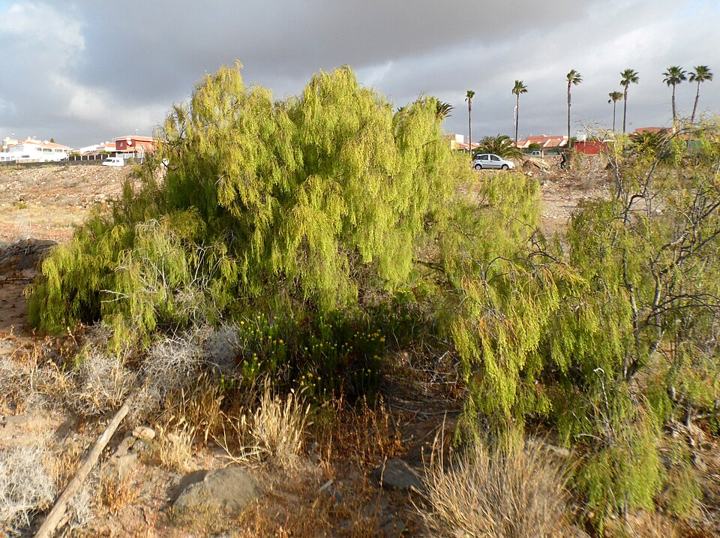
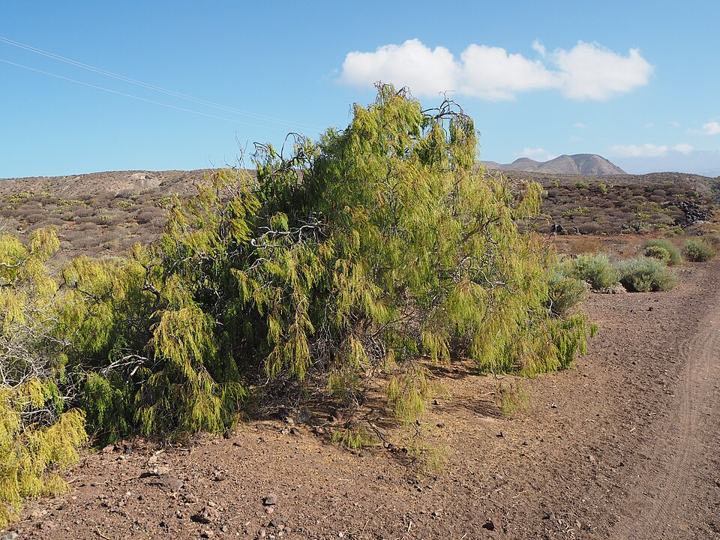
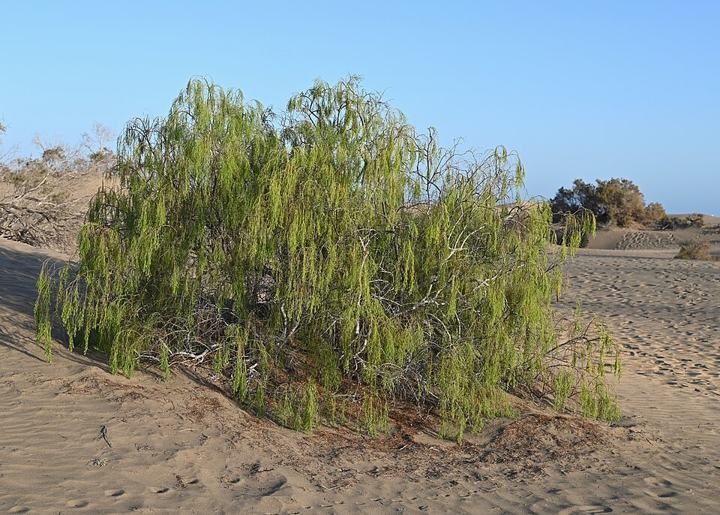
From Wikipedia
Plocama pendula is a species of flowering plant in the coffee family Rubiaceae, endemic to the Canary Islands. It is a shrub growing up to 2 m (6 ft 7 in), with filiform (very narrow leaves) and minute flowers grouped near the tips of slender, pendulous branches. The fruit, a berry, is black.
Text from Wikipedia, CC BY-SA 4.0: Plocama pendula
Description
Shrub with a very pungent smell, up to 2 m tall, with flexible, arching and drooping branches. Leaves thread-like, up to 5-6 cm long, pale green. Flowers tiny, whitish, clustered in an almost terminal position. Fruits small, globose and fleshy, turning blackish when ripe. Flowers in spring.
Propagation and growing
The fruits of balo are small berries, translucent at first but turning blackish when ripe. The seeds, once cleaned, germinate easily and quickly, producing fast-growing plants; they need deep soils (cultivation in deep containers) and high temperatures for optimum growth. It is a very drought-resistant plant that is not usually available in native-plant nurseries. Its cultivation should be ordered at least a year in advance.
Garden use
This shrub with drooping branches, which can reach up to 4 m tall, has a weeping habit reminiscent of the weeping willow and a distinctive silhouette that characterises the landscapes of all the low-lying areas on the island's southern slope (SE and SW). It is of particular scientific interest as a species and genus endemic to the Canary Islands, and of great ecological value, since its fruits in summer form a key part of the diet of reptiles and it is pollinated by numerous insects. It tolerates saline but deep soils and needs no maintenance or watering. For all these reasons, in our view, this plant has an important role to play as an ornamental for landscaping road infrastructure (verges, embankments, roundabouts, etc.) at mid and low elevations (0-500 m a.s.l.).
Notes
It is found on all the islands except Lanzarote.
Protection status
Not listed.
Potential vegetation
Ceropegio-Euphorbietum balsamiferae; Periploco-Euphorbietum canariensis.
Source: Cabildo de Tenerife, “Guía de especies vegetales”, CC BY. Translated from Spanish by us.
Bioclimatic belts
Warm coastal belt
- Inframediterranean, hyperarid
- Inframediterranean, arid
- Inframediterranean, semi-arid (lower level)
Districts
Anaga · Metropolitan area (Santa Cruz and La Laguna) · Acentejo · Teno · South-west · Abona · South-east · Güímar Valley