
Cherry plum
Prunus cerasifera Ehrh. · Family: Rosaceae
Withstands a wide range of climates, warm and cold. With enough moisture it accepts poor and chalky soils.
Where it grows on Tenerife
Grows in: South coast · North coast · South, 300–1000 m · North, 300–1000 m · Above 1000 m
Zones are derived approximately from the Cabildo belts.
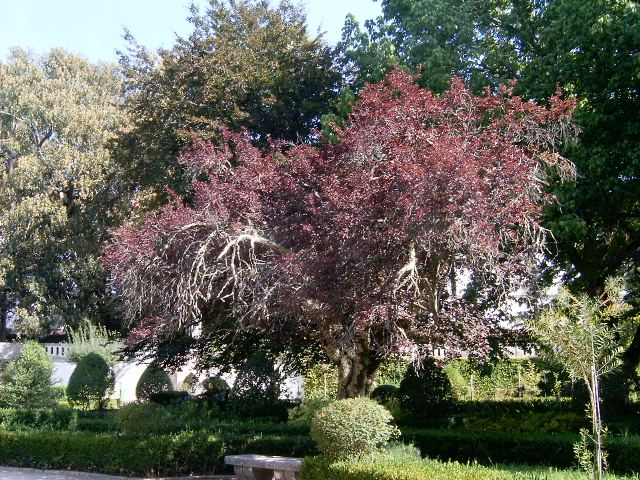
Photos
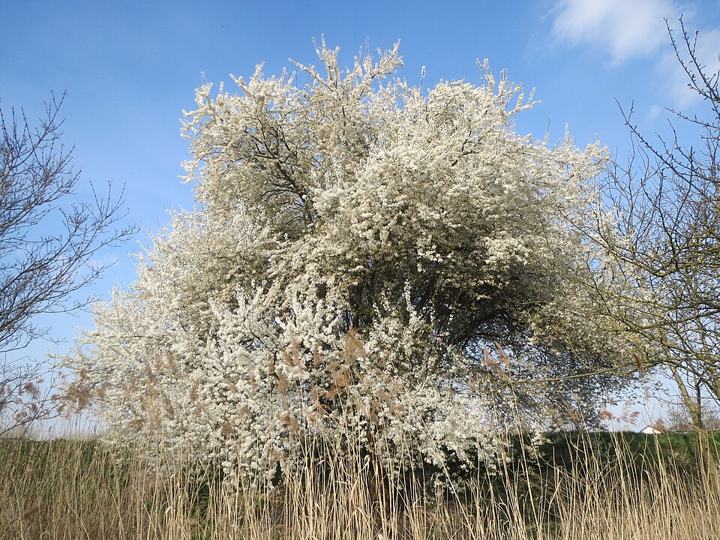
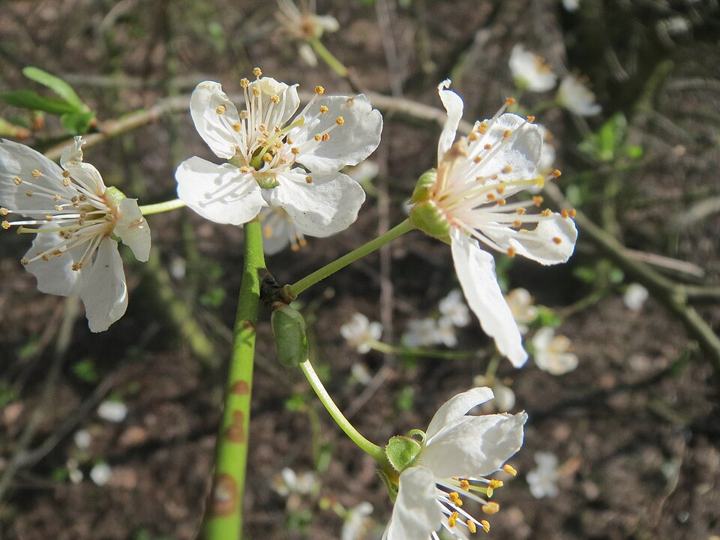
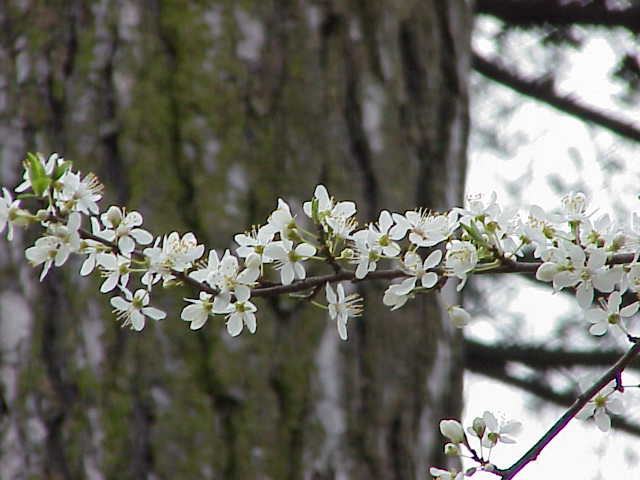
From Wikipedia
Prunus cerasifera is a species of plum known by the common names cherry plum and myrobalan plum. Native to Eurasia and naturalized elsewhere, P. cerasifera is believed to be one of the parents of the cultivated plum.
Text from Wikipedia, CC BY-SA 4.0: Prunus cerasifera
Description
Deciduous shrub or small tree, native to the Caucasus and Western Asia, no more than 8–9 m tall. Leaves simple, ovate to obovate with an acute tip and angular base, alternate, dark green turning wine-purple in autumn. The margin is toothed and the surface glabrous, except for the midrib on the underside. Flowers solitary, white or pinkish, appearing before the leaves in spring. Fruit a drupe on a short stalk, reddish, ripening in summer.
Propagation and growing
Grown as an ornamental plant; it needs a sunny position and moderate watering. Flowering and fruiting take place between March and April. Propagation by seed and cuttings.
Garden use
A deciduous tree. Its fruits are barely edible, and with proper maintenance it can reach 8 metres in height. Ideal for parks, gardens and squares, as well as short rows of street trees. It tolerates pruning and can be kept as a shrub branching from the base.
Notes
Its attractive purple foliage makes it one of the ornamental "Prunus" species par excellence.
Source: Cabildo de Tenerife, “Guía de especies vegetales”, CC BY. Translated from Spanish by us.
Bioclimatic belts
Warm coastal belt
- Inframediterranean, semi-arid (lower level)
- Inframediterranean, semi-arid (upper level)
- Inframediterranean, dry, without trade-wind fog
- Inframediterranean, dry, with trade-wind fog
Warm mid-slope belt
- Thermomediterranean, semi-arid (lower level)
- Thermomediterranean, semi-arid (upper level), without trade-wind fog
- Thermomediterranean, semi-arid (upper level), with trade-wind fog
- Thermomediterranean, dry, with trade-wind fog
- Thermomediterranean, dry (lower level), without trade-wind fog
- Thermomediterranean, subhumid, with trade-wind fog
- Thermomediterranean, dry (upper level), without trade-wind fog
- Thermomediterranean, humid, with trade-wind fog
Temperate belt of laurel and pine forest
- Mesomediterranean, lower, semi-arid (upper level), without trade-wind fog
- Mesomediterranean, lower, dry, with trade-wind fog
- Mesomediterranean, lower, dry, without trade-wind fog
- Mesomediterranean, lower, subhumid, with trade-wind fog
- Mesomediterranean, lower, subhumid, without trade-wind fog
- Mesomediterranean, lower, humid, with trade-wind fog