
Pomegranate
Punica granatum L. · Family: Punicaceae
Needs full sun or a sheltered, very bright spot in warm-temperate climates. Permeable, fertile, deep, well-drained soil, moderately moist to dry.
Where it grows on Tenerife
Grows in: South coast · North coast · South, 300–1000 m · North, 300–1000 m
Zones are derived approximately from the Cabildo belts.
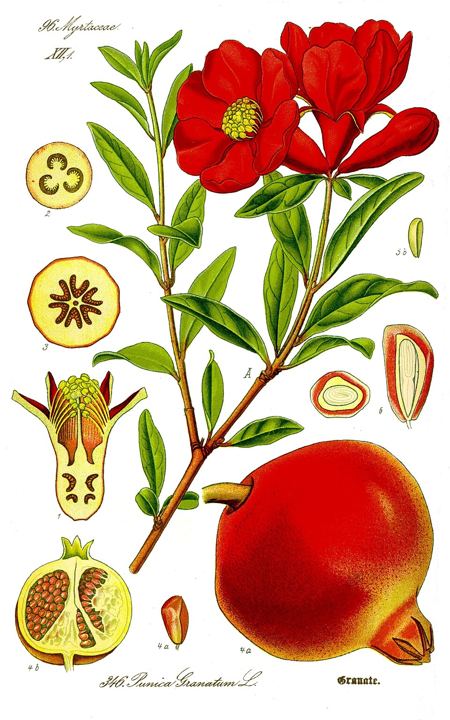
Photos
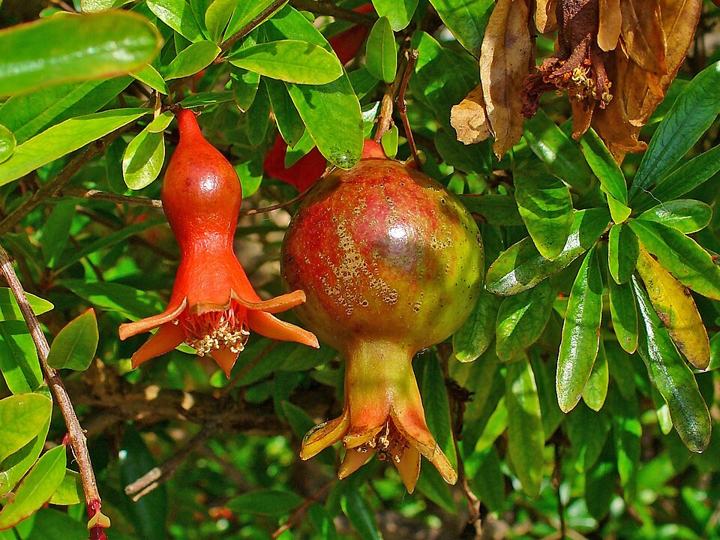
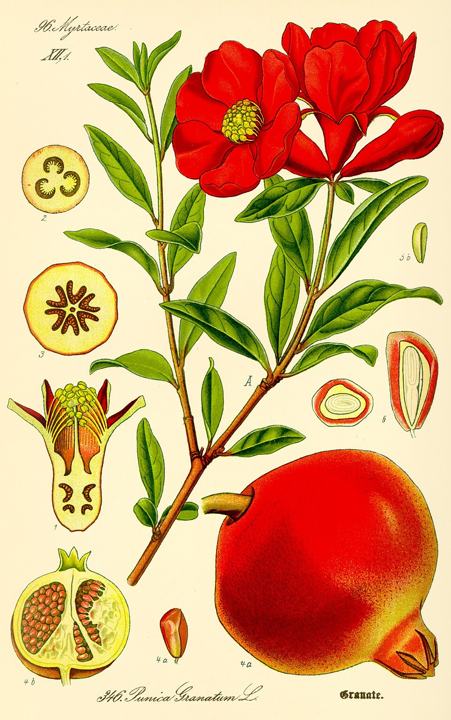
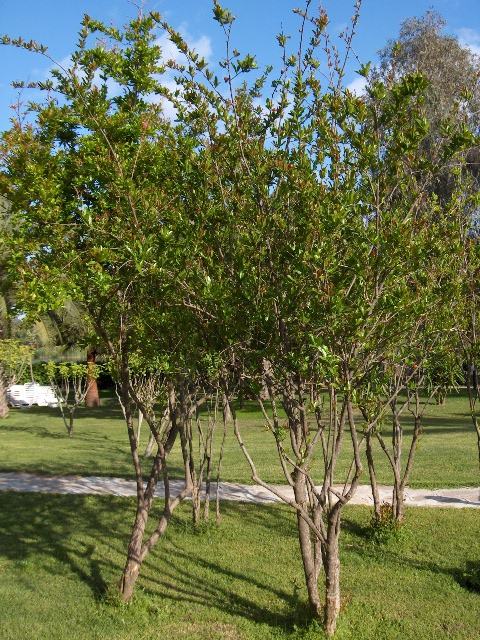
From Wikipedia
The pomegranate (Punica granatum) is a fruit-bearing, deciduous shrub or tree in the family Lythraceae, subfamily Punicoideae, that grows to between 1.5–5 metres (5–16 ft) tall. Rich in symbolic and mythological associations in many cultures, and mentioned in the Old Testament, it originated in the region spanning the Caucasus and the Iranian plateau—including modern-day Iran, Turkmenistan and Afghanistan—and down to Pakistan. Pomegranates were first domesticated by ancient Iranians in the Iranian plateau and nearby regions about 5,000 years ago. They are extensively cultivated for their fruit.
Pomegranate was exported from the Iranian plateau to other parts of Asia including all over the Middle East, Turkey, and India, as well as parts of Africa and Europe. It was also introduced into Spanish America in the late 16th century and into California by Spanish settlers in 1769.
Although the pomegranate is indigenous to Iran and its nearby regions, it is also nowadays cultivated across West Asia, South Asia, Central Asia, north and Sub-Saharan Africa, the drier parts of Southeast Asia, the Mediterranean basin, United States and Chile. The fruit is typically in season in the Northern Hemisphere from September to February, and in the Southern Hemisphere from March to May.
Pomegranate molasses is a key ingredient in traditional Persian cuisine, where it is used to add a rich sweet-sour flavour to dishes such as stews, sauces, and marinades, most notably in classic recipes like fesenjān, kabab torsh and zeytoon parvardeh. The pomegranate and its juice are variously used in baking, cooking, juice blends, garnishes, nonalcoholic drinks, and cocktails.
Text from Wikipedia, CC BY-SA 4.0: Pomegranate
Description
Deciduous shrub or small tree, native to southern Asia and spread around the Mediterranean, reaching 6 m in height, often spiny. Leaves oblong-lanceolate, 3–8 cm long, with a leathery, bright green blade. Flowers showy, orange-red, up to 3 cm across, solitary or in small groups of 2–4 at the tips of the current year's twigs. Characteristic spherical fruits (pomegranates), red when ripe and crowned by the persistent sepals. Flowers in spring–summer.
Propagation and growing
For best growth it needs a sunny position and moderate watering, although it is drought-resistant. With adequate watering it can reach 6 m in height. It flowers and fruits between April and July. Medium growth rate. Propagation by seed, cuttings, layering and grafting.
Garden use
Its flowers are a very striking orange-red, which has encouraged its use in gardening. It takes pruning fairly well and can be planted in gardens and squares. Grown in parks and gardens, in short rows. It is also grown in kitchen gardens and along the edges of paths, often as hedges. It tolerates and needs pruning and trimming. Regular watering, more frequent in summer.
Notes
Widely used in the Mediterranean area, its use is more limited in the Islands.
Source: Cabildo de Tenerife, “Guía de especies vegetales”, CC BY. Translated from Spanish by us.
Bioclimatic belts
Warm coastal belt
- Inframediterranean, hyperarid
- Inframediterranean, arid
- Inframediterranean, semi-arid (lower level)
- Inframediterranean, semi-arid (upper level)
- Inframediterranean, dry, without trade-wind fog
- Inframediterranean, dry, with trade-wind fog
Warm mid-slope belt
- Thermomediterranean, semi-arid (lower level)
- Thermomediterranean, semi-arid (upper level), without trade-wind fog
- Thermomediterranean, semi-arid (upper level), with trade-wind fog
- Thermomediterranean, dry, with trade-wind fog
- Thermomediterranean, dry (lower level), without trade-wind fog
- Thermomediterranean, subhumid, with trade-wind fog