
Flame vine
Pyrostegia venusta (Ker Gawl.) Miers · Family: Bignoniaceae
A tropical or subtropical plant of warm places. Undemanding about soil, preferably fertile, moist and well drained. Needs sun.
Where it grows on Tenerife
Grows in: South coast · North coast · South, 300–1000 m · North, 300–1000 m
Zones are derived approximately from the Cabildo belts.
Photos
From Wikipedia
Pyrostegia venusta, also commonly known as flamevine or orange trumpet vine, is a plant species of the genus Pyrostegia of the family Bignoniaceae originally native to southern Brazil, Bolivia, northeastern Argentina and Paraguay; today, it is also a widely cultivated garden species.
Text from Wikipedia, CC BY-SA 4.0: Pyrostegia venusta
Description
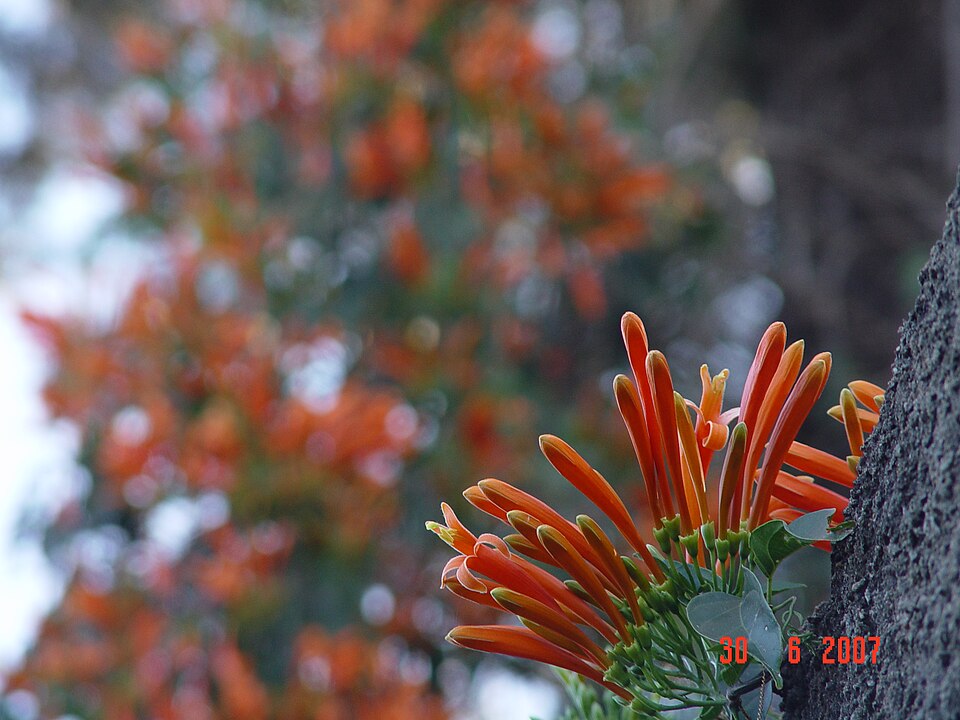
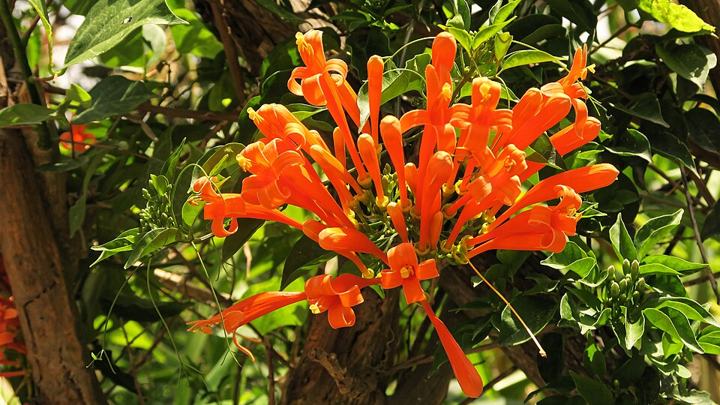
A climbing shrub native to South America (Brazil, Paraguay, Bolivia and Argentina), with angular twigs. Leaves compound, with 2–3 leaflets and thread-like, three-parted tendrils; leaflets ovate to oblong-lanceolate, up to 11 cm long. Flowers in racemes, tubular, with linear lobes, up to 6 cm long, orange. Flowers almost all year round.
Propagation and growing
An evergreen, fast-growing species, propagated by cuttings. It needs a sunny position and some soil moisture, although it can withstand periods of drought. It is very widely grown in the Canaries. Fast-growing. Usually propagated by cuttings and air layering.
Garden use
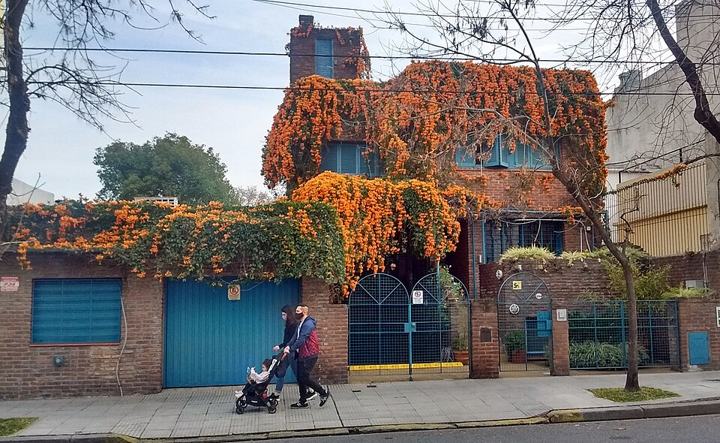
Its rapid growth has made it a much sought-after species for planting schemes. It tolerates regular pruning, which is also advisable, and needs moderate watering. It is recommended in gardening as a climber not only for its fast growth but also for its compact habit and showy flowers. Used to cover walls, fences, banks and pergolas, it needs to be well watered in summer.
Notes
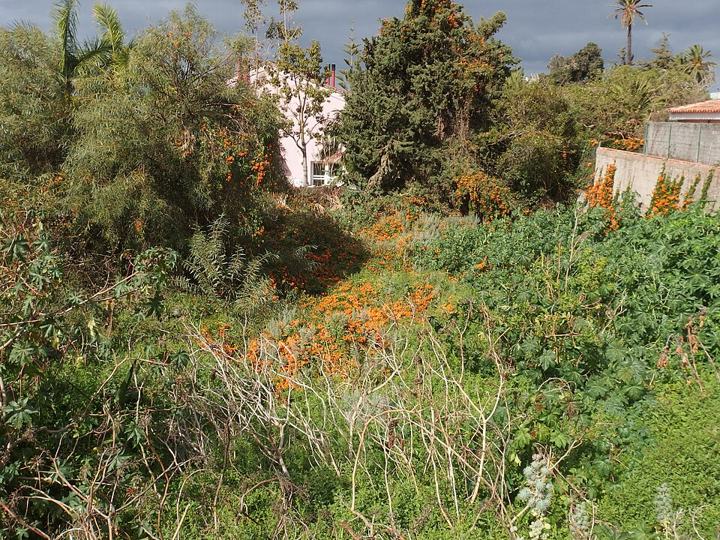
Its flowering is truly striking, like cascades of fire over its supports. Moderately aggressive if the climate is very favourable.
Source: Cabildo de Tenerife, “Guía de especies vegetales”, CC BY. Translated from Spanish by us.
Bioclimatic belts
Warm coastal belt
- Inframediterranean, hyperarid
- Inframediterranean, arid
- Inframediterranean, semi-arid (lower level)
- Inframediterranean, semi-arid (upper level)
- Inframediterranean, dry, without trade-wind fog
- Inframediterranean, dry, with trade-wind fog
Warm mid-slope belt
- Thermomediterranean, semi-arid (lower level)
- Thermomediterranean, semi-arid (upper level), without trade-wind fog
- Thermomediterranean, semi-arid (upper level), with trade-wind fog
- Thermomediterranean, dry, with trade-wind fog
- Thermomediterranean, dry (lower level), without trade-wind fog
- Thermomediterranean, subhumid, with trade-wind fog
- Thermomediterranean, dry (upper level), without trade-wind fog