
White broom (retama)
Retama rhodorhizoides Webb & Berthel. · Family: Fabaceae
Rocky ground and dry sunny slopes at 150–1,000 m, sometimes forming dense stands.
Where it grows on Tenerife
Grows in: South coast · North coast · South, 300–1000 m
Zones are derived approximately from the Cabildo belts.
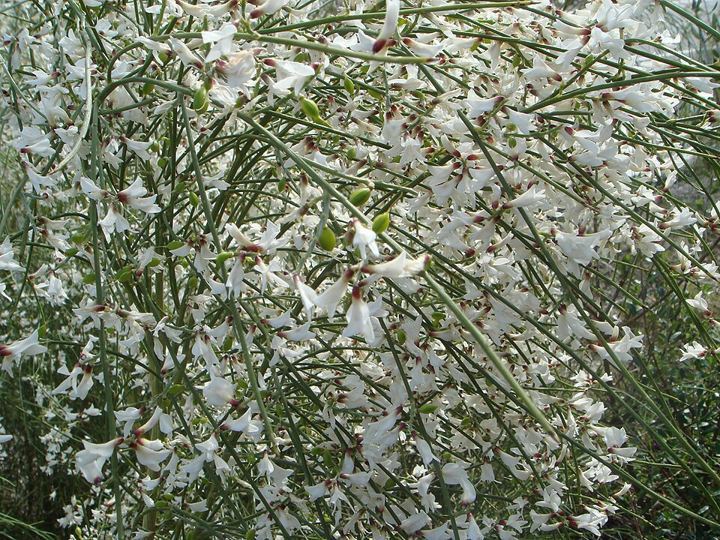
Photos
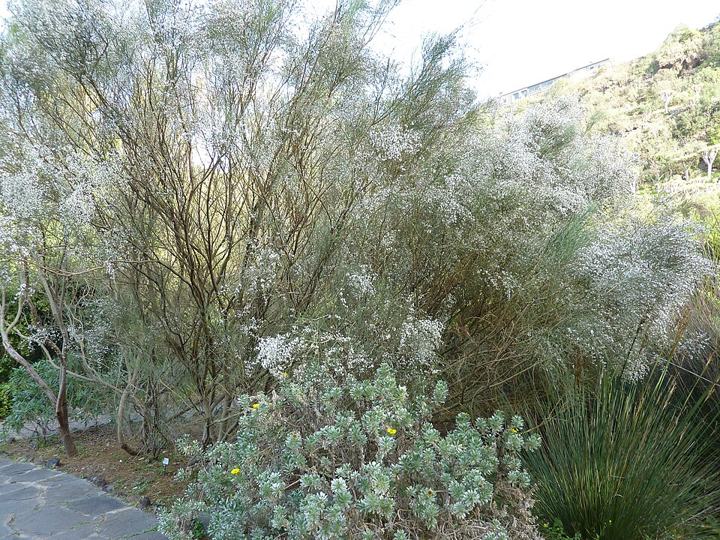
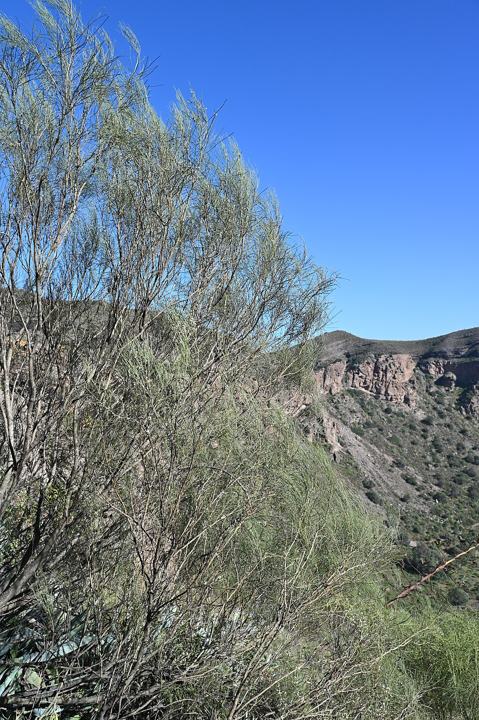
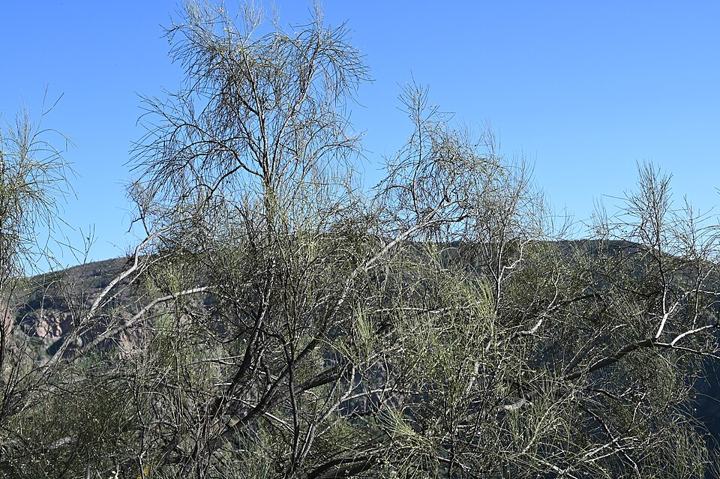
From Wikipedia
Retama rhodorhizoides is a species or subspecies of flowering plant in the family Fabaceae, endemic to the Canary Islands.
Text from Wikipedia, CC BY-SA 4.0: Retama rhodorhizoides
Description
Shrub 2-4 m tall with a broad crown and grooved, flexible, spreading and drooping branches, with greyish-brown bark. Tiny leaves present in winter, shed for the rest of the year. Flowers white and very fragrant, in large, showy, terminal inflorescences. Pods very small, subglobose, woody, brown. Flowers in winter and spring.
Propagation and growing
The fruit of this retama is a small, fleshy, pointed pod whose shell is stuck to the single seed it contains (rarely 2 or 3). The seeds germinate quite well if immersed in boiling water for one minute, bearing in mind that this plant needs warmth at every stage of its cycle, including germination. The seedlings are vigorous and should be grown in a deep container that lets the root grow without circling. They are undemanding as to soil, though they prefer sandy soils, and need little watering and full sun (it is a strongly sun-loving species). Growth is not very fast, and after a year in cultivation they do not reach half a metre in height. It is not usually available in nurseries, and its cultivation should be ordered at least a year and a half in advance. Seed collection takes place from June to August. The time to collect is when the seeds turn brown, by hand-stripping ("milking") them directly from the tree. There are approximately 13,600 seeds per kilo, and processing involves three stages: drying, in which they are put in the sun until they reach optimum ripeness; depulping, in which they are soaked and beaten in a mixer; and sieving, to separate out impurities. In storage at room temperature the seed keeps its germination capacity for at least 2 or 3 years. Pre-germination treatment consists of placing the seeds in boiling water for 5 seconds. Planting spacing is 2 metres and root growth is moderate. Retama rhodorhizoides, or Retama raetam, is grown in a seedbed or in polyethylene trays under controlled conditions, from October to December. Ideal conditions are 70-80 % humidity, a temperature of 20-25 ºC and low light. Watering needs are low: keep the soil moist while avoiding waterlogging. Damping-off is prevented and controlled by alternating fungicides. Germination occurs 10-15 days after sowing, at rates of approx. 75 %. The growing-on stage takes place in a shade house or outdoors under the same conditions as above.
Garden use
This short-trunked, broad-crowned shrub is leafless (in fact the leaves are tiny and appear only in winter); nevertheless its abundant white, pleasantly scented flowers make it an excellent ornamental species for all kinds of landscaping, even fairly close to the sea. Planted in moist places it tolerates a lot of pruning, and it is advisable to control its growth with pruning at first so that it does not become too "twiggy". It needs minimal maintenance and is quite drought-resistant. It is very long-lived (perhaps up to 40 years). Superb for environmental restoration work.
Notes
Synonym: Retama raetam (Forssk.) Webb & Berth. It also occurs in North Africa and the Middle East. The branches are used as bedding for livestock and, when in flower, are sold in local markets as cut flowers. Its firewood also…
Protection status
Not listed.
Potential vegetation
Periploco-Euphorbietum canariensis subas. jasminetosum odoratissimi; Junipero-Oleetum cerasiformis; Echio-Retametum rhodorhizoidis.
Source: Cabildo de Tenerife, “Guía de especies vegetales”, CC BY. Translated from Spanish by us.
Bioclimatic belts
Warm coastal belt
- Inframediterranean, semi-arid (lower level)
- Inframediterranean, semi-arid (upper level)
- Inframediterranean, dry, without trade-wind fog
Warm mid-slope belt
- Thermomediterranean, semi-arid (lower level)
- Thermomediterranean, semi-arid (upper level), without trade-wind fog
- Thermomediterranean, dry (lower level), without trade-wind fog
Districts
Daute · Teno · South-west · Güímar Valley