
Sanguino (Rhamnus glandulosa)
Rhamnus glandulosa Aiton · Family: Rhamnaceae
Typical of the laurel forest, in ravines and on shady slopes.
Where it grows on Tenerife
Grows in: North, 300–1000 m · Above 1000 m
Zones are derived approximately from the Cabildo belts.
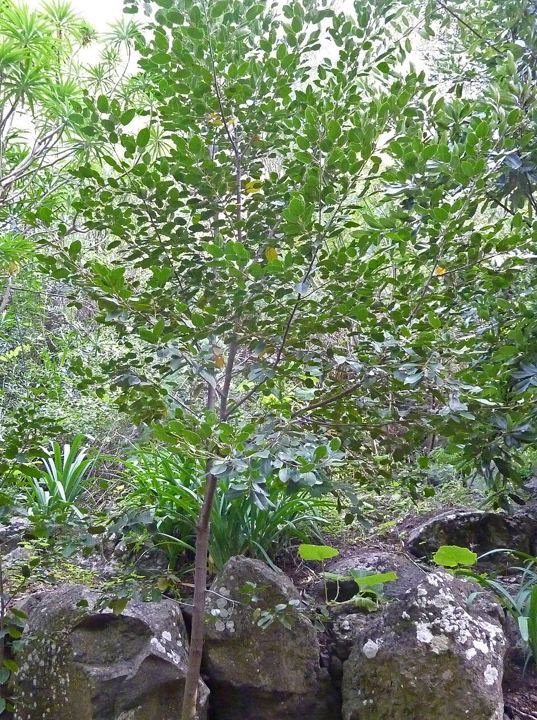
Photos
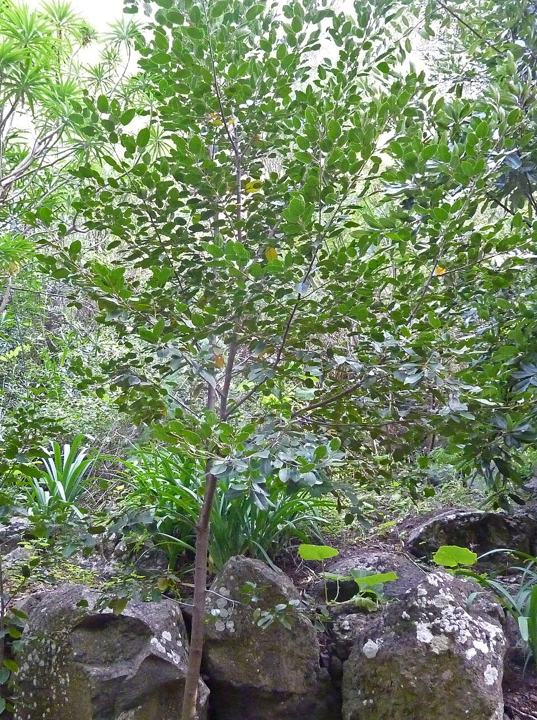
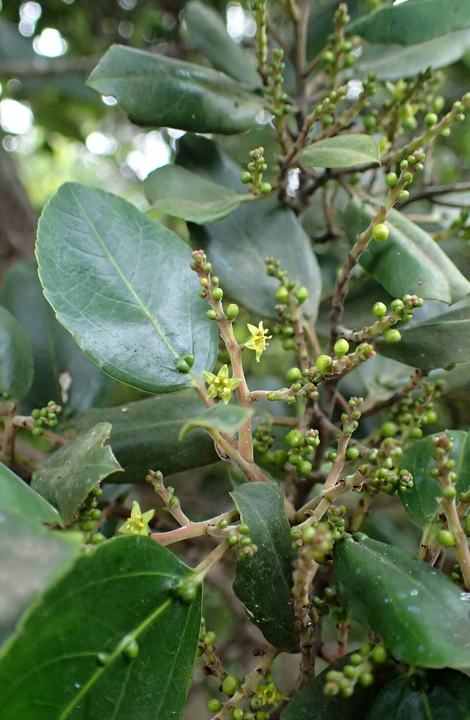
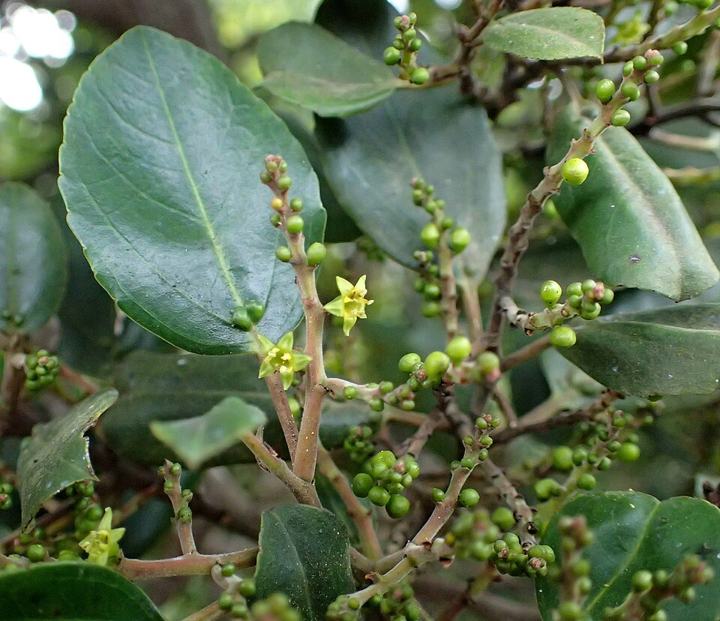
From Wikipedia
Rhamnus glandulosa is a species of plant in the family Rhamnaceae. It is endemic to Madeira and the Canary Islands.
Text from Wikipedia, CC BY-SA 4.0: Rhamnus glandulosa
Description
Small evergreen tree, 5–8 (10) m tall, with dark grey, fissured bark. Leaves ovate, subcoriaceous, 4–7 cm long, with a grooved petiole and serrate margin, glossy green on the upper surface, which bears small, round, prominent glands in the axils of the basal veins. Flowers numerous, small, greenish, in dense subterminal inflorescences whose stalks are jointed and brittle. Fruits fleshy, globose, dark reddish. Flowers in winter–spring.
Propagation and growing
The spherical, garnet-coloured fruits of this small tree contain three seeds that germinate easily. Seedlings are somewhat delicate, but a high percentage thrive and grow quickly. Container-grown plants are rather sensitive to lack of moisture in the substrate and tend to become leggy (elongated), which can be reduced by placing them in direct sun; they are also prone to aphid attack in summer, but this pest can be controlled with nicotine sprays. After a year in a container the plant can exceed half a metre in height. Usually available in native-plant nurseries.
Garden use
This tree has great value as an ornamental, developing when mature a dense, umbrella-shaped crown decorated with small flowers and showy fruits. It grows quickly in the ground, reaching considerable height and spread within a few years. It is an undemanding species, highly adaptable to varied climates and conditions; together with the Paloblanco and the Barbuzano, it is particularly successful in reforestation. In open places exposed to frequent wind it is advisable to stake it for the first two years. It needs no special maintenance apart from moderate watering during the dry season of the first year. A laurel-forest (laurisilva) species, it needs humid conditions and relatively fertile soils. With its dense crown it suits cool gardens. It tolerates moderate pruning.
Notes
Also present on Madeira.
Protection status
Annex II of the Order of 20 February 1991 on the protection of wild flora of the Canary Islands.
Potential vegetation
Visneo-Arbutetum canariensis; Lauro-Perseetum indicae; Diplazio-Ocoteetum foetentis; Ilici-Ericetum platycodonis.
Source: Cabildo de Tenerife, “Guía de especies vegetales”, CC BY. Translated from Spanish by us.
Bioclimatic belts
Warm mid-slope belt
- Thermomediterranean, semi-arid (upper level), with trade-wind fog
- Thermomediterranean, dry, with trade-wind fog
- Thermomediterranean, subhumid, with trade-wind fog
- Thermomediterranean, humid, with trade-wind fog
Temperate belt of laurel and pine forest
- Mesomediterranean, lower, dry, with trade-wind fog
- Mesomediterranean, lower, subhumid, with trade-wind fog
- Mesomediterranean, lower, humid, with trade-wind fog
Districts
Anaga · Metropolitan area (Santa Cruz and La Laguna) · Acentejo · La Orotava Valley · Güímar Valley