
Canary sorrel (vinagrera)
Rumex lunaria L. · Family: Polygonaceae
Very abundant in scrub on dry sunny slopes of the low and middle zones. Also found on shady road banks.
Where it grows on Tenerife
Grows in: South coast · North coast · South, 300–1000 m · North, 300–1000 m · Above 1000 m
Zones are derived approximately from the Cabildo belts.
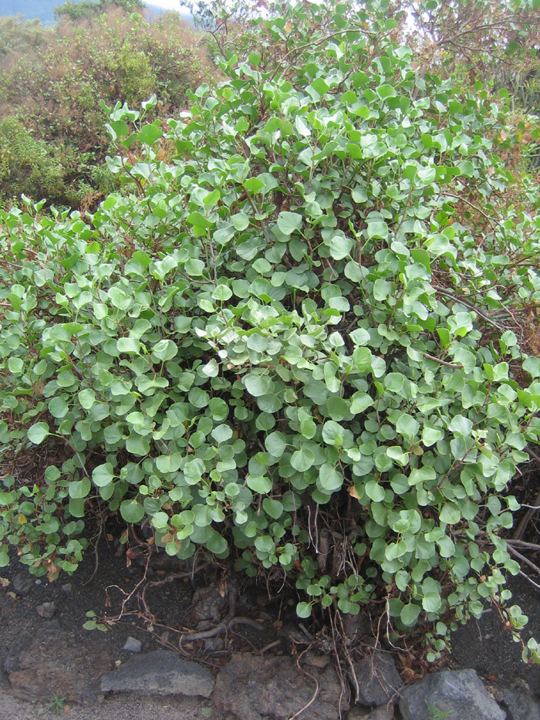
Photos
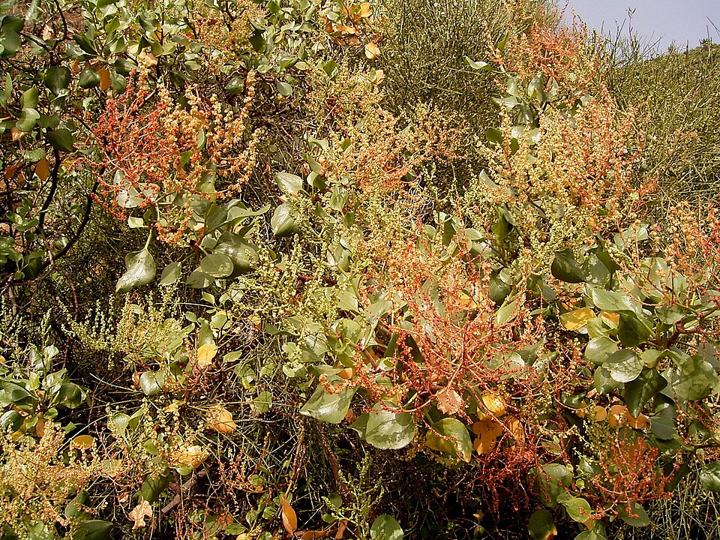
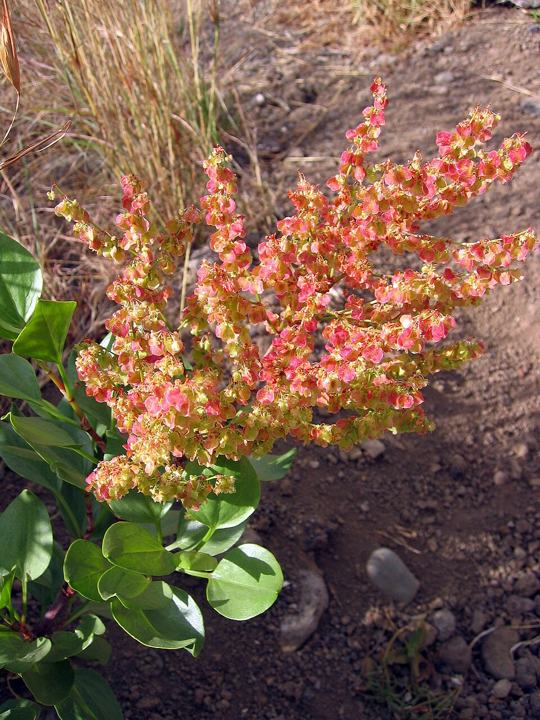
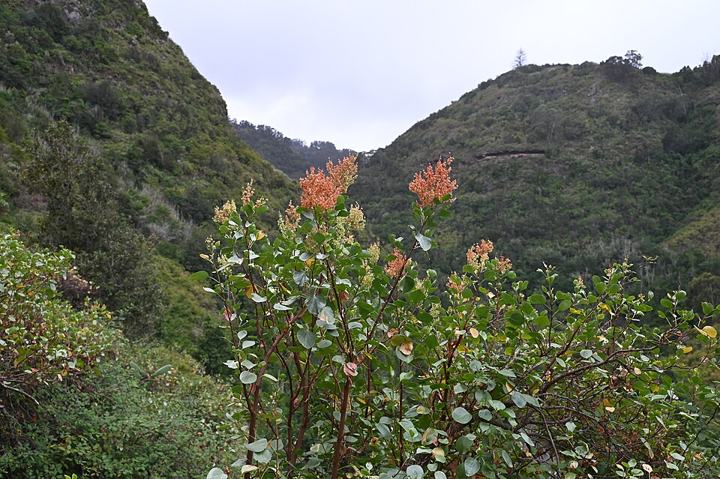
From Wikipedia
Rumex lunaria is a species of flowering plant in the family Polygonaceae, native to the Canary Islands. It has been introduced to Italy, Sardinia and Sicily. It was first described by Carl Linnaeus.
Text from Wikipedia, CC BY-SA 4.0: Rumex lunaria
Description
A shrub that can reach 4 m tall, branching from the base. Leaves fleshy, bright green, long-stalked, ovate-spatulate, often broader than long, 2.5-5 cm long and up to 6 cm wide. Flowers small, greenish, clustered in dense inflorescences. Fruits very small, wrapped in floral valves forming three wings, reddish or rust-coloured, which together create striking infructescences. Flowers in winter and spring.
Propagation and growing
The abundant winged fruits of vinagrera contain seeds that germinate easily, producing vigorous plants with a powerful root system and extremely fast growth, limited only by the size of the container holding them. After a year in container cultivation they reach more than half a metre tall. They are undemanding as to soil and watering, highly adaptable to very different climatic and soil conditions, and prefer sunny positions, though they tolerate partial shade and shade perfectly well. It is not usually available in native-plant nurseries, but its cultivation can be ordered just 4 or 5 months in advance.
Garden use
This leafy shrub, branching profusely from the base, is usually 1.5-2 m tall, though it can sometimes reach up to 4 m depending on the ground where it is planted. It has a very wide altitudinal range and few soil or climate requirements, adapting to very diverse environments. An excellent, traditional fodder plant, it is very useful for stabilising steep banks and embankments, where it takes on an attractive trailing habit. Its powerful root system allows it to build up a considerable amount of biomass, greening a large area of ground in a short time. Its use in restoring degraded areas in the domain of tabaibal-cardonal (spurge scrub), thermophilous woodland and even the lower monteverde (laurel forest) may well prove very worthwhile. It takes clipping well and can be used as a specimen or in groups, in gardens, beds and roadsides, even to form hedges. It needs no special maintenance or watering, and plants should be widely spaced.
Notes
It is a fodder plant, and the leaves are considered edible, though they have a sour taste.
Protection status
Not listed.
Potential vegetation
Forma parte de la vegetación nitrófila arbustiva de sustitución (Artemisio thusculae-Rumicetum lunariae) de Periploco laevigatae-Euphorbietum canariensis, Junipero canariensis-Oleetum cerasiformis, Visneo mocanerae-Arbutetum canariensis y cotas bajas de L…
Source: Cabildo de Tenerife, “Guía de especies vegetales”, CC BY. Translated from Spanish by us.
Bioclimatic belts
Warm coastal belt
- Inframediterranean, semi-arid (lower level)
- Inframediterranean, semi-arid (upper level)
- Inframediterranean, dry, without trade-wind fog
- Inframediterranean, dry, with trade-wind fog
Warm mid-slope belt
- Thermomediterranean, semi-arid (lower level)
- Thermomediterranean, semi-arid (upper level), without trade-wind fog
- Thermomediterranean, semi-arid (upper level), with trade-wind fog
- Thermomediterranean, dry, with trade-wind fog
- Thermomediterranean, dry (lower level), without trade-wind fog
- Thermomediterranean, subhumid, with trade-wind fog
- Thermomediterranean, humid, with trade-wind fog
Temperate belt of laurel and pine forest
- Mesomediterranean, lower, semi-arid (upper level), without trade-wind fog
- Mesomediterranean, lower, dry, with trade-wind fog
- Mesomediterranean, lower, subhumid, with trade-wind fog
- Mesomediterranean, lower, humid, with trade-wind fog
Districts
Anaga · Metropolitan area (Santa Cruz and La Laguna) · Acentejo · La Orotava Valley · Daute · Teno · South-west · Abona · South-east · Güímar Valley