
Salvia broussonetii
Salvia broussonetii Benth. · Family: Lamiaceae
Cliffs and ravines of the Anaga and Teno massifs, dry sunny spots, 200–400 m.
Where it grows on Tenerife
Grows in: South coast · North coast
Zones are derived approximately from the Cabildo belts.
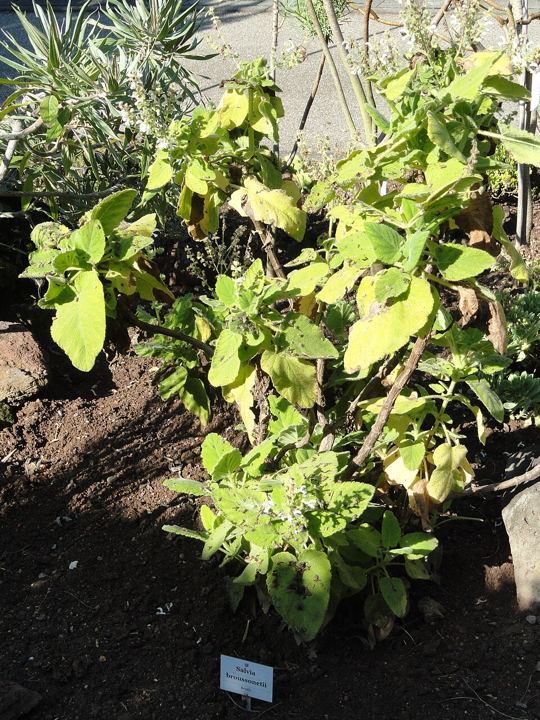
Photos
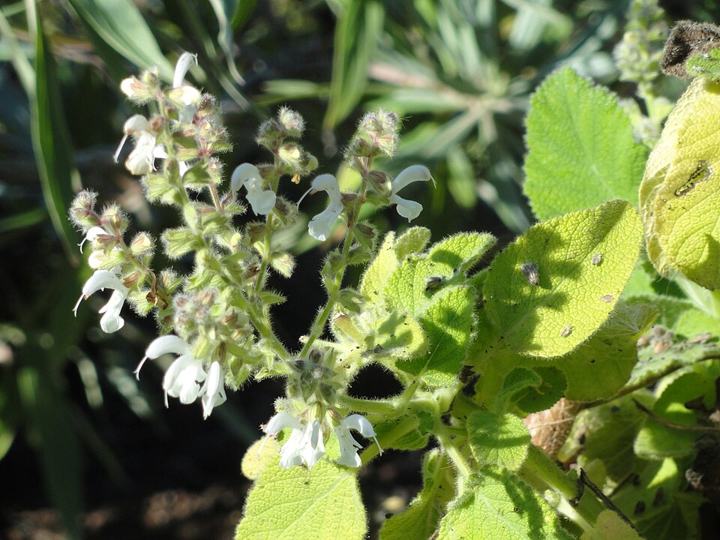
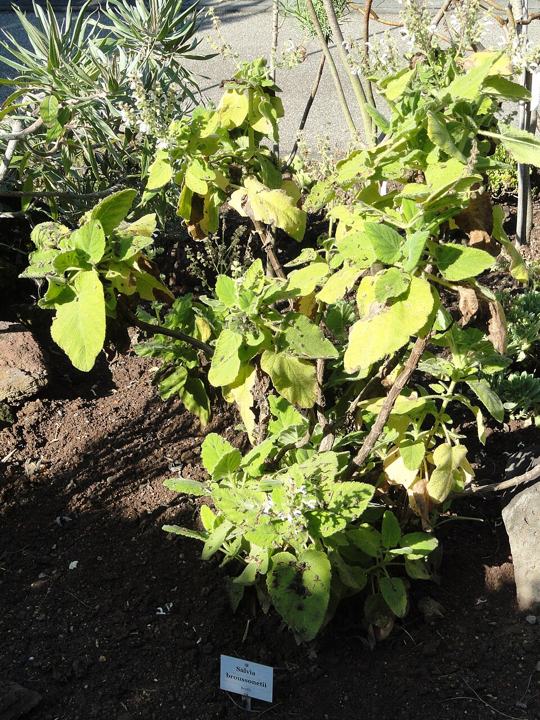
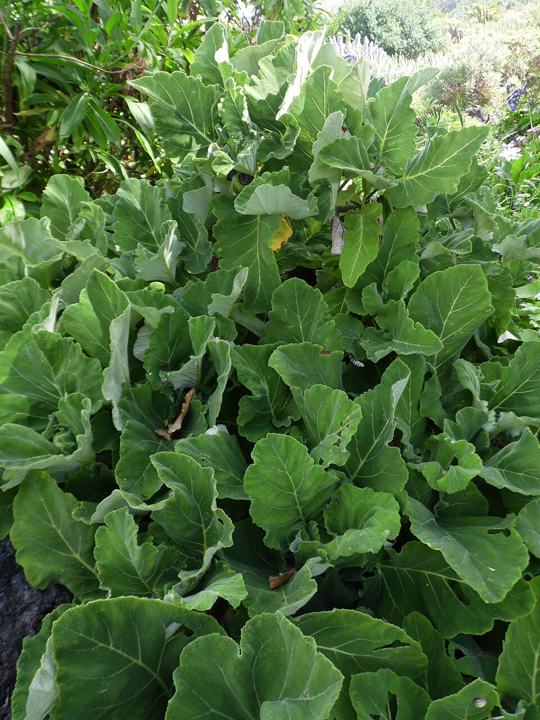
From Wikipedia
Salvia broussonetii is a shrubby perennial native to ocean cliffs of the Canary Islands, and is found on Tenerife and Lanzarote growing in basalt rock. The plant was named after Pierre Marie Auguste Broussonet. It grows about 2 ft tall and wide, with a woody rootstock and sturdy appearance, with large (4 inches long) yellow-green elliptical shaped sticky leaves. It has small white flowers on short inflorescences (8–10 in).
Text from Wikipedia, CC BY-SA 4.0: Salvia broussonetii
Description
A small shrub up to 75 cm tall, partly branched. Leaves large, 10–20 cm long, broadly ovate, with crenate margins and a cordate base, clustered at the ends of the branches, hairy and sticky. Inflorescences loose, branched, with showy white flowers tinged with pink. Flowers in spring.
Propagation and growing
This rare Tenerife endemic, which fruits in summer, produces abundant seeds that, mixed with soil and sown, germinate easily, giving plants that are convenient to grow in containers. They are undemanding as to soil and watering and grow quickly. It is not usually available in native-flora nurseries, and plants must be ordered at least a year in advance.
Garden use
A shrub up to 1 m tall with untidy branching, large hairy, sticky leaves that are whitish and woolly underneath, and white to pinkish flowers grouped in terminal inflorescences. The whole plant gives off a soft, pleasant scent. The beautiful look of the plant in flower gives it value as an ornamental for landscaping in mid and low altitude zones (100–500 m above sea level). For this species, listed as "endangered", propagation and spread through local gardening has been proposed as a conservation measure, although from a conservation point of view it should not be grown near "S. canariensis" (A. Santos Guerra & E. González Feria 1996). It needs no maintenance or special care.
Notes
A rare endemic of Tenerife (Anaga and Teno); it hybridises with "Salvia canariensis".
Protection status
Annex II (vulnerable) of the Canary Catalogue of Protected Species.
Potential vegetation
Periploco-Euphorbietum canariensis; Junipero-Oleetum cerasiformis.
Source: Cabildo de Tenerife, “Guía de especies vegetales”, CC BY. Translated from Spanish by us.
Bioclimatic belts
Warm coastal belt
- Inframediterranean, semi-arid (lower level)
- Inframediterranean, semi-arid (upper level)
- Inframediterranean, dry, without trade-wind fog
Districts
Anaga · Metropolitan area (Santa Cruz and La Laguna) · Teno