
Canary sage
Salvia canariensis L. · Family: Lamiaceae
A drought-loving species of stony lowland slopes; on dry south-facing slopes it climbs to 1,000 m.
Where it grows on Tenerife
Grows in: South coast · North coast · South, 300–1000 m
Zones are derived approximately from the Cabildo belts.
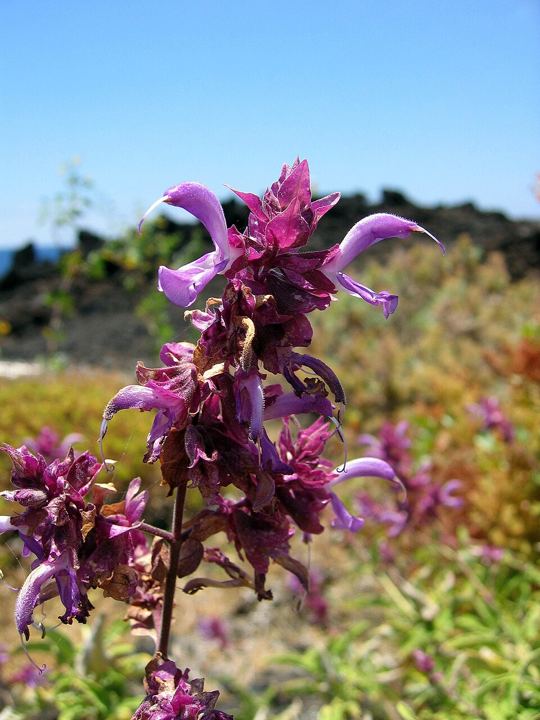
Photos
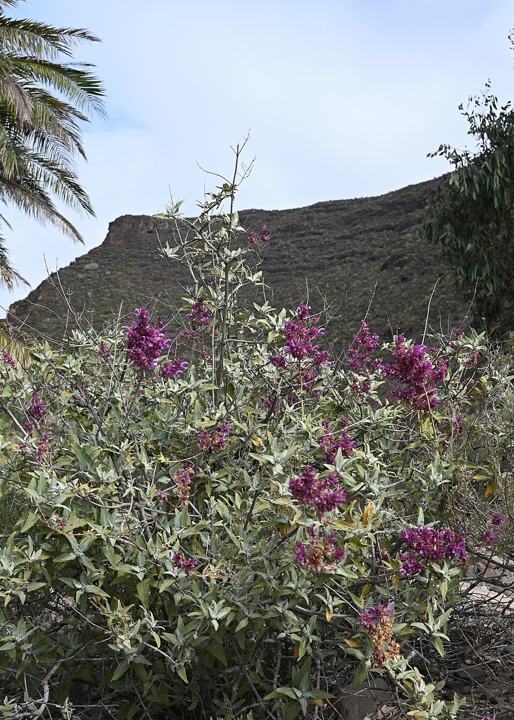
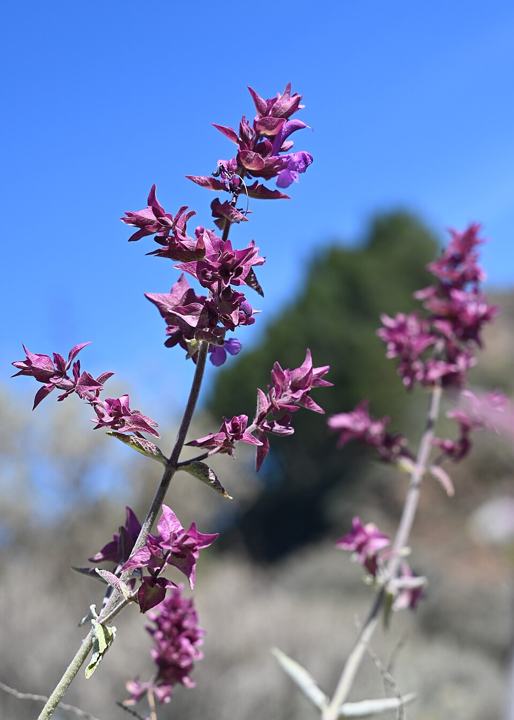
From Wikipedia
Salvia canariensis, the Canary Island sage, is an erect perennial shrub native to the Canary Islands. It can reach 2.0–2.3 m in height and 1.5 m width in a single season. The hastate leaves are pale green, and the stems and underside of the leaves are covered with long white hairs. The flowers range from pale purple to deep purple magenta.
Text from Wikipedia, CC BY-SA 4.0: Salvia canariensis
Description
Shrub up to 2 m tall, spreading in habit, hairy. Leaves lanceolate, 5-15 cm long, tomentose. Inflorescences terminal and branched, with showy violet-pink flowers. Flowers in spring and summer.
Propagation and growing
This shrub produces numerous small, dark seeds which, mixed with soil and sown in a seedbed, will germinate easily from the first week. The plants are easy to grow in containers and undemanding as to soil and watering. They grow fast and prefer sunny positions. It is not usually available in native-plant nurseries, but its cultivation can be ordered 4 or 5 months in advance.
Garden use
This shrub, up to 2 m tall, is sometimes straggly in habit, putting out long branches (up to 2 m) that are square in cross-section, with large, opposite, arrowhead-shaped leaves. The whole plant gives off a harsh aroma. Over a long period, from late winter until after summer, it bears attractive pinkish-violet flowers, giving it some value as an ornamental; this, together with the very wide altitudinal range in which it can grow (50-1,500 m a.s.l.), makes it an interesting species for all kinds of landscaping in low, mid and high zones. After flowering the plant is worn out and lacking vigour, so it is advisable to prune it hard after the first rains to revitalise it.
Notes
A Canary Islands endemic, present on all the islands of the archipelago.
Protection status
Annex III of the Order of 20 February 1991 on the protection of wild flora of the Canary Islands.
Potential vegetation
Periploco-Euphorbietum canariensis; Junipero-Oleetum cerasiformis.
Source: Cabildo de Tenerife, “Guía de especies vegetales”, CC BY. Translated from Spanish by us.
Bioclimatic belts
Warm coastal belt
- Inframediterranean, semi-arid (lower level)
- Inframediterranean, semi-arid (upper level)
- Inframediterranean, dry, without trade-wind fog
Warm mid-slope belt
- Thermomediterranean, semi-arid (lower level)
- Thermomediterranean, semi-arid (upper level), without trade-wind fog
- Thermomediterranean, dry (lower level), without trade-wind fog
Districts
Anaga · Metropolitan area (Santa Cruz and La Laguna) · Acentejo · La Orotava Valley · Daute · Teno · South-west · Abona · South-east · Güímar Valley